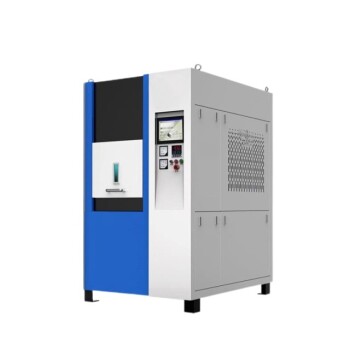
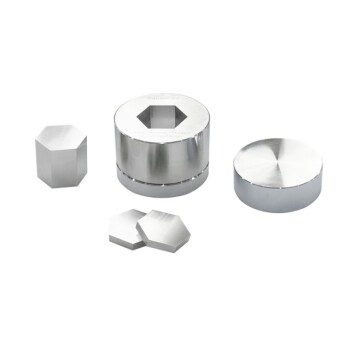
In the context of Spark Plasma Sintering (SPS) for LATP materials, the graphite mold serves as a multifunctional reactor rather than a passive container. It acts simultaneously as the electrical heating element, the mechanical die for pressure application, and the shaping vessel for the powder.
Core Takeaway The graphite mold facilitates the rapid densification of LATP by converting pulsed electrical current into uniform heat (Joule heating) while enduring the high mechanical pressures (up to 40 MPa) required to sinter the powder into a solid, shaped component.
The Active Roles of the Graphite Mold
Generating Heat Through Electrical Resistance
In standard sintering, heat is applied externally. In SPS, the graphite mold itself generates the heat.
Because graphite is an electrical conductor with specific resistance properties, it converts the pulsed DC current passing through it into thermal energy.
This effectively turns the mold into a Joule heating element. This allows for rapid heating rates and ensures the thermal energy is distributed uniformly directly around the LATP sample.
Transmitting Mechanical Pressure
Achieving high density is critical for LATP electrolytes to ensure ionic conductivity. The graphite mold acts as the primary pressure transmission medium.
It must possess high mechanical strength to withstand significant axial force from the SPS hydraulic rams.
According to the primary data, the mold allows for the application of pressures around 40 MPa during the sintering process. This pressure is transferred to the powder to facilitate densification through plastic flow and diffusion.
Defining Geometry and Shape
The mold functions as a precision die that defines the macroscopic shape and size of the final sintered product.
It acts as a container that confines the loose LATP powder in a specific configuration.
Because graphite maintains dimensional stability even at high temperatures (up to 1500°C), it ensures the final component retains high geometric accuracy after the process is complete.
Understanding the Trade-offs
Mechanical Limits vs. Sintering Pressure
While graphite has excellent high-temperature strength, it is not indestructible. There is a physical limit to the pressure a graphite mold can withstand before fracturing.
Pushing pressures beyond the standard 40-50 MPa range to achieve higher LATP density may require specialized mold designs or alternative mold materials.
Surface Interaction and Removal
Graphite offers a degree of lubricity, which generally facilitates the removal of the sample after sintering.
However, the direct contact between the mold and the powder at high temperatures requires high-purity graphite to prevent unwanted contamination of the LATP material.
Making the Right Choice for Your Goal
When designing your SPS experiments for LATP, the mold configuration is as important as the powder itself.
- If your primary focus is Maximizing Density: Ensure your graphite mold design (wall thickness) is robust enough to handle pressures of at least 40 MPa without deformation.
- If your primary focus is Geometric Precision: Use high-purity, high-density graphite to maintain rigid dimensional stability and minimize surface roughness on the final pellet.
The graphite mold is the critical interface that translates electrical energy and mechanical force into the physical properties of your final material.
Summary Table:
| Function | Role in SPS Process | Benefit for LATP Materials |
|---|---|---|
| Joule Heating | Converts pulsed DC current into thermal energy | Enables rapid heating rates and uniform thermal distribution |
| Pressure Transmission | Withstands and transfers axial force (up to 40 MPa) | Facilitates densification and eliminates porosity for high conductivity |
| Structural Die | Acts as a precision shaping vessel | Ensures high geometric accuracy and dimensional stability |
| Material Purity | High-purity graphite construction | Minimizes sample contamination during high-temperature reactions |
Elevate Your Material Research with KINTEK's Advanced Sintering Solutions
Precision in Spark Plasma Sintering starts with the right equipment. KINTEK specializes in providing high-performance laboratory solutions, including state-of-the-art high-temperature furnaces, hydraulic presses, and specialized graphite components designed to meet the rigorous demands of LATP research and battery development.
Whether you need robust muffle or vacuum furnaces, high-precision pellet presses, or specialized crushing and milling systems, our expert team is ready to support your lab's unique requirements.
Ready to optimize your sintering process and achieve superior material density? Contact KINTEK today for a consultation and custom quote!
Related Products
- Spark Plasma Sintering Furnace SPS Furnace
- Ultra-High Temperature Graphite Vacuum Graphitization Furnace
- High Purity Pure Graphite Crucible for Evaporation
- Polygon Press Mold for Lab
- High Purity Pure Graphite Crucible for Electron Beam Evaporation
People Also Ask
- What is SPS sintering method? A Guide to High-Speed, High-Performance Material Fabrication
- Why are Spark Plasma Sintering (SPS) furnaces or hot presses utilized in the preparation of Li3PS4 solid electrolytes?
- What is the difference between spark plasma sintering and flash sintering? A Guide to Advanced Sintering Methods
- What technical advantages does a Spark Plasma Sintering (SPS) furnace offer for LZP ceramics? Enhance Ionic Conductivity
- What is the theory of spark plasma sintering? A Guide to Rapid, Low-Temperature Densification