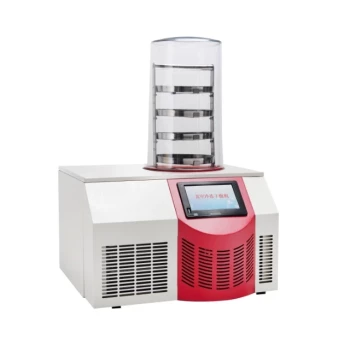
The vacuum drying oven serves as a precise purification tool in the synthesis of Copper Maleate Hydrate (CuMH) and its lithiated derivatives. Its primary function is to eliminate residual solvents, such as acetonitrile, and surface moisture under controlled thermal conditions while maintaining the material's essential structural composition.
Core Takeaway The vacuum drying process is a delicate balancing act that ensures the removal of volatile contaminants without degrading the material's crystal structure. For lithiated derivatives, this step is vital for retaining structural water, which is directly linked to the electrolyte's purity and electrochemical capabilities.
The Role of Vacuum Drying in CuMH Synthesis
Removing Volatile Contaminants
The synthesis of Copper Maleate Hydrate involves the use of solvents that must be completely removed to ensure material purity.
The vacuum drying oven facilitates the thorough removal of residual acetonitrile solvents. It also eliminates adsorbed moisture—water that has adhered to the surface of the material but is not part of its internal structure.
Controlled Thermal Environment
Unlike standard drying methods, vacuum drying allows for evaporation at lower temperatures, reducing thermal stress on the material.
For CuMH preparation, the process is typically conducted at specific, controlled temperatures such as 60 °C or 100 °C. This precise temperature control creates an environment where volatiles can be extracted efficiently without damaging the base material.
Critical Functions for Lithiated Derivatives (Li-CuMH)
Post-Impregnation Purification
When preparing lithiated Copper Maleate Hydrate (Li-CuMH) solid-state electrolytes, the material undergoes an impregnation process involving organic solvents.
The vacuum drying oven is essential for the subsequent removal of these residual organic solvents. Failing to remove these residues could impede ion transport and degrade the electrolyte's performance.
Preserving Structural Integrity
The most sophisticated function of the vacuum oven in this context is its selectivity. While it removes solvents, it must carefully preserve structural water.
This water exists within the crystal lattice of the Li-CuMH. Retaining this specific hydration is non-negotiable, as it is essential for maintaining the purity of the crystal structure and ensuring high electrochemical performance.
Understanding the Trade-offs
The Risk of Over-Drying
One might assume that "drier is better," but in the context of CuMH, this is a dangerous misconception.
Aggressive drying that targets all moisture content can strip away the structural water from the crystal lattice. If this lattice water is lost, the crystal structure may collapse or alter, rendering the material ineffective as an electrolyte.
The Impact of Incomplete Drying
Conversely, insufficient drying leaves behind organic solvents or adsorbed moisture.
These impurities act as barriers to performance, potentially reacting during electrochemical cycling or blocking ion pathways. The vacuum oven must therefore be operated in a "Goldilocks" zone—strong enough to clean the material, but gentle enough to maintain its hydrated crystal form.
Making the Right Choice for Your Goal
To optimize the preparation of Copper Maleate Hydrate, you must align your drying parameters with your specific structural requirements.
- If your primary focus is Material Purity: Ensure the vacuum environment is sufficient to fully extract residual acetonitrile and organic solvents at 60 °C to 100 °C.
- If your primary focus is Electrochemical Performance: strictly monitor drying conditions to ensure that while surface solvents are removed, the lattice-bound structural water remains intact.
Success in CuMH synthesis relies not just on drying the material, but on selectively purifying it to preserve the delicate crystal architecture required for ion transport.
Summary Table:
| Feature | Function in CuMH/Li-CuMH Synthesis | Impact on Material |
|---|---|---|
| Solvent Removal | Eliminates acetonitrile and organic residues | Ensures high purity and clear ion pathways |
| Moisture Control | Removes adsorbed (surface) moisture | Prevents unwanted side reactions |
| Thermal Precision | Controlled drying at 60°C to 100°C | Protects material from thermal degradation |
| Lattice Preservation | Selective evaporation to keep structural water | Maintains crystal architecture and performance |
Elevate Your Material Research with KINTEK Precision
Precise thermal processing is the backbone of high-performance electrolyte synthesis. KINTEK specializes in advanced laboratory solutions, offering a comprehensive range of vacuum drying ovens, high-temperature furnaces, and rotary systems designed for the delicate requirements of CuMH and battery research.
Whether you are refining solid-state electrolytes or scaling chemical synthesis, our equipment—including high-temperature high-pressure reactors, crushing systems, and vacuum solutions—ensures your materials maintain their critical structural integrity.
Ready to optimize your lab’s electrochemical performance? Contact KINTEK today to discover how our high-precision tools can support your next breakthrough.
Related Products
- 56L Vertical Laboratory Vacuum Drying Oven
- 23L Laboratory Vacuum Drying Oven
- Laboratory Scientific Electric Heating Blast Drying Oven
- Benchtop Laboratory Vacuum Freeze Dryer
- Vacuum Heat Treat Sintering Brazing Furnace
People Also Ask
- Why is a laboratory vacuum drying oven recommended for rice straw residues? Protect Your Biomass Integrity
- What role does a laboratory vacuum drying oven play in the preparation of modified multi-walled carbon nanotubes?
- What is the importance of using a laboratory vacuum drying oven? Preserving Slow-Release Microcapsule Integrity
- Why is a Laboratory Vacuum Drying Oven recommended for PBAT microspheres? Protect Sensitive Polymer Integrity
- What role does a laboratory vacuum drying oven play in processing nanoparticle powder samples? Protect Sample Integrity