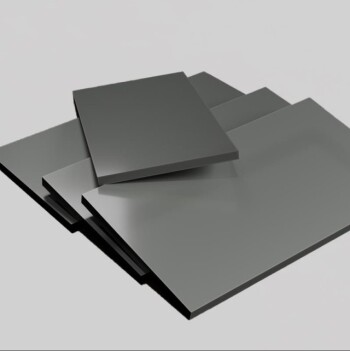
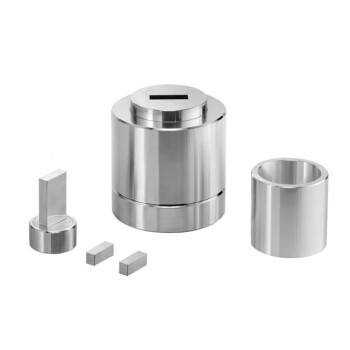
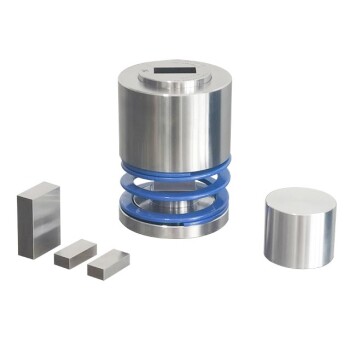
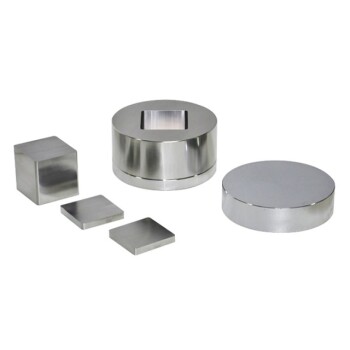
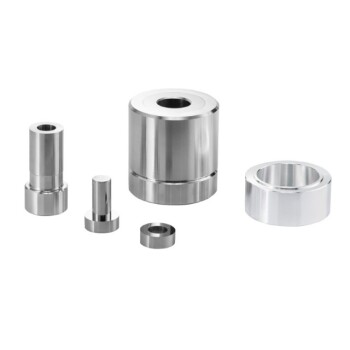
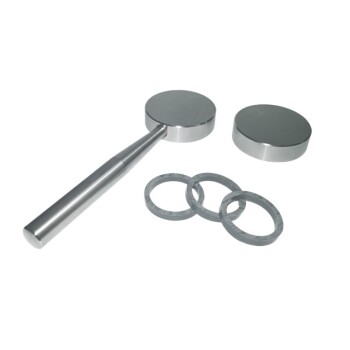
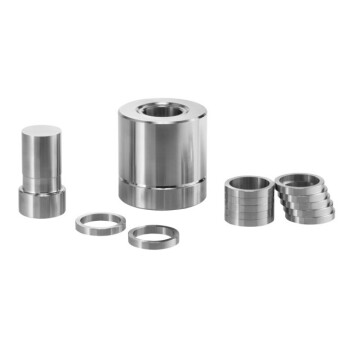
Graphite molds function as the structural and thermal foundation of the hot pressing sintering process. They serve as high-strength containers that define the macroscopic shape of the coating while simultaneously transmitting the extreme heat and axial pressure required to densify the alloy powder. This dual capability ensures the material compacts uniformly and forms a permanent metallurgical bond with the substrate.
Core Insight: The efficacy of a graphite mold lies in its ability to withstand significant mechanical pressure (up to 30 MPa) without deforming, while possessing the thermal conductivity necessary to distribute heat evenly across the specimen, preventing structural defects during sintering.
The Mechanics of Containment and Shaping
Defining Macroscopic Geometry
The primary function of the graphite mold is to act as a precise container for the loose high entropy alloy powder. It confines the material, strictly defining the final macroscopic shape of both the coating and the substrate during the transition from loose powder to solid mass.
Dimensional Stability at High Temperatures
Graphite is unique because it maintains superior structural integrity at temperatures where other materials might soften or deform (often ranging from 650°C to 1500°C). This stability ensures that the mold does not warp, guaranteeing that the final coating retains accurate dimensions after the sintering cycle.
Facilitating Sample Removal
Beyond simple containment, the natural lubricity of graphite plays a critical role in the post-sintering phase. This property prevents the alloy from adhering aggressively to the mold walls, facilitating easy removal of the densified sample without damaging the newly formed coating.
Pressure Transmission and Densification
Withstanding Axial Loads
Hot pressing relies on the application of massive force to eliminate voids within the powder. Graphite molds are designed to withstand significant axial pressures, typically reaching 30 MPa (and up to 40 MPa in specific contexts), without catastrophic failure.
Compacting the Alloy Matrix
The mold acts as the medium that transfers hydraulic pressure directly to the internal powder specimen. This transmission is vital for compacting the alloy powder, forcing particles together to achieve high density and reduce porosity within the coating.
Thermal Regulation and Bonding
Uniform Heat Distribution
Graphite possesses excellent thermal conductivity, which allows it to act as an effective thermal regulator. It ensures that heat is distributed uniformly throughout the powder specimen, preventing thermal gradients that could lead to uneven sintering or cracking.
Enabling Metallurgical Bonding
The combination of high pressure and uniform heat facilitates a strong metallurgical bond between the alloy coating and the substrate. By maintaining these conditions consistently, the mold allows the powder to sinter fully, adhering chemically and physically to the surface rather than simply sitting on top of it.
Operational Constraints and Considerations
Pressure Limits vs. Mold Geometry
While graphite is strong, it is brittle; the mold design must account for the specific pressure limits (typically 30-40 MPa) to prevent cracking. Exceeding these limits to achieve higher density poses a risk of mold failure, requiring a careful balance between applied force and mold wall thickness.
Environmental Requirements
Graphite is susceptible to oxidation at high temperatures. Therefore, the process generally requires a vacuum or inert atmosphere to preserve the mold's integrity. Failing to maintain these conditions can lead to rapid degradation of the mold surface, compromising the shape and surface finish of the alloy coating.
Making the Right Choice for Your Goal
To optimize your sintering process, align your mold usage with your specific technical objectives:
- If your primary focus is Coating Density: Prioritize mold designs with thicker walls that can withstand axial pressures exceeding 30 MPa to maximize powder compaction.
- If your primary focus is Dimensional Accuracy: Ensure the graphite grade selected offers the highest thermal stability to resist deformation at peak sintering temperatures (up to 1500°C).
- If your primary focus is Substrate Adhesion: Focus on the mold's thermal conductivity to ensure the uniform heating required for a consistent metallurgical bond at the interface.
Success in hot pressing high entropy alloys depends on treating the graphite mold not just as a vessel, but as an active participant in thermal and mechanical transmission.
Summary Table:
| Function | Description | Impact on Coating |
|---|---|---|
| Containment | Defines macroscopic shape and dimensions | Ensures geometric accuracy |
| Pressure Transmission | Withstands axial loads up to 40 MPa | Maximizes powder compaction and density |
| Thermal Regulation | Distributes heat uniformly via high conductivity | Prevents thermal gradients and cracking |
| Surface Lubricity | Natural property of graphite | Facilitates easy sample removal after sintering |
| Structural Stability | Maintains integrity at 1500°C | Guarantees dimensional stability during cooling |
Optimize Your Material Research with KINTEK
Achieve precision and durability in your high-temperature processes with KINTEK. As a leading specialist in laboratory equipment, we provide the high-performance tools you need to succeed in high entropy alloy development. Our portfolio includes:
- High-Temperature Vacuum & Atmosphere Furnaces for oxidation-free sintering.
- Precision Hydraulic & Hot Presses for uniform densification.
- Advanced Crushing & Milling Systems for alloy powder preparation.
- Specialized Graphite & Ceramic Consumables for superior thermal stability.
Whether you are working on metallurgical bonding or complex material coatings, KINTEK offers the technical expertise and comprehensive range of autoclaves, reactors, and cooling solutions to elevate your lab's performance.
Ready to upgrade your sintering setup? Contact our experts today and let's find the perfect solution for your research goals.
Related Products
- Special Heat Press Mold for Lab Use
- Anti-Cracking Press Mold for Lab Use
- Special Shape Press Mold for Lab
- Ball Press Mold for Lab
- Double Plate Heating Press Mold for Lab
People Also Ask
- How to use a press mold? Master the Art of Creating Consistent Ceramic Forms
- What is the press mould method? A Guide to Consistent, Detailed Ceramic Forms
- What is a press mold used for? Achieve Repeatable Precision and Efficiency
- What is the function of press molds during the preparation of SiCf/Ti-43Al-9V composites? Achieve Structural Precision
- What is the purpose of specialized pressure devices in sulfide solid-state batteries? Ensure Chemo-Mechanical Stability