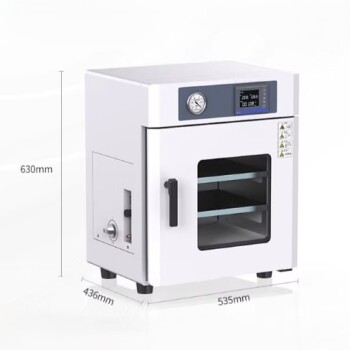
A laboratory vacuum drying oven is primarily used to eliminate trace moisture and residual solvents from critical battery components such as electrode sheets, separators, and active materials. By creating an environment of extremely low pressure, this equipment facilitates the removal of contaminants that would otherwise compromise the chemical stability of high-energy density batteries.
The presence of moisture in electrochemical systems is a critical failure point. Vacuum drying prevents electrolyte decomposition and harmful side reactions, serving as a fundamental step to ensure both the cycle life and the safety performance of modern battery technologies.
The Critical Role of Moisture Removal
Protecting the Electrochemical System
High-energy density batteries, including lithium-ion and thermal batteries, are highly sensitive to moisture. Even microscopic amounts of water can destabilize the internal chemistry of the cell.
Vacuum drying ovens are essential because they lower the boiling point of water and solvents. This allows for effective drying without subjecting delicate materials to excessive thermal stress.
Preventing Electrolyte Decomposition
One of the most dangerous risks in battery R&D is electrolyte decomposition. When moisture reacts with the electrolyte, it degrades the battery's performance and can generate gas.
This reaction not only reduces the battery's efficiency but can also lead to swelling or rupture. Vacuum drying mitigates this risk by ensuring the environment is chemically inert before assembly.
Ensuring Cycle Life
Long-term battery performance, known as cycle life, is directly tied to material purity. Residual solvents or moisture can cause continuous parasitic reactions during charging and discharging.
By removing these impurities early in the R&D process, researchers can accurately test the true limits of their battery chemistry without interference from avoidable contaminants.
Key Applications in R&D Workflows
Processing Electrode Sheets
The preparation of electrode sheets involves casting slurry onto metal foils, which often leaves behind residual solvents.
Vacuum drying is the standard method for removing these solvents completely. It ensures the electrode coating is dry, uniform, and ready for cell assembly.
Preparing Active Materials
Active materials, which store the energy in the battery, are often hygroscopic (water-absorbing).
Before these materials are mixed into a slurry or applied to a collector, they must be thoroughly dried. The vacuum oven extracts deep-seated moisture from the porous structures of these materials.
Drying Separators
Separators act as the physical barrier between the anode and cathode. If they contain moisture, they become a pathway for chemical degradation.
Drying separators under vacuum ensures they remain electrically insulating and chemically neutral, preventing short circuits and maintaining ion transport efficiency.
Understanding the Trade-offs
Process Speed vs. Drying Thoroughness
Vacuum drying is rarely a fast process; it is designed for thoroughness rather than speed.
Rushing this step to increase throughput can leave trace moisture trapped in deep pores. In R&D, patience during the drying cycle is non-negotiable for valid data.
Thermal Sensitivity
While vacuum allows for drying at lower temperatures, heat is still a factor.
Researchers must balance the vacuum level with the temperature setting. If the temperature is too high, it may degrade the binder or separator; if too low, the drying process may be incomplete.
Ensuring Battery Performance and Safety
When integrating vacuum drying into your R&D process, prioritize your specific testing goals to determine the rigour of your drying protocol.
- If your primary focus is Safety: Prioritize extended drying times for separators and active materials to eliminate any risk of gas generation or thermal runaway caused by moisture.
- If your primary focus is Cycle Life: Ensure all residual solvents are removed from electrode sheets to prevent parasitic reactions that degrade capacity over time.
Strict control over moisture and solvent removal is not just a procedural step; it is the baseline requirement for reliable high-energy battery innovation.
Summary Table:
| Application Component | Primary Function | Impact on Battery Performance |
|---|---|---|
| Electrode Sheets | Removal of residual casting solvents | Ensures uniform coating and prevents parasitic reactions |
| Active Materials | Deep-pore moisture extraction | Maintains chemical stability and prevents electrolyte degradation |
| Separators | Thermal-safe drying | Prevents internal short circuits and ensures ion transport efficiency |
| Cell Assembly | Creating a moisture-free environment | Maximizes cycle life and prevents gas generation/swelling |
Elevate Your Battery Research with Precision Drying Solutions
Moisture is the enemy of high-energy density battery innovation. KINTEK specializes in advanced laboratory equipment designed to meet the rigorous demands of lithium-ion and thermal battery R&D. Our high-performance vacuum drying ovens and high-temperature furnaces ensure the material purity required for breakthrough performance.
From crushing and milling systems for active material preparation to hydraulic pellet presses and battery research tools, KINTEK provides the comprehensive suite of tools your lab needs to ensure safety and extend cycle life.
Ready to optimize your drying protocols? Contact our technical experts today to find the perfect equipment for your battery development workflow!
References
- John R. Varcoe, Lin Zhuang. Anion-exchange membranes in electrochemical energy systems. DOI: 10.1039/c4ee01303d
This article is also based on technical information from Kintek Solution Knowledge Base .
Related Products
- 56L Vertical Laboratory Vacuum Drying Oven
- 23L Laboratory Vacuum Drying Oven
- Laboratory Scientific Electric Heating Blast Drying Oven
- Benchtop Laboratory Vacuum Freeze Dryer
- Dental Porcelain Zirconia Sintering Ceramic Vacuum Press Furnace
People Also Ask
- Why is a laboratory vacuum drying oven recommended for rice straw residues? Protect Your Biomass Integrity
- What role does a laboratory vacuum drying oven play in the preparation of modified multi-walled carbon nanotubes?
- What is the importance of using a laboratory vacuum drying oven? Preserving Slow-Release Microcapsule Integrity
- Why is a Laboratory Vacuum Drying Oven recommended for PBAT microspheres? Protect Sensitive Polymer Integrity
- What role does a laboratory vacuum drying oven play in processing nanoparticle powder samples? Protect Sample Integrity