Knowledge What are the primary functions of graphite molds in the 2000°C hot-pressing? Optimize Your C-SiC-B4C-TiB2 Composites
Author avatar

Tech Team · Kintek Solution

Updated 1 day ago

What are the primary functions of graphite molds in the 2000°C hot-pressing? Optimize Your C-SiC-B4C-TiB2 Composites


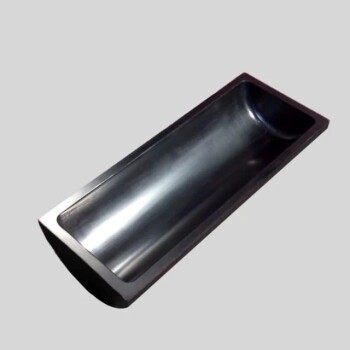
Graphite molds act as the critical structural interface between the high-temperature furnace environment and the C-SiC-B4C-TiB2 composite material. In this specific 2000°C process, their primary function is to serve as a robust container that withstands extreme thermal shock while simultaneously acting as a transmission medium to transfer 25 MPa of mechanical pressure to the internal green body.

The graphite mold determines the success of the sintering process by converting external hydraulic force into internal material density, all while maintaining precise geometry under extreme thermal stress.

Physical Containment and Geometry

Resisting Extreme Temperatures

The mold must maintain its structural integrity at 2000°C. Graphite is utilized specifically for its ability to remain stable and rigid at these temperatures, where most other containment materials would fail or deform.

Defining Dimensional Precision

The mold acts as a physical boundary for the powder. By holding the material in place, it prevents lateral deformation (spreading sideways) when vertical pressure is applied. This ensures the final sintered product achieves precise geometric dimensions.

Pressure Transmission Mechanics

Converting External Force

The mold serves as the vehicle for physical force. It transmits the 25 MPa of pressure generated by the hydraulic press directly to the internal composite powder.

Densifying the Green Body

This transmitted pressure is what forces the C-SiC-B4C-TiB2 powder to compact. The mold ensures that this force is applied effectively to the green body (the unfired compacted powder), driving the densification required for a high-quality composite.

Thermal Regulation and Uniformity

Facilitating Heat Transfer

Graphite possesses excellent thermal conductivity. This property allows the mold to transfer heat from the furnace elements to the internal composite powder efficiently.

Ensuring Homogeneous Sintering

By distributing heat uniformly rather than insulating the sample, the mold ensures consistent temperature across the sintering zone. This leads to structural homogeneity, preventing defects caused by uneven heating.

Understanding the Trade-offs

Mechanical Limits under Load

While graphite is strong, it acts as a pressure vessel under significant stress (25 MPa). The mold must be designed with sufficient wall thickness and density to resist cracking; if the mold fails under this uniaxial pressure, the sample's geometry is immediately compromised.

Material Interaction

Graphite is generally chemically stable, but at high temperatures, interaction with the sample is possible. As noted in similar processes, isolation layers (such as alumina) are sometimes required to facilitate demolding and prevent the composite from bonding to the mold walls.

Making the Right Choice for Your Goal

To maximize the effectiveness of graphite molds in your specific application:

  • If your primary focus is densification: Ensure the mold design is robust enough to transmit the full 25 MPa of pressure without deflecting, as this pressure is the primary driver of eliminating porosity in the C-SiC-B4C-TiB2 composite.
  • If your primary focus is dimensional accuracy: Prioritize the precision of the mold's internal machining, as the mold's ability to prevent lateral deformation at 2000°C will directly dictate the final tolerances of your part.

Graphite molds are not just containers; they are active thermal and mechanical tools that define the physical properties of the final high-performance composite.

Summary Table:

Function Description Key Benefit
Containment Resists 2000°C thermal shock Maintains precise geometry and integrity
Pressure Transmission Transfers 25 MPa hydraulic force Drives material densification & removes porosity
Thermal Regulation High thermal conductivity Ensures structural homogeneity & uniform sintering
Deformation Control Physical boundary for powders Prevents lateral deformation under uniaxial load

Elevate Your Material Research with KINTEK Precision

High-performance composites like C-SiC-B4C-TiB2 require more than just heat; they demand precision-engineered solutions. KINTEK specializes in advanced laboratory equipment, offering a comprehensive range of high-temperature vacuum and atmosphere furnaces, graphite molds, and hydraulic pellet presses designed to withstand the rigors of 2000°C sintering.

Whether you are focusing on densification or dimensional accuracy, our expert team provides the crushing, milling, and high-pressure tools necessary to ensure your research integrity. Contact KINTEK today to discover how our specialized laboratory consumables and high-temperature systems can optimize your composite manufacturing process.

Related Products

People Also Ask

Related Products

Special Heat Press Mold for Lab Use

Special Heat Press Mold for Lab Use

Square, round and flat plate forming dies for hot presses.

Special Shape Press Mold for Lab

Special Shape Press Mold for Lab

Discover high-pressure special shape press molds for diverse applications, from ceramics to automotive parts. Ideal for precise, efficient molding of various shapes and sizes.

Anti-Cracking Press Mold for Lab Use

Anti-Cracking Press Mold for Lab Use

The anti-cracking press mold is a specialized equipment designed for molding various shapes and sizes of film using high pressure and electric heating.

Square Bidirectional Pressure Mold for Lab Use

Square Bidirectional Pressure Mold for Lab Use

Discover precision in molding with our Square Bidirectional Pressure Mold. Ideal for creating diverse shapes and sizes, from squares to hexagons, under high pressure and uniform heating. Perfect for advanced material processing.

Assemble Square Lab Press Mold for Laboratory Applications

Assemble Square Lab Press Mold for Laboratory Applications

Achieve perfect sample preparation with Assemble Square Lab Press Mold. Quick disassembly eliminates sample deformation. Perfect for battery, cement, ceramics, and more. Customizable sizes available.

Ball Press Mold for Lab

Ball Press Mold for Lab

Explore versatile Hydraulic Hot Press molds for precise compression molding. Ideal for creating various shapes and sizes with uniform stability.

Assemble Lab Cylindrical Press Mold

Assemble Lab Cylindrical Press Mold

Get reliable and precise molding with Assemble Lab Cylindrical Press Mold. Perfect for ultra-fine powder or delicate samples, widely used in material research and development.

Round Bidirectional Press Mold for Lab

Round Bidirectional Press Mold for Lab

The round bidirectional press mold is a specialized tool used in high-pressure molding processes, particularly for creating intricate shapes from metal powders.

Polygon Press Mold for Lab

Polygon Press Mold for Lab

Discover precision polygon press molds for sintering. Ideal for pentagon-shaped parts, our molds ensure uniform pressure and stability. Perfect for repeatable, high-quality production.

Square Lab Press Mold for Laboratory Applications

Square Lab Press Mold for Laboratory Applications

Create uniform samples easily with Square Lab Press Mold - available in various sizes. Ideal for battery, cement, ceramics, and more. Custom sizes available.

Cylindrical Press Mold for Lab Applications

Cylindrical Press Mold for Lab Applications

Efficiently form and test most samples with Cylindrical Press Molds in a range of sizes. Made of Japanese high-speed steel, with long service life and customizable sizes.

Graphite Vacuum Continuous Graphitization Furnace

Graphite Vacuum Continuous Graphitization Furnace

High-temperature graphitization furnace is a professional equipment for graphitization treatment of carbon materials. It is a key equipment for the production of high-quality graphite products. It has high temperature, high efficiency and uniform heating. It is suitable for various high-temperature treatments and graphitization treatments. It is widely used in metallurgy, electronics, aerospace, etc. industry.

Cylindrical Press Mold with Scale for Lab

Cylindrical Press Mold with Scale for Lab

Discover precision with our Cylindrical Press Mold. Ideal for high-pressure applications, it molds various shapes and sizes, ensuring stability and uniformity. Perfect for lab use.

Ultra-High Temperature Graphite Vacuum Graphitization Furnace

Ultra-High Temperature Graphite Vacuum Graphitization Furnace

The ultra-high temperature graphitization furnace utilizes medium frequency induction heating in a vacuum or inert gas environment. The induction coil generates an alternating magnetic field, inducing eddy currents in the graphite crucible, which heats up and radiates heat to the workpiece, bringing it to the desired temperature. This furnace is primarily used for graphitization and sintering of carbon materials, carbon fiber materials, and other composite materials.

No Demolding Lab Infrared Press Mold for Laboratory Applications

No Demolding Lab Infrared Press Mold for Laboratory Applications

Effortlessly test your samples with no demolding required using our lab infrared press mold. Enjoy high transmittance and customizable sizes for your convenience.

Carbide Lab Press Mold for Laboratory Applications

Carbide Lab Press Mold for Laboratory Applications

Form ultra-hard samples with Carbide Lab Press Mold. Made of Japanese high-speed steel, it has a long service life. Custom sizes available.

XRF Boric Acid Lab Powder Pellet Pressing Mold for Laboratory Use

XRF Boric Acid Lab Powder Pellet Pressing Mold for Laboratory Use

Get accurate results with our XRF Boric Acid lab Powder Pellet Pressing Mold. Perfect for preparing samples for X-ray fluorescence spectrometry. Custom sizes available.

Graphite Vacuum Furnace High Thermal Conductivity Film Graphitization Furnace

Graphite Vacuum Furnace High Thermal Conductivity Film Graphitization Furnace

The high thermal conductivity film graphitization furnace has uniform temperature, low energy consumption and can operate continuously.

Graphite Vacuum Furnace Negative Material Graphitization Furnace

Graphite Vacuum Furnace Negative Material Graphitization Furnace

Graphitization furnace for battery production has uniform temperature and low energy consumption. Graphitization furnace for negative electrode materials: an efficient graphitization solution for battery production and advanced functions to enhance battery performance.

Multi-Punch Rotary Tablet Press Mold Ring for Rotating Oval and Square Molds

Multi-Punch Rotary Tablet Press Mold Ring for Rotating Oval and Square Molds

The multi-punch rotary tablet press mold stands as a pivotal component in pharmaceutical and manufacturing industries, revolutionizing the process of tablet production. This intricate mold system comprises multiple punches and dies arranged in a circular fashion, facilitating rapid and efficient tablet formation.


Leave Your Message