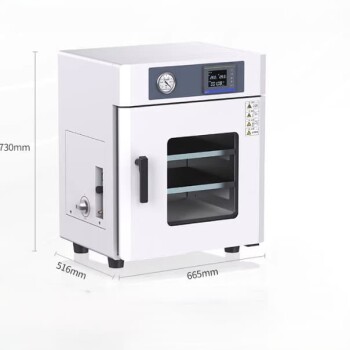
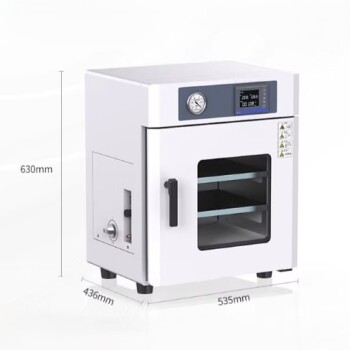
The primary process advantage of using a vacuum oven over a standard constant temperature oven lies in its ability to significantly reduce internal pressure. This facilitates the rapid volatilization of residual water and organic solvents, such as chloroform, at much lower temperatures than would otherwise be possible.
By decoupling solvent removal from high heat, vacuum drying prevents the thermal damage associated with standard ovens. This process preserves the chemical structure of the polymer matrix while simultaneously eliminating physical defects like voids.
Preserving Matrix Integrity Through Low-Temperature Drying
Accelerating Solvent Volatilization
In the preparation of RGO/PMMA nanocomposites, removing solvents like chloroform is a critical step. A vacuum oven operates by reducing the internal pressure within the drying chamber.
This pressure drop forces liquids to boil and evaporate at lower temperatures. Consequently, residual water and organic solvents volatilize rapidly without requiring excessive thermal energy.
Preventing Oxidative Degradation
Standard constant temperature ovens typically rely on high heat to drive off stubborn solvents. However, prolonged exposure to these high temperatures can lead to oxidative degradation of the PMMA polymer matrix.
By allowing for effective drying at lower temperatures, the vacuum oven bypasses this risk entirely. It ensures the chemical structure of the composite remains intact throughout the processing phase.
Optimizing Mechanical Properties
Removing Trapped Micro-bubbles
During the mixing and preparation of nanocomposites, air and gas pockets are frequently trapped within the material. If left unchecked, these inclusions create weak points in the final product.
The vacuum environment effectively extracts these trapped micro-bubbles from the composite. This is a mechanical advantage that standard thermal ovens cannot replicate merely through heating.
Ensuring Consistent Density
The removal of voids is directly linked to the physical quality of the final molded samples. A void-free internal structure leads to higher, more consistent material density.
This structural uniformity is essential for guaranteeing the mechanical performance of the RGO/PMMA nanocomposite, ensuring it performs as predicted under stress.
Comparative Risks: Standard vs. Vacuum Processing
The Limitations of Standard Ovens
Standard constant temperature ovens operate at ambient pressure. To achieve the same level of solvent removal as a vacuum oven, they require significantly higher temperatures or longer processing times.
This introduces a trade-off: you essentially sacrifice the integrity of the polymer to ensure the dryness of the material. The heat required to remove the solvent is often high enough to initiate degradation.
The "Void" Risk
Standard ovens dry the material but do not actively de-gas it. Without the negative pressure of a vacuum, micro-bubbles are more likely to remain suspended in the viscous composite as it cures.
This results in a finished product with lower density and unpredictable mechanical failure points, rendering the composite less reliable for engineering applications.
Making the Right Choice for Your Goal
When preparing RGO/PMMA nanocomposites, the choice of equipment dictates the quality of the final material.
- If your primary focus is chemical stability: Use a vacuum oven to remove solvents at low temperatures, preventing the oxidative degradation of the polymer matrix.
- If your primary focus is mechanical reliability: Rely on the vacuum environment to eliminate micro-bubbles, ensuring high density and consistent structural performance.
Using a vacuum oven transforms the drying stage from a potential liability into a process that actively enhances the material's final properties.
Summary Table:
| Feature | Vacuum Oven Processing | Standard Oven Processing |
|---|---|---|
| Solvent Removal | Rapid volatilization at low temperatures | Slow removal; requires high heat |
| Material Integrity | Prevents oxidative degradation of PMMA | High risk of polymer thermal damage |
| Structural Quality | Extracts trapped micro-bubbles (void-free) | Leaves bubbles/voids in the matrix |
| Final Density | High and consistent density | Lower density with physical defects |
| Key Outcome | Preserves chemical & mechanical properties | Compromises material performance |
Elevate Your Nanocomposite Research with KINTEK Precision
Don't let oxidative degradation or internal voids compromise your RGO/PMMA research. KINTEK specializes in advanced laboratory solutions designed to optimize your material science workflows. Whether you require high-performance vacuum ovens for bubble-free drying, high-temperature furnaces for thermal processing, or crushing and milling systems for uniform nanoparticle dispersion, we have the expertise to support your lab's specific needs.
Our value to you:
- Comprehensive Equipment Range: From CVD/PECVD systems to isostatic hydraulic presses.
- Enhanced Material Quality: Tools designed to maintain the chemical and mechanical integrity of polymers and composites.
- End-to-End Support: Providing everything from ULT freezers to essential PTFE and ceramic consumables.
Achieve consistent, high-density results today. Contact KINTEK for a tailored equipment consultation!
References
- Shin Yiing Kee, Koon Chun Lai. Effect of Preparation Methods on the Tensile, Morphology and Solar Energy Conversion Efficiency of RGO/PMMA Nanocomposites. DOI: 10.3390/polym9060230
This article is also based on technical information from Kintek Solution Knowledge Base .
Related Products
- 56L Vertical Laboratory Vacuum Drying Oven
- 23L Laboratory Vacuum Drying Oven
- Dental Porcelain Zirconia Sintering Ceramic Vacuum Press Furnace
- Vacuum Heat Treat Sintering Brazing Furnace
- Ultra-High Temperature Graphite Vacuum Graphitization Furnace
People Also Ask
- Why is a laboratory vacuum drying oven recommended for rice straw residues? Protect Your Biomass Integrity
- What role does a laboratory vacuum drying oven play in the preparation of modified multi-walled carbon nanotubes?
- What is the importance of using a laboratory vacuum drying oven? Preserving Slow-Release Microcapsule Integrity
- Why is a Laboratory Vacuum Drying Oven recommended for PBAT microspheres? Protect Sensitive Polymer Integrity
- What role does a laboratory vacuum drying oven play in processing nanoparticle powder samples? Protect Sample Integrity