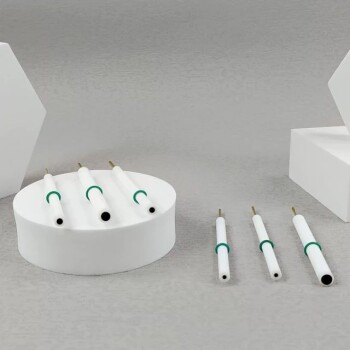
The Platinum electrode functions as the auxiliary (or counter) electrode responsible for completing the current circuit, while the Saturated Calomel Electrode (SCE) acts as the reference electrode to provide a stable potential baseline. By separating current transmission from potential measurement, this configuration ensures that the data collected reflects only the corrosion behavior of the coating, without interference from the measurement tools themselves.
Core Insight A three-electrode system is designed to isolate variables. The platinum electrode handles the electrical current "heavy lifting" without reacting chemically, while the SCE sits outside the current path to maintain an unshakeable voltage standard, guaranteeing that any fluctuation you see is actually happening on your coating.
The Role of the Platinum Electrode (The Auxiliary)
Completing the Current Loop
In electrochemical testing, current must flow through the system to drive the reaction. The platinum electrode serves as the auxiliary (or counter) electrode.
It acts as the necessary partner to the working electrode (your coating). It closes the electrical circuit, allowing electrons to transfer and the test reaction to proceed.
Chemical Inertness is Critical
The primary reason platinum is chosen is its superior chemical inertness.
As the counter electrode drives the current, it is exposed to the same harsh environment (such as HCl or H2SO4 solutions) as your sample. Because platinum does not easily corrode or participate in the reaction, it ensures that the electrochemical signals originate entirely from your coating.
Preventing Signal Contamination
If the counter electrode were to react or dissolve, it would generate "noise" in your data.
Platinum functions as a pure medium for electron transfer. This guarantees that the measured corrosion current accurately reflects the intrinsic properties of the working electrode, rather than a mix of sample and counter-electrode reactions.
The Role of the Saturated Calomel Electrode (The Reference)
Establishing a Stable Baseline
The Saturated Calomel Electrode (SCE) functions strictly as the reference electrode.
Its sole purpose is to provide a fixed, known potential that does not change during the experiment. It serves as the "zero point" or ruler against which the potential of your coating is measured.
Ensuring Data Reproducibility
Corrosion testing requires precise comparisons over time or between different samples.
The SCE provides an extremely stable standard potential baseline. This stability ensures that the potential coordinates on your polarization curves are accurate and that your kinetic parameters (corrosion rates) are reproducible across different tests.
Non-Current Carrying
Unlike the platinum electrode, the SCE is not designed to carry significant current.
By remaining part of the voltage sensing circuit rather than the power circuit, it maintains its equilibrium. This protects the reference potential from shifting due to polarization, which would otherwise skew your voltage readings.
Common Pitfalls to Avoid
Counter Electrode Surface Area
A common mistake is using a platinum electrode that is too small relative to the working electrode.
To ensure uniform current distribution and prevent the counter electrode from limiting the reaction, the platinum surface area should generally be larger than the surface area of the coating being tested. A platinum mesh or helical wire is often used to maximize this surface area.
Reference Electrode Maintenance
While the SCE is stable, it is not maintenance-free.
The accuracy of the SCE relies on the saturation of its internal solution. If the electrode creates a high liquid-junction potential or becomes contaminated, the "baseline" shifts, rendering the calculated corrosion potential invalid.
Making the Right Choice for Your Goal
To ensure your corrosion testing yields valid, publishable data, apply the roles of these electrodes to your specific objectives:
- If your primary focus is precise reaction kinetics: Ensure your platinum counter electrode has a surface area significantly larger than your sample to prevent current bottlenecks.
- If your primary focus is historical data comparison: Stick to the SCE as your reference, as it is a long-standing industry standard, allowing for easy comparison with legacy corrosion data.
The integrity of your corrosion data depends entirely on the stability of your reference and the inertness of your counter electrode.
Summary Table:
| Electrode Type | Specific Name | Role in System | Key Function |
|---|---|---|---|
| Working Electrode | Coated Sample | Subject of Test | The material being analyzed for corrosion. |
| Auxiliary/Counter | Platinum (Pt) | Current Carrier | Completes the circuit; inertly handles current flow without reacting. |
| Reference | Saturated Calomel (SCE) | Voltage Standard | Provides a stable, fixed potential baseline for measurement. |
| Circuit Type | 3-Electrode | Configuration | Separates current transmission from potential sensing for accuracy. |
Maximize Your Research Precision with KINTEK
Don't let measurement noise compromise your electrochemical data. KINTEK specializes in premium laboratory equipment, offering high-performance electrolytic cells and electrodes specifically designed for demanding coating corrosion studies.
Whether you require high-surface-area platinum meshes for uniform current distribution or ultra-stable reference electrodes for reproducible kinetics, our experts are here to support your lab's success. From high-temperature furnaces and reactors to precision crushing systems, KINTEK provides the tools global researchers trust.
Ready to upgrade your laboratory setup? Contact us today to explore our full range of electrochemical solutions!
References
- Long Huang, Guodong Zhang. Effect of ZrC on the Microstructure and Properties of CrMnFeCoNi High-Entropy Alloy Coatings Prepared by a Plasma Transferred Arc Process. DOI: 10.3390/ma16237401
This article is also based on technical information from Kintek Solution Knowledge Base .
Related Products
- Platinum Sheet Electrode for Laboratory and Industrial Applications
- Rotating Platinum Disk Electrode for Electrochemical Applications
- Platinum Sheet Electrode for Battery Lab Applications
- Platinum Auxiliary Electrode for Laboratory Use
- RRDE rotating disk (ring disk) electrode / compatible with PINE, Japanese ALS, Swiss Metrohm glassy carbon platinum
People Also Ask
- What is a common use for a platinum sheet electrode? As a Reliable Counter Electrode in Electrochemical Cells
- What is the most critical guideline for immersing a platinum sheet electrode in an electrolyte? Ensure Accurate Electrochemical Measurements
- What is the purity of the platinum sheet in a platinum sheet electrode? The Key to Reliable Electrochemical Data
- What is the expected lifespan of a platinum sheet electrode? Maximize Your Electrode's Service Life
- What are the available specifications for platinum sheet electrodes? Find the Perfect Fit for Your Electrochemical Needs