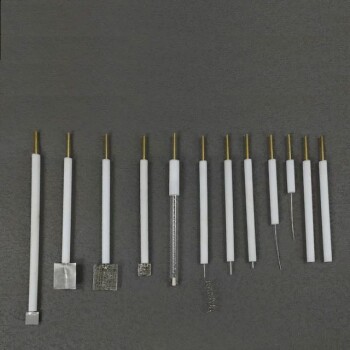
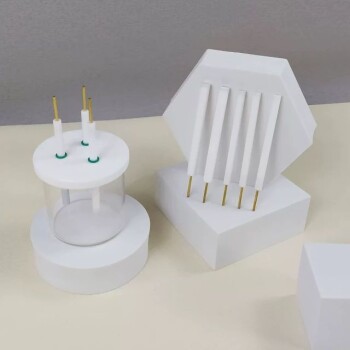
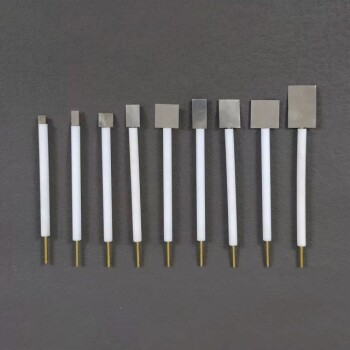
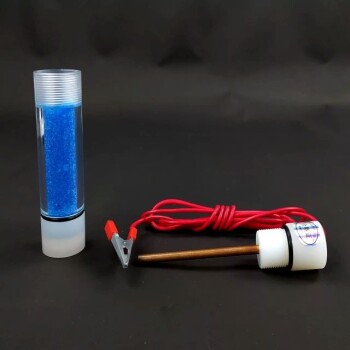
The primary technical advantages of this setup are stability, accuracy, and standardization. A Platinum (Pt) counter electrode ensures efficient, non-degrading current transmission, while a Silver/Silver Chloride (Ag/AgCl) reference electrode provides a precise, unchanging potential baseline. Together, they allow you to isolate the true electrochemical behavior of your alloy thin film without interference from system artifacts.
Core Takeaway In a three-electrode system, the reliability of your data depends entirely on the stability of your peripheral components. Using Pt and Ag/AgCl eliminates variables, ensuring that the catalytic data you capture is objective, reproducible, and directly comparable to industry standards.
The Role of the Platinum (Pt) Counter Electrode
Unwavering Chemical Stability
The counter electrode must complete the circuit without reacting with the electrolyte or the working electrode.
Platinum is chemically inert, meaning it allows for stable current transmission without corroding or degrading over time. This is particularly critical in harsh testing environments, such as strong alkaline solutions, ensuring that the kinetic parameters you measure are reliable.
High Conductivity
For accurate electrochemical analysis, the counter electrode must not impede the flow of charge.
Platinum offers high electrical conductivity, which facilitates efficient charge conduction through the electrolyte. This efficiency allows the electrochemical analyzer to detect even subtle electrical signals produced by the material, such as those found in photocatalytic applications.
Withstanding Current Loads
During testing, the counter electrode is often subjected to significant current.
Because of its robust nature, Platinum can withstand high current loads during rigorous testing cycles. This durability ensures that the electrode remains physically intact and electrically consistent throughout the experiment.
The Role of the Ag/AgCl Reference Electrode
Precision in Potential Coordinates
The reference electrode has one job: to maintain a constant potential against which the working electrode is measured.
The Ag/AgCl electrode provides an extremely stable reference potential. This stability is essential for establishing accurate potential coordinates on polarization curves, ensuring that your voltage readings are true to the chemistry occurring at the alloy surface.
Reproducibility and Standardization
Data is only valuable if it can be compared to other datasets.
The Ag/AgCl electrode is a widely accepted industry standard that offers a reproducible potential reference. Using it ensures that your data—specifically for materials like Platinum-Ruthenium (PtRu) alloy thin films—can be objectively compared against other studies and industry benchmarks.
Understanding the Operational Trade-offs
The Necessity of the Three-Electrode Setup
While simpler two-electrode setups exist, they often conflate the counter and reference functions.
By separating these functions using high-quality Pt and Ag/AgCl components, you increase the complexity of the physical setup but gain the ability to isolate the working electrode's performance. Deviating from these standard materials to save cost or space risks introducing noise or drift that renders the data incomparable to established literature.
Making the Right Choice for Your Goal
To maximize the value of your electrochemical testing, align your equipment choice with your specific analytical needs.
- If your primary focus is obtaining industry-standard data: Prioritize this specific pairing to ensuring your results for alloys (like PtRu) are legally and scientifically comparable to external benchmarks.
- If your primary focus is corrosion kinetics in harsh media: Rely on the chemical inertness of the Platinum counter electrode to prevent sensor degradation from skewing long-term durability tests.
- If your primary focus is detecting subtle catalytic signals: Leverage the high conductivity of the Platinum component to minimize resistance and capture low-level electrical responses.
Ultimately, the choice of Pt and Ag/AgCl is less about preference and more about establishing a rigorous baseline of truth for your electrochemical measurements.
Summary Table:
| Component | Role | Key Advantages |
|---|---|---|
| Platinum (Pt) Counter Electrode | Current Transmission | Chemical inertness, high conductivity, withstands high current loads without degradation. |
| Ag/AgCl Reference Electrode | Potential Baseline | Provides a stable potential coordinate, ensures data reproducibility and industry standardization. |
| Three-Electrode System | Isolation | Separates current and potential functions to isolate the true behavior of the working electrode. |
Elevate Your Electrochemical Research with KINTEK Precision
Don't let unstable hardware compromise your alloy thin film data. KINTEK provides high-performance electrolytic cells and electrodes, including premium Platinum (Pt) and Silver/Silver Chloride (Ag/AgCl) components designed for rigorous laboratory standards.
Our comprehensive range includes:
- High-Temperature Furnaces (Muffle, Tube, Vacuum, CVD/PECVD) for material synthesis.
- Precision Milling & Sieving equipment for sample preparation.
- Advanced Autoclaves & Reactors for high-pressure testing.
- Specialized Consumables including ceramics and PTFE products.
Maximize your lab's efficiency and ensure reproducible results. Contact our technical experts today to find the perfect configuration for your electrochemical testing needs!
References
- Yeseul Son, Soo‐Hyun Kim. Advanced Atomic Layer Modulation Based Highly Homogeneous PtRu Precious Metals Alloy Thin Films. DOI: 10.1002/advs.202503561
This article is also based on technical information from Kintek Solution Knowledge Base .
Related Products
- Reference Electrode Calomel Silver Chloride Mercury Sulfate for Laboratory Use
- Platinum Auxiliary Electrode for Laboratory Use
- Rotating Platinum Disk Electrode for Electrochemical Applications
- Platinum Sheet Electrode for Laboratory and Industrial Applications
- Copper Sulfate Reference Electrode for Laboratory Use
People Also Ask
- What is the function of a reference electrode? Master Precision in Three-Electrode Reactor Reconstruction
- What is the recommended maintenance for the filling solution of a reference electrode? A Guide to Stable & Accurate Readings
- Which electrode is used as a ground reference? Master the Key to Accurate Electrochemical Measurements
- What is the reference electrode in potentiometry? The Key to Stable & Accurate Measurements
- Which electrode is used as a reference? A Guide to Accurate Electrochemical Measurements