Knowledge What are the technical advantages of using a vacuum hot press sintering furnace? Achieve High-Density Alloy Blocks
Author avatar

Tech Team · Kintek Solution

Updated 5 days ago

What are the technical advantages of using a vacuum hot press sintering furnace? Achieve High-Density Alloy Blocks


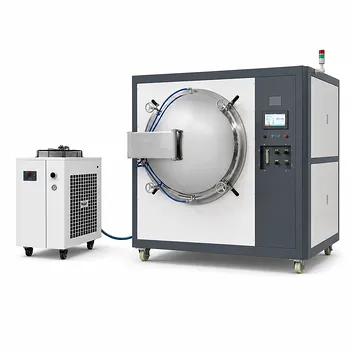
The primary technical advantage of using a vacuum hot press sintering furnace is the ability to achieve near-theoretical density through the simultaneous application of high thermal energy and mechanical pressure. For NiCrCoTiV high-entropy alloy blocks, this process utilizes temperatures up to 1150°C and pressures of 25 MPa to drive atomic diffusion and eliminate internal defects that pressureless sintering often leaves behind.

By coupling mechanical force with thermal energy in a vacuum, this method solves the dual challenges of porosity and oxidation. It forces particle rearrangement and evacuates trapped gases, ensuring the fabrication of a dense, high-purity alloy block with minimal structural flaws.

Mechanisms of Enhanced Densification

Thermo-Mechanical Synergy

The core benefit of this furnace is the coupling of heat and pressure. While typical sintering relies solely on thermal energy to fuse particles, the vacuum hot press applies a mechanical pressure of 25 MPa alongside temperatures of 1150°C. This combination forces powder particles together, significantly shortening the diffusion distance between atoms.

Promotion of Atomic Diffusion

The application of external pressure accelerates the kinetics of densification. By mechanically reducing the space between particles, the furnace promotes rapid atomic diffusion across particle boundaries. This allows the material to consolidate faster and more completely than it would under heat alone.

Elimination of Internal Pores

One of the persistent failure modes in alloy fabrication is porosity. The vacuum hot press effectively eliminates gases trapped within powder gaps during the molding process. The mechanical pressure collapses these voids, while the vacuum environment ensures that any residual gas is evacuated rather than trapped inside the solidifying block.

Environmental Control and Purity

Prevention of Oxidation

High-entropy alloys containing reactive elements like Titanium (Ti) and Chromium (Cr) are highly susceptible to oxidation at sintering temperatures. The vacuum environment is critical for preventing the formation of oxide inclusions. These inclusions can weaken grain boundaries and degrade the material's mechanical and thermal performance.

Maintaining Compositional Integrity

By sintering in a vacuum, the furnace maintains the chemical purity of the NiCrCoTiV alloy. It ensures that the final block reflects the intended chemical composition without contamination from atmospheric gases, which is essential for consistent material performance.

Understanding the Trade-offs

Forming vs. Refining

It is critical to distinguish between densification and microstructural optimization. While the vacuum hot press excels at creating a dense, solid block, it does not necessarily optimize the grain structure for specific properties like corrosion resistance.

The Need for Post-Processing

Achieving specific performance metrics often requires secondary treatments. For example, while the hot press creates the block, a separate box furnace is often required for long-duration annealing (e.g., 500–700°C) to refine grains and adjust precipitated phases. The hot press is the foundation; it is not always the complete solution.

Making the Right Choice for Your Goal

To maximize the quality of your NiCrCoTiV alloy fabrication, you must align your equipment choice with your specific processing stage.

  • If your primary focus is Densification and Molding: Prioritize the vacuum hot press sintering furnace to eliminate porosity and achieve a solid, oxidation-free block using simultaneous heat (1150°C) and pressure (25 MPa).
  • If your primary focus is Microstructural Tuning: Follow the sintering process with a box furnace annealing treatment to refine grain structure and enhance properties like corrosion resistance.

The vacuum hot press provides the essential thermo-mechanical foundation required to transform loose powder into a dense, high-performance engineering material.

Summary Table:

Feature Advantage for NiCrCoTiV Alloys Impact on Final Block
Thermo-Mechanical Pressure Simultaneous 1150°C and 25 MPa Forces particle rearrangement and near-theoretical density.
Atomic Diffusion Kinetics Shortened diffusion distances Accelerates consolidation and eliminates internal defects.
Vacuum Environment Removal of atmospheric gases Prevents oxidation and ensures high chemical purity.
Porosity Elimination Collapse of internal voids Removes trapped gases and increases material structural integrity.

Elevate Your Material Research with KINTEK

Ready to achieve superior densification for your high-entropy alloys? KINTEK specializes in advanced laboratory solutions, offering state-of-the-art vacuum hot press sintering furnaces, high-temperature muffle and box furnaces, and precision hydraulic presses. Whether you are fabricating NiCrCoTiV blocks or performing delicate microstructural tuning with our cooling solutions and annealing tools, we provide the expertise and equipment to ensure your lab's success.

Maximize your alloy performance today—contact KINTEK for a tailored equipment consultation!

Related Products

People Also Ask

Related Products

Vacuum Hot Press Furnace Machine Heated Vacuum Press

Vacuum Hot Press Furnace Machine Heated Vacuum Press

Discover the advantages of Vacuum Hot Press Furnace! Manufacture dense refractory metals & compounds, ceramics, and composites under high temp and pressure.

Vacuum Hot Press Furnace Heated Vacuum Press Machine Tube Furnace

Vacuum Hot Press Furnace Heated Vacuum Press Machine Tube Furnace

Reduce forming pressure & shorten sintering time with Vacuum Tube Hot Press Furnace for high-density, fine-grain materials. Ideal for refractory metals.

600T Vacuum Induction Hot Press Furnace for Heat Treat and Sintering

600T Vacuum Induction Hot Press Furnace for Heat Treat and Sintering

Discover the 600T Vacuum Induction Hot Press Furnace, designed for high-temperature sintering experiments in vacuum or protected atmospheres. Its precise temperature and pressure control, adjustable working pressure, and advanced safety features make it ideal for nonmetal materials, carbon composites, ceramics, and metal powders.

Touchscreen Automatic Vacuum Heat Press

Touchscreen Automatic Vacuum Heat Press

Precision vacuum heat press for labs: 800°C, 5-ton pressure, 0.1MPa vacuum. Ideal for composites, solar cells, aerospace.

Vacuum Heat Treat and Sintering Furnace with 9MPa Air Pressure

Vacuum Heat Treat and Sintering Furnace with 9MPa Air Pressure

The air pressure sintering furnace is a high-tech equipment commonly used for the sintering of advanced ceramic materials. It combines vacuum sintering and pressure sintering techniques to achieve high-density and high-strength ceramics.

2200 ℃ Tungsten Vacuum Heat Treat and Sintering Furnace

2200 ℃ Tungsten Vacuum Heat Treat and Sintering Furnace

Experience the ultimate refractory metal furnace with our Tungsten vacuum furnace. Capable of reaching 2200℃, perfect for sintering advanced ceramics and refractory metals. Order now for high-quality results.

Vacuum Heat Treat and Molybdenum Wire Sintering Furnace for Vacuum Sintering

Vacuum Heat Treat and Molybdenum Wire Sintering Furnace for Vacuum Sintering

A vacuum molybdenum wire sintering furnace is a vertical or bedroom structure, which is suitable for withdrawal, brazing, sintering and degassing of metal materials under high vacuum and high temperature conditions. It is also suitable for dehydroxylation treatment of quartz materials.

Molybdenum Vacuum Heat Treat Furnace

Molybdenum Vacuum Heat Treat Furnace

Discover the benefits of a high-configuration molybdenum vacuum furnace with heat shield insulation. Ideal for high-purity, vacuum environments like sapphire crystal growth and heat treatment.

Vacuum Heat Treat Sintering Brazing Furnace

Vacuum Heat Treat Sintering Brazing Furnace

A vacuum brazing furnace is a type of industrial furnace used for brazing, a metalworking process that joins two pieces of metal using a filler metal that melts at a lower temperature than the base metals. Vacuum brazing furnaces are typically used for high-quality applications where a strong, clean joint is required.

Vacuum Heat Treat Furnace with Ceramic Fiber Liner

Vacuum Heat Treat Furnace with Ceramic Fiber Liner

Vacuum furnace with polycrystalline ceramic fiber insulation liner for excellent heat insulation and uniform temperature field. Choose from 1200℃ or 1700℃ max. working temperature with high vacuum performance and precise temperature control.

Ultra-High Temperature Graphite Vacuum Graphitization Furnace

Ultra-High Temperature Graphite Vacuum Graphitization Furnace

The ultra-high temperature graphitization furnace utilizes medium frequency induction heating in a vacuum or inert gas environment. The induction coil generates an alternating magnetic field, inducing eddy currents in the graphite crucible, which heats up and radiates heat to the workpiece, bringing it to the desired temperature. This furnace is primarily used for graphitization and sintering of carbon materials, carbon fiber materials, and other composite materials.

1800℃ Muffle Oven Furnace for Laboratory

1800℃ Muffle Oven Furnace for Laboratory

KT-18 muffle furnace with Japan Al2O3 polycrystalline fibe and Silicon Molybdenum heating element, up to 1900℃, PID temperature control and 7" smart touch screen. Compact design, low heat loss, and high energy efficiency. Safety interlock system and versatile functions.

1700℃ Laboratory High Temperature Tube Furnace with Alumina Tube

1700℃ Laboratory High Temperature Tube Furnace with Alumina Tube

Looking for a high-temperature tube furnace? Check out our 1700℃ Tube Furnace with Alumina Tube. Perfect for research and industrial applications up to 1700C.

Horizontal High Temperature Graphite Vacuum Graphitization Furnace

Horizontal High Temperature Graphite Vacuum Graphitization Furnace

Horizontal Graphitization Furnace: This type of furnace is designed with the heating elements placed horizontally, allowing for uniform heating of the sample. It's well-suited for graphitizing large or bulky samples that require precise temperature control and uniformity.

Laboratory Vacuum Tilt Rotary Tube Furnace Rotating Tube Furnace

Laboratory Vacuum Tilt Rotary Tube Furnace Rotating Tube Furnace

Discover the versatility of Laboratory Rotary Furnace: Ideal for calcination, drying, sintering, and high-temperature reactions. Adjustable rotating and tilting functions for optimal heating. Suitable for vacuum and controlled atmosphere environments. Learn more now!

Vertical High Temperature Graphite Vacuum Graphitization Furnace

Vertical High Temperature Graphite Vacuum Graphitization Furnace

Vertical high temperature graphitization furnace for carbonization and graphitization of carbon materials up to 3100℃.Suitable for shaped graphitization of carbon fiber filaments and other materials sintered in a carbon environment.Applications in metallurgy, electronics, and aerospace for producing high-quality graphite products like electrodes and crucibles.

1400℃ Muffle Oven Furnace for Laboratory

1400℃ Muffle Oven Furnace for Laboratory

Get precise high-temperature control up to 1500℃ with KT-14M Muffle furnace. Equipped with a smart touch screen controller and advanced insulation materials.

1700℃ Muffle Oven Furnace for Laboratory

1700℃ Muffle Oven Furnace for Laboratory

Get superior heat control with our 1700℃ Muffle Furnace. Equipped with intelligent temperature microprocessor, TFT touch screen controller & advanced insulation materials for precise heating up to 1700C. Order now!

1200℃ Split Tube Furnace with Quartz Tube Laboratory Tubular Furnace

1200℃ Split Tube Furnace with Quartz Tube Laboratory Tubular Furnace

KT-TF12 split tube furnace: high-purity insulation, embedded heating wire coils, and max. 1200C. Widely used for new materials and chemical vapour deposition.

Laboratory Muffle Oven Furnace Bottom Lifting Muffle Furnace

Laboratory Muffle Oven Furnace Bottom Lifting Muffle Furnace

Efficiently produce batches with excellent temperature uniformity using our Bottom Lifting Furnace. Features two electric lifting stages and advanced temperature control up to 1600℃.


Leave Your Message