For melting steel, the best and most common choice for general foundry work is a clay-graphite or silicon carbide (SiC) crucible. These materials offer the best balance of extreme temperature resistance, durability against thermal shock, and reasonable cost. However, the specific type of steel you're melting and the furnace you're using are critical factors in the final decision.
The core challenge of melting steel isn't just reaching its high melting point of around 1500°C (2800°F), but managing the chemical reactions that occur at that temperature. The "best" crucible is one that can withstand the heat without cracking while also controlling for unwanted contamination of your metal.
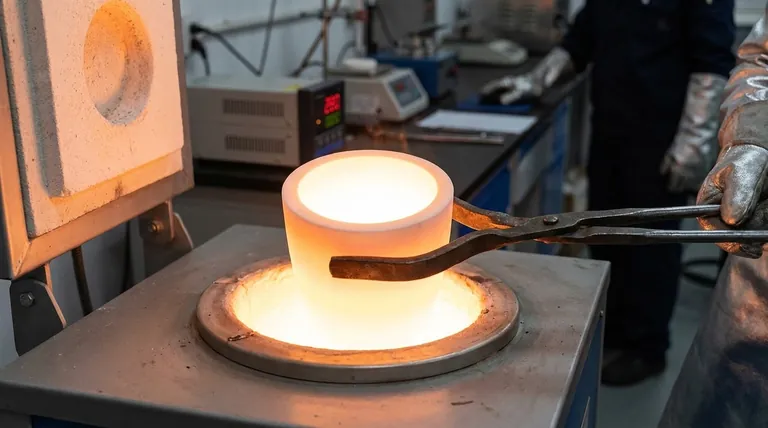
Why Melting Steel Demands a Specialized Crucible
Melting steel is fundamentally different and more demanding than working with lower-temperature metals like aluminum or bronze. The crucible you choose must be engineered to handle several extreme conditions simultaneously.
The Extreme Temperature Requirement
Steel melts at temperatures that will destroy or melt many common materials. A crucible must maintain its structural integrity well above 1500°C (2800°F). This immediately disqualifies many cheaper or lower-grade crucibles designed for non-ferrous metals.
The Risk of Thermal Shock
Thermal shock is the stress a material undergoes when it experiences a rapid change in temperature. Pouring molten steel and exposing the hot crucible to cooler air can cause lesser materials to crack or shatter catastrophically. A proper steel-rated crucible is designed to expand and contract without failing.
The Problem of Contamination
At molten temperatures, steel is chemically reactive. The crucible material can leach into the melt, or elements from the steel can react with the crucible. The most common issue is carbon contamination, where carbon from the crucible dissolves into the steel, changing its properties.
Evaluating Crucible Materials for Steel
Your choice will primarily be between graphite-based composites and specialized ceramics. Each has a distinct purpose.
Clay-Graphite Crucibles
These are the versatile workhorses of the foundry world. A mixture of graphite and refractory clays, they offer excellent resistance to thermal shock. The graphite provides thermal conductivity for even heating, while the clay acts as a durable binder. They are a cost-effective and reliable choice for most steel alloys.
Silicon Carbide (SiC) Crucibles
Often bonded with carbon or clay, silicon carbide crucibles provide superior physical strength and excellent thermal conductivity, leading to faster melt times. They are extremely durable and long-lasting, but typically come at a higher price point than standard clay-graphite.
Pure Graphite Crucibles
A crucible made of pure graphite is almost exclusively used with an induction furnace. In this setup, the magnetic field directly heats the conductive graphite crucible, which in turn melts the steel. These have outstanding thermal shock resistance but will absolutely leach carbon into the melt, raising the steel's carbon content.
Ceramic Crucibles (Alumina, Zirconia)
These are high-purity, specialized crucibles used when preventing contamination is the absolute highest priority. For laboratory work or melting specific alloys like low-carbon stainless steel, a high-alumina crucible is used to avoid any carbon pickup. However, they are significantly more expensive and often more brittle than their graphite-based counterparts.
Understanding the Trade-offs
There is no single "best" crucible, only the best one for a specific application. The decision balances cost, purity, and your heating method.
Cost vs. Lifespan
A specialized ceramic crucible may cost many times more than a clay-graphite one. While a high-quality SiC crucible has a long service life that can justify its cost, cheap crucibles that fail after only a few uses are both expensive in the long run and dangerous.
Purity vs. Durability
This is the central trade-off. If you must maintain the exact carbon content of your alloy, you need a ceramic crucible and must handle it with extreme care. If some carbon pickup is acceptable or even desired, the durability and thermal shock resistance of a clay-graphite or SiC crucible is the superior choice.
Your Furnace Type is Non-Negotiable
The type of furnace you use dictates your options. A fuel-fired (gas, propane, diesel) or resistance furnace can use clay-graphite, SiC, or ceramic crucibles. An induction furnace absolutely requires a conductive crucible like graphite or SiC to function.
Making the Right Choice for Your Goal
Base your decision on the intended outcome of your melt.
- If your primary focus is general-purpose steel casting or hobbyist work: A high-quality clay-graphite crucible is the most versatile, reliable, and cost-effective starting point.
- If you are using an induction furnace: You must use a graphite or silicon carbide crucible specifically designed for induction heating.
- If you need maximum durability and faster melt times in a fuel-fired furnace: Invest in a silicon carbide (SiC) crucible.
- If you are melting low-carbon alloys where purity is critical: You must use a high-alumina or other ceramic crucible and accept the associated cost and handling requirements.
Choosing the correct crucible is the foundation of a safe and successful steel melt.
Summary Table:
| Crucible Material | Best For | Key Advantage | Key Consideration |
|---|---|---|---|
| Clay-Graphite | General-purpose casting, hobbyist work | Excellent thermal shock resistance, cost-effective | Can cause carbon contamination |
| Silicon Carbide (SiC) | Induction furnaces, fast melt times | Superior durability, high thermal conductivity | Higher cost |
| Ceramic (Alumina/Zirconia) | High-purity alloys, laboratory work | Prevents carbon contamination, high purity | Brittle, expensive, requires careful handling |
| Pure Graphite | Induction furnaces only | Outstanding thermal shock resistance | Will significantly increase carbon content |
Ready to Select the Perfect Crucible for Your Steel Melting Application?
Choosing the right crucible is critical for the safety, efficiency, and success of your lab work. KINTEK specializes in high-performance lab equipment and consumables, including a full range of crucibles designed for demanding applications like melting steel. Our experts can help you navigate the trade-offs between temperature resistance, contamination control, and furnace compatibility to find the ideal solution for your specific needs.
Contact us today to ensure your next melt is a success. Let KINTEK provide the reliable equipment your laboratory depends on.
Get a Personalized Recommendation
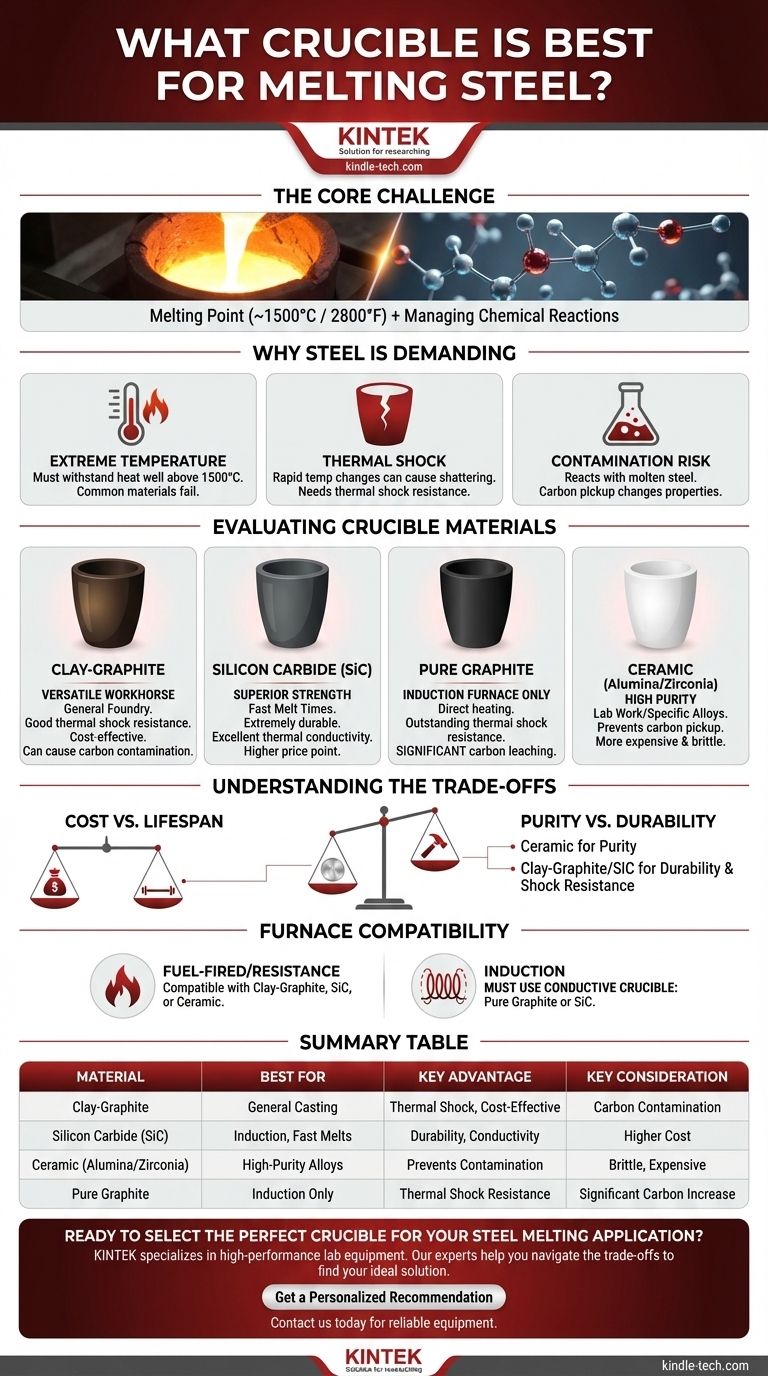
Visual Guide
Related Products
- High Purity Pure Graphite Crucible for Evaporation
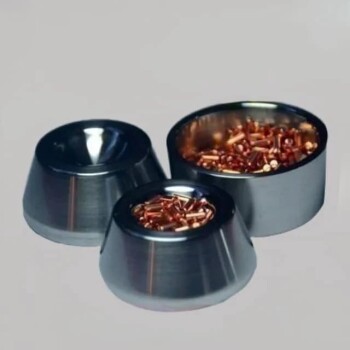
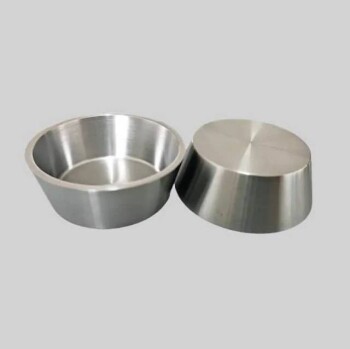
- Electron Beam Evaporation Coating Gold Plating Tungsten Molybdenum Crucible for Evaporation
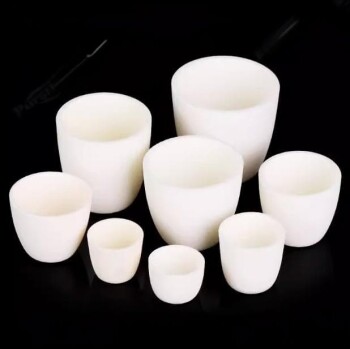
- Engineering Advanced Fine Alumina Al2O3 Ceramic Crucible for Laboratory Muffle Furnace
- E Beam Crucibles Electron Gun Beam Crucible for Evaporation
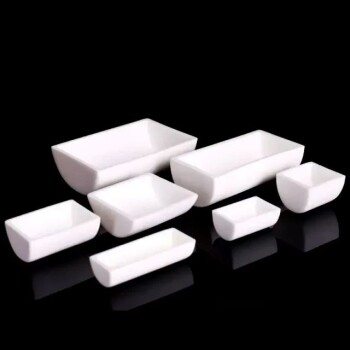
- Arc-Shaped Alumina Ceramic Crucible High Temperature Resistant for Engineering Advanced Fine Ceramics
People Also Ask
- Why must high-purity graphite crucibles be treated in a vacuum oven and pre-baked? Ensure Pure Molten Salt Experiments
- Why is a graphite crucible selected for Na2S-NPS-C composites? Ensure High Purity in Casting-Annealing Processes
- Is graphite used to make heat resistant crucibles? Unlock Faster Melting and Superior Performance
- What dual roles do high-purity graphite crucibles play? Expert Insights into Fluoride Salt Testing
- Why are high-purity graphite crucibles preferred for sulfide solid electrolytes? Achieve Superior Material Purity