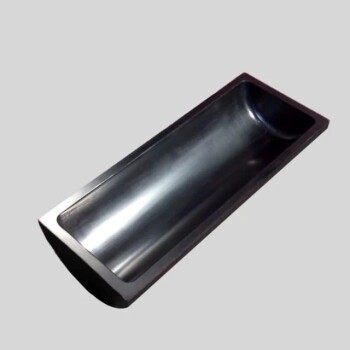
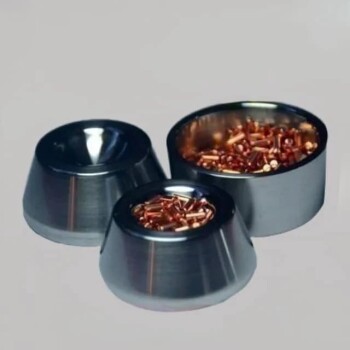
In high-temperature fluoride salt electrochemical testing, high-purity graphite crucibles perform a critical dual function by acting as both the physical vessel and an active electrical component. Specifically, they serve as a corrosion-resistant container for the eutectic molten salt while simultaneously functioning as the auxiliary (counter) electrode within the measurement system.
High-purity graphite provides a unique combination of chemical inertness and electrical conductivity. This allows the crucible to hold corrosive fluoride melts without contaminating them, while also simplifying the circuit design by acting as a stable counter electrode.
The Mechanics of the Dual Role
Role 1: The Corrosion-Resistant Container
The primary physical requirement in these tests is holding the eutectic molten salt. Fluoride salts at high temperatures are extremely aggressive and corrosive to many standard materials.
High-purity graphite is selected because it acts as a robust, high-temperature container. It resists the corrosive nature of the fluoride melt, maintaining structural integrity throughout the experiment.
Role 2: The Integrated Auxiliary Electrode
Beyond simple containment, the crucible becomes an active part of the electrochemical measurement system. It serves as the auxiliary electrode, also known as the counter electrode.
Because the crucible itself acts as this electrode, you do not need to insert a separate rod to complete the circuit. This simplifies the cell geometry and reduces the number of components introduced into the melt.
Why This Combination Works
The success of this dual role relies on graphite’s high electrical conductivity. This property ensures the stable operation of the electrochemical test circuit.
Furthermore, graphite offers chemical stability in fluoride melts. Unlike metal crucibles, graphite does not dissolve or react in a way that introduces interfering metal ions, preserving the purity of the chemical environment.
Critical Considerations for Accuracy
The Necessity of High Purity
The "high-purity" designation mentioned in the reference is not a suggestion; it is a requirement. Standard graphite may contain trace metals or ash.
If low-purity graphite is used, those impurities can leach into the melt. This defeats the purpose of using graphite, as it introduces the very interference you are trying to avoid.
Stability vs. Interference
The core advantage of this setup is the elimination of background noise. Metal containers can slowly corrode, altering the electrochemical baseline.
By using graphite, you ensure that the signals you measure are from the analyte of interest, not from the degradation of the vessel holding it.
Optimizing Your Experimental Setup
To maximize the reliability of your electrochemical data, choose your materials based on your specific experimental constraints.
- If your primary focus is Data Integrity: Ensure your graphite is certified high-purity to prevent background currents caused by leaching metal ions.
- If your primary focus is Circuit Stability: Utilize the large surface area of the crucible as the counter electrode to minimize polarization effects compared to a smaller rod.
Leveraging the crucible's dual nature streamlines your physical setup while safeguarding the chemical validity of your results.
Summary Table:
| Feature | Role as Container | Role as Auxiliary Electrode |
|---|---|---|
| Function | Holds aggressive eutectic molten fluoride salts | Completes the electrochemical circuit (Counter Electrode) |
| Key Property | Exceptional chemical inertness & corrosion resistance | High electrical conductivity for stable circuit operation |
| Advantage | Prevents contamination and structural failure | Simplifies cell geometry and reduces experimental components |
| Requirement | High purity to avoid leaching trace metal ions | Large surface area to minimize polarization effects |
Elevate Your Electrochemical Research with KINTEK
Precision in high-temperature testing starts with high-purity materials. KINTEK specializes in providing premium laboratory equipment and consumables designed for the most demanding environments. Whether you need high-purity graphite crucibles, advanced electrolytic cells and electrodes, or specialized high-temperature furnaces, our solutions ensure your data remains untainted by impurities.
From battery research tools to high-pressure reactors, we empower researchers with the reliability they need to push boundaries. Don't let inferior materials compromise your results. Contact KINTEK today to discuss your specific experimental requirements and discover how our comprehensive portfolio can enhance your lab's efficiency and accuracy.
References
- Marta Ambrová, Vladimír Danielik. Corrosion resistance of tungsten and nickel in molten eutectic mixture LiF-NaF-KF. DOI: 10.2478/v10188-012-0018-y
This article is also based on technical information from Kintek Solution Knowledge Base .
Related Products
- High Purity Pure Graphite Crucible for Evaporation
- High Purity Pure Graphite Crucible for Electron Beam Evaporation
- Carbon Graphite Boat -Laboratory Tube Furnace with Cover
- Arc-Shaped Alumina Ceramic Crucible High Temperature Resistant for Engineering Advanced Fine Ceramics
- Ultra-High Temperature Graphite Vacuum Graphitization Furnace
People Also Ask
- Why are high-purity graphite crucibles preferred for sulfide solid electrolytes? Achieve Superior Material Purity
- Why is a high-purity graphite crucible required for Chromel-TaC composites? Ensure Peak Purity at 1400°C
- What role do high-purity graphite crucibles play in molten salt corrosion research? Ensure Reactor-Grade Precision
- Why are high-purity graphite crucibles used for magnesium distillation? Ensure 3N8 Purity & Thermal Stability
- Why is a high-purity graphite crucible ideal for nitrogen-doped graphene at 1500 °C? Maximize Purity and Stability