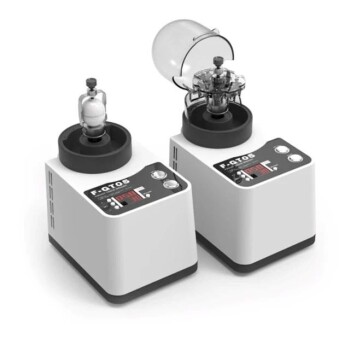
The ball mill functions as a high-energy mechanical activator and homogenizer. Specifically for the synthesis of Li6.25Al0.25La3Zr2O12 (LLZO), it grinds raw materials—Lithium Hydroxide (LiOH), Lanthanum Hydroxide (La(OH)3), Zirconium Oxide (ZrO2), and Aluminum Oxide (Al2O3)—to ensure the uniform distribution of the aluminum dopant and create high-activity precursor powders necessary for forming the cubic garnet structure.
Core Insight: The success of LLZO synthesis relies heavily on the "pre-reaction" state of the materials. The ball mill does not merely shrink particles; it creates a homogeneous microscopic architecture that allows the aluminum dopant to stabilize the conductive cubic phase during the subsequent heating process.
Achieving Microscopic Homogeneity
Distribution of the Aluminum Dopant
The most critical function of the ball mill in this specific formulation is the dispersion of Aluminum Oxide (Al2O3).
Because aluminum acts as a dopant (present in small quantities, typically 0.25 moles in this formula), manual mixing cannot achieve the necessary distribution. High-energy grinding forces the aluminum into a uniform mixture with the bulk components, which is essential for stabilizing the pure-phase cubic garnet structure later in the process.
Uniformity of Major Components
Simultaneously, the process intermixes the bulk oxides and hydroxides: LiOH, La(OH)3, and ZrO2.
Operating at speeds such as 400 r/min, the ball mill breaks down agglomerates inherent in these raw powders. This ensures that the stoichiometry (the ratio of elements) is consistent throughout the entire batch, preventing the formation of impurity phases caused by local pockets of unmixed material.
Enhancing Chemical Reactivity
Creating High-Activity Precursors
The mechanical action of the ball mill converts inert raw powders into high-activity precursors.
By subjecting the materials to intense shear and impact forces for extended periods (e.g., 8 hours), the specific surface area of the powder is drastically increased. This "activation" lowers the energy barrier for the subsequent solid-phase reaction.
Facilitating Solid-Phase Diffusion
Unlike liquid-state reactions, the synthesis of oxide ceramics like LLZO relies on solid-state diffusion.
The ball milling process refines particle sizes to the micro-nanoscale. This reduces the diffusion path length required for lithium, lanthanum, and zirconium ions to rearrange into the garnet crystal lattice during calcination.
Critical Process Parameters
Mechanical Energy Input
The efficacy of the process is dictated by the rotational speed, cited here as 400 r/min.
Insufficient speed results in mere mixing rather than grinding, failing to break down the crystalline structures enough to induce the necessary surface activity.
Duration and Stability
The process requires a sustained duration, typically 8 hours for this specific composition.
This timeframe balances the need for thorough refinement against the efficiency of the production cycle. It ensures the mixture reaches a steady state of homogeneity before the milling is stopped.
Understanding the Nuance: Mixing vs. Mechanochemistry
Oxide vs. Sulfide Synthesis
It is important to distinguish the role of ball milling here compared to other solid electrolytes.
In sulfide electrolytes (like Li2S-P2S5), the ball mill often drives a mechanochemical reaction, creating the final compound directly in the jar.
In oxide electrolytes (like LLZO), the ball mill acts primarily as a physical conditioner. It prepares the "green" mixture to ensure the chemical reaction proceeds correctly during the subsequent high-temperature sintering or calcination phase.
Making the Right Choice for Your Goal
To optimize your LLZO synthesis, align your milling parameters with your specific material requirements:
- If your primary focus is Phase Purity: Ensure the milling duration is sufficient (e.g., 8 hours) to fully disperse the Al-dopant; poor dispersion leads to tetragonal phase impurities.
- If your primary focus is Reactivity: Prioritize higher rotational speeds (e.g., 400 r/min) to maximize impact energy and specific surface area, allowing for potentially lower sintering temperatures later.
The ball mill is not just a grinder; it is the tool that programs the atomic-level uniformity required for high-performance solid-state electrolytes.
Summary Table:
| Parameter | Process Role | Impact on LLZO Quality |
|---|---|---|
| Homogenization | Disperses Al2O3 dopant & bulk oxides | Stabilizes conductive cubic phase; prevents impurities |
| Size Reduction | Refines particles to micro-nanoscale | Shortens solid-state diffusion paths during sintering |
| Mechanical Activation | Increases specific surface area | Lowers the energy barrier for solid-phase reactions |
| Energy Input | High-speed rotation (e.g., 400 r/min) | Breaks agglomerates for consistent stoichiometry |
Elevate Your Battery Research with KINTEK Precision
Achieving the perfect cubic garnet structure for LLZO solid-state electrolytes requires more than just mixing—it requires precise mechanical activation. KINTEK specializes in high-performance crushing and milling systems, including advanced planetary ball mills designed to deliver the high-energy impact and consistency your research demands.
From high-temperature furnaces for sintering your precursors to pellet and isostatic hydraulic presses for electrolyte shaping, KINTEK provides a comprehensive ecosystem of laboratory equipment. Whether you are working on oxide-based electrolytes or battery research consumables, our experts are here to support your workflow.
Ready to optimize your material synthesis?
Contact KINTEK today for a tailored solution
Related Products
- High-Energy Omnidirectional Planetary Ball Mill Milling Machine for Laboratory
- High-Energy Omnidirectional Planetary Ball Mill Machine for Laboratory
- Stainless Steel Laboratory Ball Mill for Dry Powder and Liquid with Ceramic Polyurethane Lining
- Laboratory Planetary Ball Mill Rotating Ball Milling Machine
- Hybrid High Energy Vibratory Ball Mill for Lab Use
People Also Ask
- What is the role of a planetary ball mill in preparing doped high-nickel cathode materials? Enhance Battery Stability
- How does a planetary ball mill solve mixing challenges with PEO? Unlock solid-state synthesis for insoluble dopants
- Why is a planetary ball mill used for LNMO precursor powders? Optimize Particle Uniformity & Battery Performance
- What is the function of a planetary ball mill in the solid-state synthesis of LiTa2PO8? Achieve High-Purity Electrolytes
- What is the role of a planetary ball mill in sulfide-based solid-state batteries? Engineer High-Performance Cathodes