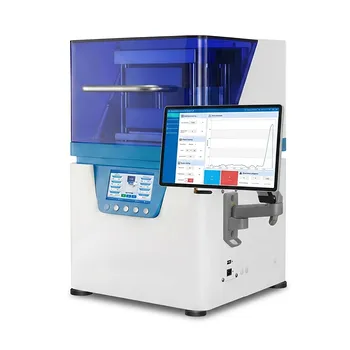
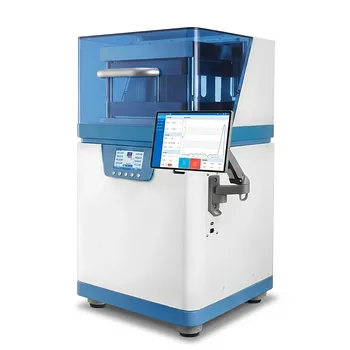
The laboratory hydraulic press transforms powdered T-ZIF-8 into a standardized physical state required for precision surface analysis. By compressing loose powder into dense, flat tablets, the press eliminates topological variables that would otherwise skew contact angle data. This preparation is essential for isolating the material's inherent chemical hydrophobicity from the physical interference caused by irregular powder packing.
A laboratory hydraulic press ensures that hydrophobicity measurements reflect the true chemical characteristics of T-ZIF-8 by creating a uniform, low-roughness surface. This standardization is the only way to achieve the reproducible contact angle data necessary for evaluating how processes like heat treatment alter material wettability.
Standardizing the Physical Interface
Converting Powder to Solid Pellets
T-ZIF-8 typically exists in a powdered form, which is incompatible with standard contact angle measurement techniques. The hydraulic press applies high, uniform pressure to consolidate these particles into a cohesive, solid tablet.
Achieving Geometric Uniformity
The press creates a highly flat and dense surface, which is fundamental for accurate liquid-to-solid interface analysis. Without this compression, water droplets would simply sink into the interstitial spaces of the loose powder, making surface characterization impossible.
Maximizing Data Integrity in Surface Testing
Eliminating Physical Interference
Macroscopic surface roughness can cause liquid droplets to "pin" or spread inconsistently, leading to false readings. The press eliminates these surface irregularities, ensuring that the resulting contact angle accurately reflects the material's chemical affinity for water.
Facilitating Precision Measurements
A smooth, standardized tablet allows for the clear identification of the three-phase contact line. This clarity is vital for researchers to precisely characterize how specific variables, such as heat treatment processes, affect the material’s surface wettability and hydrophilicity.
Ensuring Scientific Reproducibility
By applying constant and uniform normal pressure, the hydraulic press ensures that every sample is prepared under identical conditions. This consistency allows for reliable comparisons between different batches of T-ZIF-8 or different processing stages.
Understanding the Trade-offs and Pitfalls
Risks of Structural Deformation
While high pressure is necessary for a flat surface, excessive force can potentially collapse the porous framework of T-ZIF-8. Researchers must calibrate the pressure to ensure it is high enough for tablet stability but low enough to preserve the material's internal crystalline structure.
Potential for Surface Contamination
The surfaces of the pressing molds must be meticulously cleaned and polished to avoid transferring impurities to the sample. Any residue from previous tests or the use of auxiliary layers (like boric acid) must be managed to prevent chemical interference with the hydrophobicity test.
How to Apply This to Your Research
For professionals evaluating the surface properties of MOFs or similar powdered materials, the preparation stage is as critical as the measurement itself.
- If your primary focus is Chemical Characterization: Use a standardized pressure (such as 5 MPa) to ensure that variations in contact angle are caused by chemical changes rather than differences in tablet density.
- If your primary focus is Heat Treatment Analysis: Prepare all samples (pre- and post-treatment) using the exact same hydraulic press settings to isolate the impact of thermal processing on surface energy.
- If your primary focus is Minimizing Measurement Error: Ensure the mold faces are mirror-polished to achieve the lowest possible macroscopic roughness, reducing the "pinning" effect on water droplets.
By mastering the standardization of sample preparation through hydraulic compression, you ensure that your data reflects the true molecular nature of your material.
Summary Table:
| Feature | Function in T-ZIF-8 Evaluation | Key Benefit |
|---|---|---|
| Pelletization | Converts loose powder into dense, solid tablets | Enables contact angle measurement |
| Surface Leveling | Creates a flat, low-roughness interface | Eliminates topological data skew |
| Pressure Control | Applies uniform, repeatable normal force | Ensures scientific reproducibility |
| Interface Clarity | Defines the three-phase contact line | Facilitates precise wettability analysis |
Elevate Your Material Characterization with KINTEK Precision
Achieving reproducible data in MOF research starts with flawless sample preparation. KINTEK specializes in high-performance laboratory equipment designed for the most demanding analytical workflows. Our range of hydraulic presses—including manual, electric, and isostatic models—provides the consistent pressure necessary to produce uniform T-ZIF-8 pellets for accurate surface analysis.
Beyond sample preparation, KINTEK offers a comprehensive portfolio to support your entire lab, including:
- High-Temperature Solutions: Muffle, vacuum, and CVD furnaces for advanced heat treatments.
- Material Processing: Crushing, milling, and sieving systems for precise particle sizing.
- Research Consumables: High-purity ceramics, crucibles, and PTFE products to prevent sample contamination.
Don't let inconsistent sample prep compromise your research outcomes. Contact KINTEK today to find the perfect hydraulic press for your laboratory and ensure your data reflects the true chemical nature of your materials.
References
- Sojin Oh, Moonhyun Oh. Boosted ability of ZIF-8 for early-stage adsorption and degradation of chemical warfare agent simulants. DOI: 10.1039/d3na00807j
This article is also based on technical information from Kintek Solution Knowledge Base .
Related Products
- Laboratory Hydraulic Press Lab Pellet Press Machine for Glove Box
- Laboratory Hydraulic Press Split Electric Lab Pellet Press
- Fully Automatic Heated Hydraulic Lab Press for Materials Sintering and Sample Preparation
- Laboratory Hydraulic Press Lab Pellet Press for Button Battery
- Automatic Laboratory Hydraulic Press for XRF & KBR Pellet Press
People Also Ask
- How do laboratory hydraulic presses contribute to zero-gap electrolyzers? Optimize Performance & Safety
- Why is a laboratory hydraulic press necessary for ZrO2/Cr2O3 interface analysis? Optimize Sample Density and Accuracy
- How do a precision laboratory hydraulic press and specialized molds contribute to the fabrication of spherical ceramic samples? Achieving High-Density Material Precision
- What is the role of a laboratory hydraulic press in the preparation of rare earth denitrification catalysts?
- How does pressure control of a laboratory hydraulic press affect W-Ti alloys? Optimize Grain Structure & Density