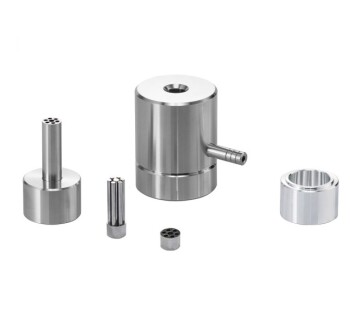
Graphite molds function as the critical interface between the processing equipment and the raw material during the vacuum hot-pressing of Carbon Fiber/Silicon Nitride (C_fiber/Si3N4) composites. They serve not only as the shaping container that defines the final geometry but also as the active medium for transferring the extreme heat and mechanical pressure required for synthesis. To successfully sinter these composites, the mold must maintain total structural integrity and chemical stability while subjected to temperatures between 1600 and 1700°C and pressures of 30 MPa.
Core Takeaway Graphite molds are far more than passive containers; they are active process enablers that simultaneously shape the material and regulate the sintering environment. Their ability to withstand extreme thermal and mechanical stress ensures that the composite achieves high density and uniform structure without chemical degradation.
Defining Geometry and Structural Integrity
Precise Containment
The most immediate function of the graphite mold is to act as a shaping container. It holds the loose C_fiber/Si3N4 powder mixture in a specific configuration, defining the final geometry of the composite component.
Maintaining Alignment
Beyond simple containment, the mold ensures the internal alignment of the materials. It positions the composite elements correctly, preventing shifting or distortion as the powder consolidates into a solid mass.
Withstanding Extreme Conditions
The sintering of C_fiber/Si3N4 requires an aggressive environment. The mold is designed to maintain its shape and strength without deformation at temperatures up to 1700°C, ensuring dimensional accuracy in the final part.
Facilitating Densification Through Pressure
The Medium for Load Transmission
The graphite mold acts as the bridge between the hydraulic press and the composite powder. It transmits the mechanical force—specifically 30 MPa in this context—directly to the material.
Promoting Uniform Densification
Because graphite has excellent mechanical properties, it distributes this load evenly across the surface of the sample. This uniformity is vital for eliminating voids and achieving a fully dense structure throughout the composite.
Preventing Structural Defects
By ensuring the pressure is applied consistently, the mold helps prevent common defects. These include local non-bonding or uneven thickness, which can occur if the load is not distributed symmetrically.
Thermal Management and Stability
Ensuring a Uniform Temperature Field
Graphite possesses high thermal conductivity, which is essential for this process. The mold allows heat to flow efficiently from the furnace elements to the composite powder.
Eliminating Thermal Gradients
This efficient heat transfer ensures that the entire sample reaches the sintering temperature of 1600–1700°C simultaneously. A uniform temperature field prevents internal stresses or uneven microstructures that could weaken the final product.
Chemical Stability
At these elevated temperatures, many materials would react with the composite components. The graphite mold provides chemical stability, preventing adverse reactions that could degrade the Silicon Nitride matrix or the Carbon Fibers.
Understanding the Operational Trade-offs
Mechanical Limits vs. Thermal Needs
While graphite is chosen for its unique balance of properties, it is not indestructible. The mold must be robust enough to withstand significant axial pressure (30 MPa) but porous or conductive enough to manage heat. Using a grade of graphite that is too dense might impede heat flow, while a grade that is too porous might fail mechanically under load.
The Cost of Precision
To ensure the "positioning" and "alignment" functions mentioned, graphite molds require high-precision machining. Any imperfection in the mold surface will be transferred to the composite, and repeated cycling at 1700°C can eventually lead to mold wear or dimensional drift, requiring frequent replacement or resurfacing.
Making the Right Choice for Your Goal
To optimize your sintering process, align your mold design with your specific project requirements:
- If your primary focus is Dimensional Precision: Prioritize high-strength graphite grades that resist deformation under the 30 MPa load to ensure the final geometry remains within tight tolerances.
- If your primary focus is Microstructural Homogeneity: Select graphite with superior thermal conductivity specifications to guarantee a perfectly uniform temperature field across the entire C_fiber/Si3N4 matrix.
Success in vacuum hot-pressing relies on viewing the graphite mold not as a consumable, but as a precision instrument that dictates the quality of your final composite.
Summary Table:
| Function Category | Specific Role | Impact on Composite |
|---|---|---|
| Geometry Control | Precise Containment & Alignment | Defines final shape; prevents internal shifting or distortion. |
| Mechanical Action | 30 MPa Pressure Transmission | Ensures uniform densification and eliminates internal voids. |
| Thermal Regulation | Uniform Temperature Field | Prevents thermal gradients and ensures microstructural homogeneity. |
| Material Stability | Chemical & Thermal Integrity | Prevents adverse reactions at 1700°C; maintains dimensional accuracy. |
Elevate Your Composite Manufacturing with KINTEK Precision
Achieving the perfect balance of mechanical strength and thermal uniformity in vacuum hot-pressing sintering requires more than just high temperatures—it requires the right tools. KINTEK specializes in advanced laboratory equipment, including high-performance vacuum and atmosphere furnaces, hydraulic presses, and the essential graphite and ceramic consumables that drive success in material science.
Whether you are developing Carbon Fiber/Silicon Nitride composites or exploring advanced battery research, our technical experts are here to provide tailored solutions that ensure dimensional precision and structural integrity. Don't let subpar equipment compromise your research—contact KINTEK today to optimize your lab's performance!
Related Products
- 2200 ℃ Graphite Vacuum Heat Treat Furnace
- Ultra-High Temperature Graphite Vacuum Graphitization Furnace
- Vacuum Heat Treat and Molybdenum Wire Sintering Furnace for Vacuum Sintering
- Ball Press Mold for Lab
- Horizontal High Temperature Graphite Vacuum Graphitization Furnace
People Also Ask
- Why do you heat treat in a vacuum? Achieve Perfect Surface Finish and Material Integrity
- How does heat transmit in a vacuum? Mastering Thermal Radiation for Purity & Precision
- What is the process of vacuum heat treating? Achieve Superior Hardening with a Clean, Bright Finish
- How does a vacuum heat treat furnace work? Achieve Pristine, Oxide-Free Metal Parts
- What is graphite heating? A Guide to Durable, High-Temp Industrial Furnace Solutions