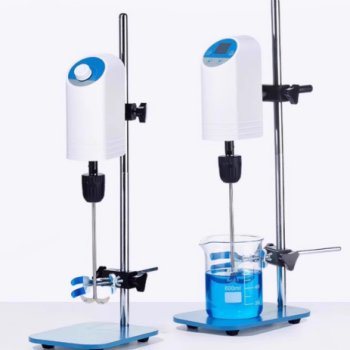
A precision magnetic stirring system primarily improves indium deposition efficiency by mechanically enhancing mass transfer and actively managing gas byproducts at the cathode. Through adjustable stirring speeds, the system significantly reduces the thickness of the diffusion layer, which increases the limiting current density and prevents defects caused by hydrogen bubbles.
Precision stirring acts as a dual-mechanism solution: it suppresses concentration polarization by actively replenishing ions at the electrode surface and simultaneously ensures physical quality by forcibly detaching hydrogen gas bubbles that would otherwise create voids.
Mechanisms of Enhanced Deposition
To understand the value of precision stirring, one must look beyond simple agitation and examine how it alters the electrochemical environment at the microscopic level.
Optimizing Mass Transfer
In static or low-flow systems, ions must diffuse through a thick, stagnant layer of liquid to reach the cathode. This slows down the reaction.
Precision stirring introduces controlled convection, which drastically reduces the thickness of this diffusion layer.
Increasing Limiting Current Density
By thinning the diffusion layer, the system allows indium ions to reach the electrode surface much faster.
This directly increases the limiting current density, allowing the cell to operate at higher currents without running out of reactants at the surface.
Suppressing Concentration Polarization
When ions are consumed faster than they arrive, "concentration polarization" occurs, leading to voltage losses and inefficiency.
Adjustable stirring speeds ensure a constant supply of fresh ions to the cathode. This effectively suppresses concentration polarization, maintaining high efficiency even at elevated reaction rates.
Managing Gas Byproducts
Efficiency is not just about speed; it is about the effective use of surface area. In indium electrowinning, the generation of hydrogen gas is a significant barrier to performance.
The Problem of Bubble Shielding
During the deposition process, hydrogen bubbles often form on the cathode surface.
If left undisturbed, these bubbles "shield" the active surface area. This prevents indium ions from depositing in those spots, leading to uneven deposition and voids.
Assisted Degassing via Stirring
A precision stirring system utilizes strong fluid motion to facilitate the rapid detachment of hydrogen bubbles.
By physically sweeping these bubbles away, the system ensures the entire cathode surface remains active and available for indium deposition. This results in a smoother, void-free product and improves the overall current efficiency of the cell.
Critical Considerations
While the benefits are clear, the effectiveness of the system relies heavily on the "precision" aspect mentioned in the source material.
The Necessity of Adjustability
The primary reference highlights adjustable stirring speeds as a key feature. A "set it and forget it" approach is often insufficient.
If the stirring speed is not tuned to the specific cell geometry and current parameters, you may fail to sufficiently thin the diffusion layer. Conversely, the ability to fine-tune speed is what allows operators to balance mass transfer needs against energy consumption.
Making the Right Choice for Your Goal
Implementing a precision magnetic stirring system allows you to tune your electrowinning process based on your specific output requirements.
- If your primary focus is Production Rate: Prioritize higher stirring speeds to minimize the diffusion layer thickness, allowing you to maximize the limiting current density.
- If your primary focus is Deposit Quality: Focus on consistent, strong agitation to ensure immediate hydrogen bubble detachment, preventing surface pitting and voids.
Ultimately, precision stirring transforms the cathode interface from a stagnant, gas-blocked environment into a highly active, efficient reaction zone.
Summary Table:
| Feature | Impact on Deposition | Key Benefit |
|---|---|---|
| Reduced Diffusion Layer | Accelerates ion transport to the cathode | Increases limiting current density |
| Enhanced Convection | Suppresses concentration polarization | Maintains high efficiency at high rates |
| Active Degassing | Forcibly detaches hydrogen bubbles | Eliminates voids and surface pitting |
| Adjustable Speed | Optimizes fluid dynamics per cell geometry | Balances power use with production rate |
Maximize Your Indium Recovery with KINTEK Precision Solutions
Elevate your electrochemical research and production with KINTEK’s advanced laboratory equipment. Our precision magnetic stirring systems and specialized electrolytic cells and electrodes are engineered to solve complex deposition challenges, ensuring uniform mass transfer and superior product quality.
From high-performance crushing and milling systems to essential PTFE and ceramic consumables, KINTEK provides a comprehensive ecosystem for material science. Whether you are refining indium or developing next-generation battery technologies, our expertise in high-temperature and high-pressure environments ensures your lab operates at peak efficiency.
Ready to optimize your deposition efficiency? Contact our technical specialists today to find the perfect equipment for your specific application.
References
- István B. Illés, Tamás Kékesi. The relative efficiency of electrowinning indium from chloride electrolytes. DOI: 10.1007/s10800-022-01779-7
This article is also based on technical information from Kintek Solution Knowledge Base .
Related Products
- Laboratory Small Constant Temperature Heated Magnetic Stirrer Heater and Stirrer
- Custom PTFE Teflon Parts Manufacturer for Magnetic Stirring Bar
- High Performance Laboratory Stirrers for Diverse Applications
- Custom PTFE Teflon Parts Manufacturer for PTFE Stirring Bar Recovery Rod
- Three-dimensional electromagnetic sieving instrument
People Also Ask
- What role does a magnetic stirrer with heating play in ZnO nanoparticle synthesis? Precision Control for Quality Results
- What role does a constant temperature heating magnetic stirrer play in MFC-HAp synthesis? Achieve Material Homogeneity
- What is the function of a laboratory magnetic stirrer in Ni–Cr–P electrodeposition? Optimize Ion Transport & Coating
- Why is a laboratory magnetic stirrer required for benzoic acid esters? Boost Reaction Speed & Yield with High RPM
- What role does a laboratory magnetic stirrer play in TiO2 and TiO2-Ag sol preparation? Master Chemical Kinetics