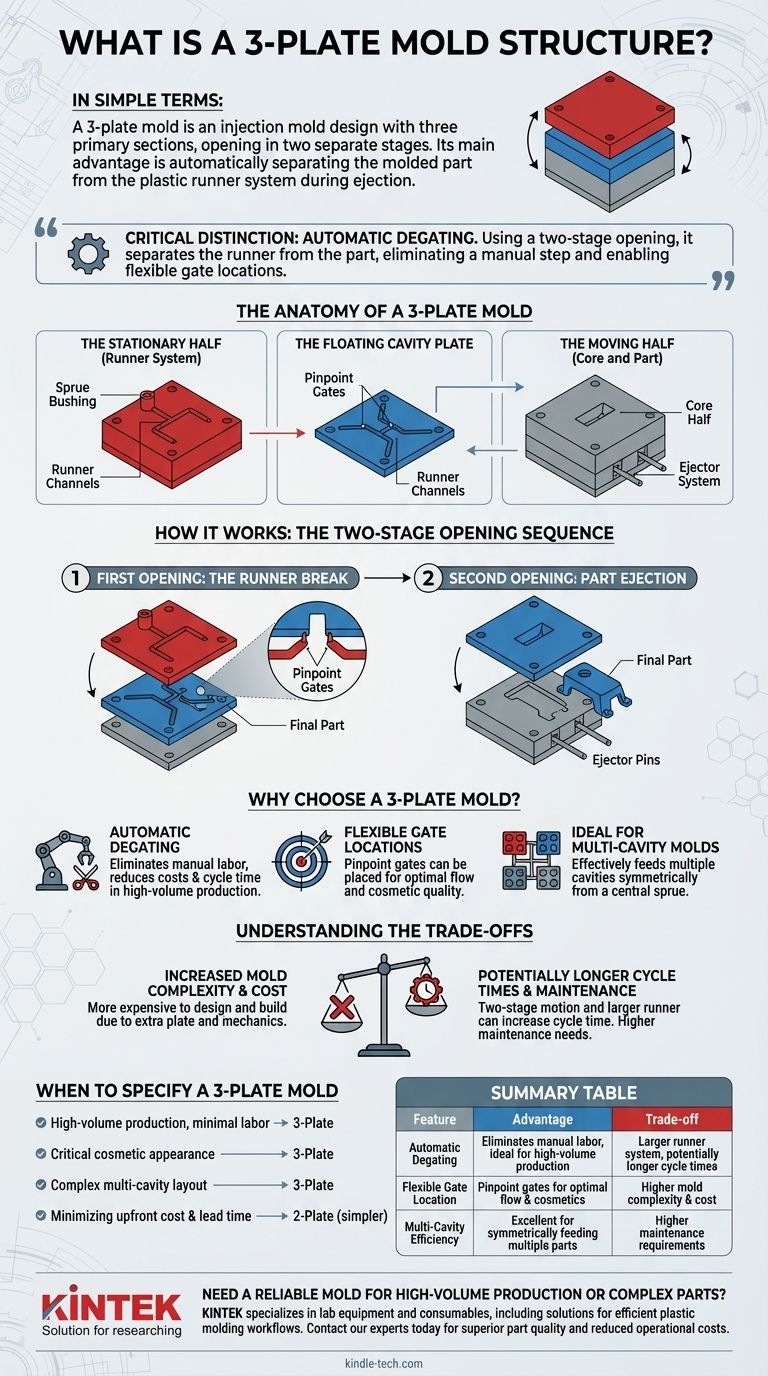
In simple terms, a 3-plate mold is an injection mold design constructed with three primary sections, or plates, that open in two separate stages. This structure is primarily used to automatically separate the molded part from its plastic runner system during the ejection process, which is its main advantage over a simpler 2-plate mold.
The critical distinction of a 3-plate mold is its ability to automatically degate parts. By using a two-stage opening sequence, it separates the runner system from the final part, eliminating a manual step and enabling more flexible gate locations.
The Anatomy of a 3-Plate Mold
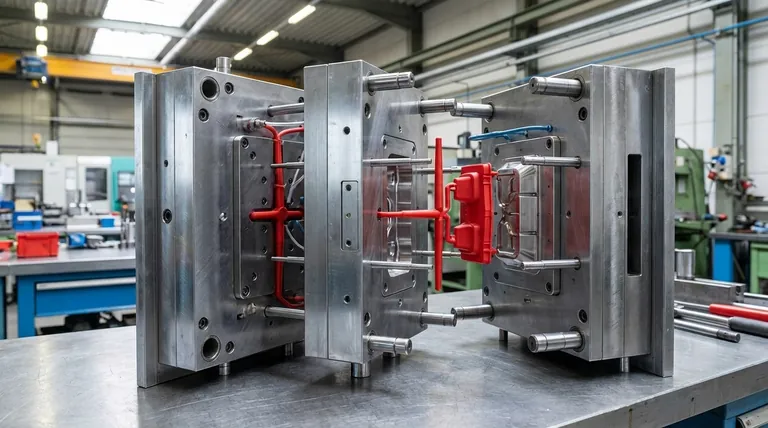
A standard injection mold has two halves that create one parting line. A 3-plate mold introduces a third major component, creating two parting lines. This is what enables its unique function.
The Stationary Half (Runner System)
This section, also known as the feed plate assembly, mounts to the stationary platen of the injection molding machine. It contains the sprue bushing where plastic first enters the mold and the primary channels of the runner system.
The Floating Cavity Plate
This is the intermediate plate and the defining feature of the design. It "floats" between the other two sections. It contains the secondary part of the runner system and the pinpoint gates that feed molten plastic directly into the part cavity.
The Moving Half (Core and Part)
This assembly mounts to the moving platen of the machine. It contains the core half of the part geometry and the ejector system that ultimately pushes the finished part out of the mold.
How It Works: The Two-Stage Opening Sequence
The genius of the 3-plate mold is not just its construction, but its sequential opening action.
First Opening: The Runner Break
As the molding machine's clamp begins to open, the first separation occurs between the stationary half and the floating cavity plate. This action pulls the tiny, frozen pinpoint gates away from the part, breaking them cleanly. The runner system is held on this side.
Second Opening: Part Ejection
After a set distance, the machine continues to open, creating a second separation between the floating cavity plate and the moving core half. This reveals the final part (or parts), which are now completely free of the runner system. The ejector pins then advance to push the part out of the mold.
Why Choose a 3-Plate Mold?
The added complexity of a 3-plate mold is justified by several key advantages that solve specific manufacturing challenges.
Automatic Degating
This is the single biggest benefit. Because the runner is separated from the part inside the mold, it eliminates the need for a person or a robot to manually clip the runner off each part. This dramatically reduces labor costs and cycle time in high-volume production.
Flexible Gate Locations
This design allows for the use of pinpoint gates, which can be placed almost anywhere on the surface of a part. This is ideal for cosmetic parts where a gate mark on the edge is unacceptable, or for parts that need to be filled from the center for optimal plastic flow.
Ideal for Multi-Cavity Molds
A 3-plate mold is very effective at feeding multiple cavities symmetrically from a central sprue. The runner system can branch out efficiently in the floating plate to ensure all cavities fill evenly.
Understanding the Trade-offs
Despite its advantages, a 3-plate mold is not always the right choice. Its complexity introduces clear trade-offs.
Increased Mold Complexity and Cost
The additional floating plate, more complex mechanics, and precise alignment features make a 3-plate mold significantly more expensive to design and build than a standard 2-plate mold.
Potentially Longer Cycle Times
While it saves labor after molding, the two-stage opening and closing motion can sometimes add a few seconds to the overall molding cycle. The runner system is also typically larger, requiring more plastic and longer cooling time.
Higher Maintenance Requirements
More moving parts and a more intricate design mean there is more potential for wear and tear. The small pinpoint gates can also be prone to damage or blockage, requiring more diligent maintenance and skilled technicians.
When to Specify a 3-Plate Mold
Choosing the right mold structure depends entirely on the priorities of your project.
- If your primary focus is high-volume production with minimal labor: A 3-plate mold is the superior choice for its automatic degating capabilities.
- If your part's cosmetic appearance is critical: The ability to place a tiny, clean pinpoint gate on a non-visible surface makes this design highly attractive.
- If you are running a complex multi-cavity layout: A 3-plate mold often provides the most balanced and efficient way to fill all parts simultaneously.
- If your primary focus is minimizing upfront tool cost and lead time: A simpler 2-plate mold is the more direct and economical solution.
Ultimately, selecting a 3-plate mold is a strategic decision to trade higher initial cost for lower long-term labor and greater design flexibility.
Summary Table:
| Feature | Advantage | Trade-off |
|---|---|---|
| Automatic Degating | Eliminates manual labor, ideal for high-volume production | Larger runner system, potentially longer cycle times |
| Flexible Gate Location | Pinpoint gates can be placed for optimal flow and cosmetics | Higher mold complexity and cost |
| Multi-Cavity Efficiency | Excellent for symmetrically feeding multiple parts | Higher maintenance requirements |
Need a reliable mold for high-volume production or complex parts? KINTEK specializes in lab equipment and consumables, including solutions for efficient plastic molding workflows. Our expertise ensures you get the right tooling for superior part quality and reduced operational costs. Contact our experts today to discuss how we can support your laboratory's injection molding needs.
Visual Guide
Related Products
- Double Plate Heating Press Mold for Lab
- Special Heat Press Mold for Lab Use
- Multi-Punch Rotary Tablet Press Mold Ring for Rotating Oval and Square Molds
- Carbon Graphite Plate Manufactured by Isostatic Pressing Method
- XRF & KBR steel ring lab Powder Pellet Pressing Mold for FTIR
People Also Ask
- How to use a press mold? Master the Art of Creating Consistent Ceramic Forms
- How to use a press mould? Master the Art of Consistent Ceramic Forms
- What is the primary function of mold pressing for LAGP powders? Achieve High-Performance Solid Electrolytes
- What is the difference between manual and automatic heat press? Choose the Right Press for Your Precision Needs
- What is the process of mold press? A Step-by-Step Guide to Compression Molding