Knowledge What is a fixed bed pyrolysis reactor? A Simple, Cost-Effective Solution for Biochar Production
Author avatar

Tech Team · Kintek Solution

Updated 1 week ago

What is a fixed bed pyrolysis reactor? A Simple, Cost-Effective Solution for Biochar Production


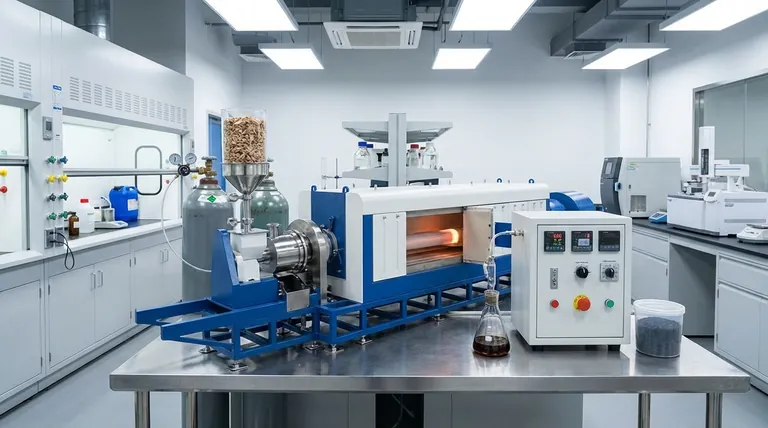
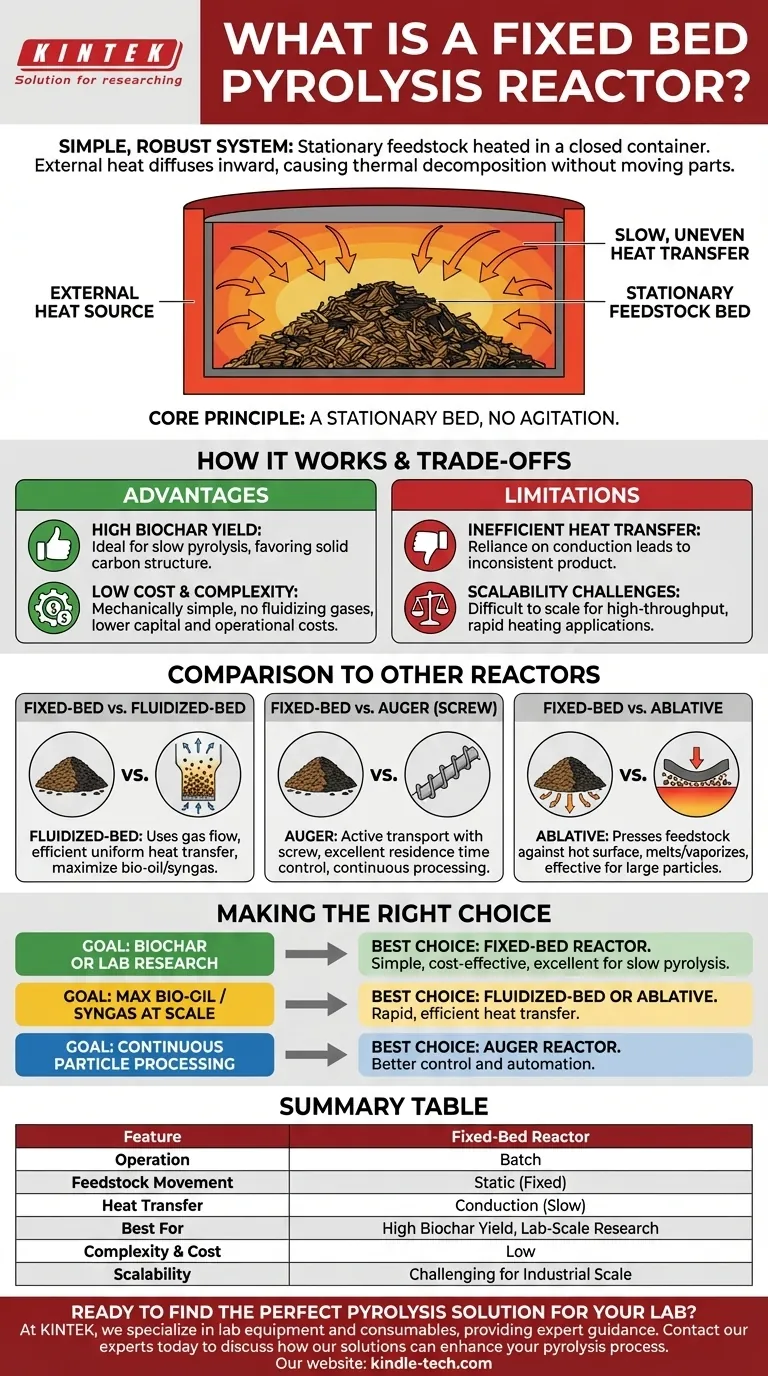
In essence, a fixed-bed pyrolysis reactor is a simple and robust system where a stationary mass of feedstock, or substrate, is heated in a closed container. Heat is applied to the outside of the vessel and slowly diffuses inward, causing the material to thermally decompose without the need for complex moving parts or fluidizing gases.

The defining characteristic of a fixed-bed reactor is its operational simplicity and static design. This makes it highly effective for producing solid biochar through slow pyrolysis but less efficient for generating liquid bio-oils at an industrial scale due to limitations in heat transfer.
What is a fixed bed pyrolysis reactor? A Simple, Cost-Effective Solution for Biochar Production

How the Fixed-Bed Reactor Works

A fixed-bed reactor is one of the most straightforward designs for pyrolysis, operating on a clear and direct principle.

The Core Principle: A Stationary Bed

The feedstock is loaded into the reactor, where it remains as a static, or "fixed," bed of material.

Unlike more dynamic systems, the particles are not agitated, circulated, or moved by mechanical means during the process.

The Heat Transfer Mechanism

Heat is supplied externally to the reactor walls. This thermal energy must then conduct and radiate from the hot walls through the packed bed of material.

This process is relatively slow and can lead to uneven temperature distribution, as particles closer to the walls get hotter faster than those in the center.

Inherent Simplicity

The design does not require a fluidizing agent like nitrogen gas or bed materials like sand. It also avoids complex internal mechanisms like rotating drums or augers.

This simplicity makes it easier and cheaper to construct and operate, particularly for smaller-scale or laboratory applications.

How Fixed-Bed Compares to Other Reactor Types

Understanding the fixed-bed reactor requires seeing it in context with other common pyrolysis technologies. Each design is optimized for different feedstocks, scales, and desired end products.

Fixed-Bed vs. Fluidized-Bed

A fluidized-bed reactor uses a flow of hot gas to suspend and agitate the feedstock particles, causing them to behave like a fluid.

This creates extremely efficient and uniform heat transfer, making it ideal for rapid pyrolysis to maximize the yield of bio-oil and syngas. The fixed-bed's static nature is comparatively slow.

Fixed-Bed vs. Auger (Screw) Reactor

An auger reactor uses a large, heated screw to actively transport the feedstock through a sealed chamber.

This provides excellent control over residence time and allows for continuous processing, whereas fixed-bed reactors are often operated in batches.

Fixed-Bed vs. Ablative Reactor

An ablative reactor works by pressing feedstock against a rapidly moving hot surface. The material effectively melts and vaporizes on contact.

This method is highly effective for large particles that would heat too slowly in a fixed-bed system, as it bypasses the need for heat to diffuse through the particle itself.

The Trade-offs of the Fixed-Bed Design

The simplicity of the fixed-bed reactor is both its greatest strength and its primary source of limitations.

Key Advantage: High Biochar Yield

The slow heating rates and longer residence times inherent to the fixed-bed design are ideal for slow pyrolysis.

This process favors the formation of a solid carbon structure, resulting in a higher yield of biochar compared to other reactor types.

Key Advantage: Low Cost and Complexity

With no major moving parts or requirements for fluidizing gases, these reactors are mechanically simple. This reduces both the initial capital cost and ongoing operational complexity.

Primary Limitation: Inefficient Heat Transfer

The reliance on conduction through a static bed is the reactor's main weakness. This can result in an inconsistent product and makes it difficult to process large volumes of material efficiently.

Primary Limitation: Scalability Challenges

The poor heat transfer characteristics make it very difficult to scale up fixed-bed reactors for high-throughput industrial applications, especially those targeting liquid fuels where rapid heating is critical.

Making the Right Choice for Your Goal

Selecting the correct reactor technology depends entirely on your primary objective, feedstock, and desired scale of operation.

  • If your primary focus is producing biochar or conducting lab-scale research: The fixed-bed reactor is an excellent, cost-effective choice due to its simplicity and effectiveness in slow pyrolysis.
  • If your primary focus is maximizing bio-oil or syngas yield at scale: A fluidized-bed or ablative reactor is far superior due to its rapid and efficient heat transfer capabilities.
  • If your primary focus is continuous processing of particulate matter: An auger reactor offers better control and automation for moving material through the system consistently.

Ultimately, choosing the right reactor is about matching the technology's inherent strengths to your specific production goals.

Summary Table:

Feature Fixed-Bed Reactor
Operation Batch
Feedstock Movement Static (Fixed)
Heat Transfer Conduction (Slow)
Best For High Biochar Yield, Lab-Scale Research
Complexity & Cost Low
Scalability Challenging for Industrial Scale

Ready to find the perfect pyrolysis solution for your lab?

At KINTEK, we specialize in lab equipment and consumables, providing expert guidance to help you select the right reactor technology for your specific research or production goals—whether you're focused on biochar, bio-oil, or syngas.

Contact our experts today to discuss how our solutions can enhance your pyrolysis process and drive your projects forward.

Visual Guide
What is a fixed bed pyrolysis reactor? A Simple, Cost-Effective Solution for Biochar Production Visual Guide

Related Products

People Also Ask

Related Products

Electric Rotary Kiln Small Rotary Furnace Biomass Pyrolysis Plant

Electric Rotary Kiln Small Rotary Furnace Biomass Pyrolysis Plant

Learn about Rotary Biomass Pyrolysis Furnaces & how they decompose organic material at high temps without oxygen. Use for biofuels, waste processing, chemicals & more.

Customizable High Pressure Reactors for Advanced Scientific and Industrial Applications

Customizable High Pressure Reactors for Advanced Scientific and Industrial Applications

This laboratory-scale high-pressure reactor is a high-performance autoclave engineered for precision and safety in demanding research and development environments.

High Pressure Laboratory Autoclave Reactor for Hydrothermal Synthesis

High Pressure Laboratory Autoclave Reactor for Hydrothermal Synthesis

Discover the applications of Hydrothermal Synthesis Reactor - a small, corrosion-resistant reactor for chemical labs. Achieve rapid digestion of insoluble substances in a safe and reliable way. Learn more now.

Stainless High Pressure Autoclave Reactor Laboratory Pressure Reactor

Stainless High Pressure Autoclave Reactor Laboratory Pressure Reactor

Discover the versatility of Stainless High Pressure Reactor - a safe and reliable solution for direct and indirect heating. Built with stainless steel, it can withstand high temperatures and pressures. Learn more now.

Mini SS High Pressure Autoclave Reactor for Laboratory Use

Mini SS High Pressure Autoclave Reactor for Laboratory Use

Mini SS High Pressure Reactor - Ideal for medicine, chemical, and scientific research industries. Programmed heating temp and stirring speed, up to 22Mpa pressure.

Inclined Rotary Plasma Enhanced Chemical Vapor Deposition PECVD Equipment Tube Furnace Machine

Inclined Rotary Plasma Enhanced Chemical Vapor Deposition PECVD Equipment Tube Furnace Machine

Upgrade your coating process with PECVD coating equipment. Ideal for LED, power semiconductors, MEMS and more. Deposits high-quality solid films at low temps.

Quartz Electrolytic Electrochemical Cell for Electrochemical Experiments

Quartz Electrolytic Electrochemical Cell for Electrochemical Experiments

Looking for a reliable quartz electrochemical cell? Our product boasts excellent corrosion resistance and complete specifications. With high-quality materials and good sealing, it's both safe and durable. Customize to meet your needs.

Cylindrical Resonator MPCVD Machine System Reactor for Microwave Plasma Chemical Vapor Deposition and Lab Diamond Growth

Cylindrical Resonator MPCVD Machine System Reactor for Microwave Plasma Chemical Vapor Deposition and Lab Diamond Growth

Learn about Cylindrical Resonator MPCVD Machine, the microwave plasma chemical vapor deposition method used for growing diamond gemstones and films in the jewelry and semi-conductor industries. Discover its cost-effective advantages over traditional HPHT methods.

Shaking Incubators for Diverse Laboratory Applications

Shaking Incubators for Diverse Laboratory Applications

Precision lab shaking incubators for cell culture & research. Quiet, reliable, customizable. Get expert advice today!

Optical Water Bath Electrolytic Electrochemical Cell

Optical Water Bath Electrolytic Electrochemical Cell

Upgrade your electrolytic experiments with our Optical Water Bath. With controllable temperature and excellent corrosion resistance, it's customizable for your specific needs. Discover our complete specifications today.

Microwave Plasma Chemical Vapor Deposition MPCVD Machine System Reactor for Lab and Diamond Growth

Microwave Plasma Chemical Vapor Deposition MPCVD Machine System Reactor for Lab and Diamond Growth

Get high-quality diamond films with our Bell-jar Resonator MPCVD machine designed for lab and diamond growth. Discover how Microwave Plasma Chemical Vapor Deposition works for growing diamonds using carbon gas and plasma.

Electrolytic Electrochemical Cell Gas Diffusion Liquid Flow Reaction Cell

Electrolytic Electrochemical Cell Gas Diffusion Liquid Flow Reaction Cell

Looking for a high-quality gas diffusion electrolysis cell? Our liquid flow reaction cell boasts exceptional corrosion resistance and complete specifications, with customizable options available to suit your needs. Contact us today!

Double-Layer Water Bath Electrolytic Electrochemical Cell

Double-Layer Water Bath Electrolytic Electrochemical Cell

Discover the temperature-controllable electrolytic cell with a double-layer water bath, corrosion resistance, and customization options. Complete specifications included.

Silicon Carbide SiC Thermal Heating Elements for Electric Furnace

Silicon Carbide SiC Thermal Heating Elements for Electric Furnace

Experience the advantages of Silicon Carbide (SiC) Heating Element: Long service life, high corrosion and oxidation resistance, fast heating speed, and easy maintenance. Learn more now!

RRDE rotating disk (ring disk) electrode / compatible with PINE, Japanese ALS, Swiss Metrohm glassy carbon platinum

RRDE rotating disk (ring disk) electrode / compatible with PINE, Japanese ALS, Swiss Metrohm glassy carbon platinum

Elevate your electrochemical research with our Rotating Disk and Ring Electrodes. Corrosion resistant and customizable to your specific needs, with complete specifications.

Thin-Layer Spectral Electrolysis Electrochemical Cell

Thin-Layer Spectral Electrolysis Electrochemical Cell

Discover the benefits of our thin-layer spectral electrolysis cell. Corrosion-resistant, complete specifications, and customizable for your needs.

Custom PTFE Teflon Parts Manufacturer PTFE Beaker and Lids

Custom PTFE Teflon Parts Manufacturer PTFE Beaker and Lids

The PTFE beaker is a laboratory container that is resistant to acid, alkali, high and low temperatures and is suitable for temperatures ranging from -200ºC to +250ºC. This beaker has excellent chemical stability and is widely used for heat treatment samples and volume analysis.

Molybdenum Disilicide (MoSi2) Thermal Elements Electric Furnace Heating Element

Molybdenum Disilicide (MoSi2) Thermal Elements Electric Furnace Heating Element

Discover the power of Molybdenum Disilicide (MoSi2) Heating Element for high-temperature resistance. Unique oxidation resistance with stable resistance value. Learn more about its benefits now!

Customizable PEM Electrolysis Cells for Diverse Research Applications

Customizable PEM Electrolysis Cells for Diverse Research Applications

Custom PEM test cell for electrochemical research. Durable, versatile, for fuel cells & CO2 reduction. Fully customizable. Get a quote!

Laboratory High Pressure Horizontal Autoclave Steam Sterilizer for Lab Use

Laboratory High Pressure Horizontal Autoclave Steam Sterilizer for Lab Use

The horizontal autoclave steam sterilizer adopts the gravity displacement method to remove the cold air in the inner chamber, so that the inner steam and cold air content is less, and the sterilization is more reliable.


Leave Your Message