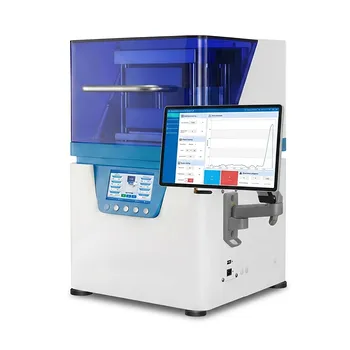
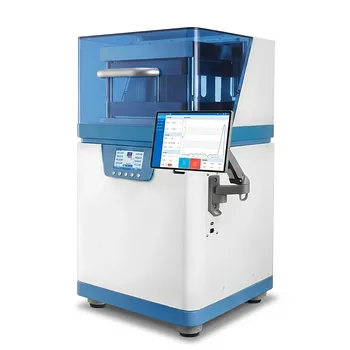
A laboratory hydraulic press is a critical tool for transforming loose active powders into standardized, dense electrode structures. It applies controlled, high-magnitude static pressure to compress mixtures of catalyst materials, conductive additives, and binders into solid pellets or uniform layers on current collectors. This process is essential for ensuring that the resulting sample reflects the intrinsic physical and electrochemical properties of the material rather than the inconsistencies of a loose powder.
The primary role of a hydraulic press in electrode preparation is to eliminate internal voids and maximize electrical contact between the active material and the current collector. By achieving a uniform density and thickness, researchers ensure that analytical data from techniques like XRD, XRF, and electrochemical cycling is both accurate and reproducible.
Enhancing Electrical and Structural Integrity
Reducing Interfacial and Contact Resistance
The hydraulic press applies significant pressure—often reaching several tons—to force active materials into tight mechanical contact with current collectors like copper foil or steel mesh. This compaction significantly reduces interfacial resistance, which is the electrical barrier between the catalyst and the substrate. Lower resistance is vital for high-current-density operations, as it ensures a more efficient flow of electrons during testing.
Improving Adhesion and Mechanical Stability
By compressing the active material layer onto substrates like nickel sheets or metal foams, the press enhances the bonding strength of the composite. This mechanical adhesion prevents the electrode material from delamination or peeling during long-term cyclic testing. A stable bond is especially critical in gas evolution reactions, where bubbles can otherwise physically dislodge poorly attached catalyst particles.
Eliminating Internal Voids
The high-pressure forming process effectively eliminates internal voids and air pockets within the electrode sheet. This creates a dense, continuous pathway for both electrons and ions to travel through the material. Consistent internal structure is the foundation for obtaining reliable data regarding the material's bulk resistivity and overall conductivity.
Ensuring Data Accuracy in Characterization
Sample Preparation for XRD and XRF
In material research, a press is used with stainless steel molds to compress powders into dense pellets for X-ray diffraction (XRD) and X-ray fluorescence (XRF). For XRD, this allows researchers to perform analysis at specific angles on a flat, uniform surface, capturing the overall physical properties of the material. In XRF, the press provides the high-volume, rapid sample preparation needed for non-destructive elemental analysis.
Geometric Precision for Network Analysis
Specialized precision molds allow the hydraulic press to create standardized ring-shaped specimens with exact dimensions (e.g., 3.04 mm inner diameter). This extreme level of geometric uniformity is vital for measurements using a Vector Network Analyzer. Any inconsistency in thickness or density would lead to data errors, making the press indispensable for high-frequency material characterization.
Representation of Intrinsic Properties
For in-situ gas or pressure testing, the press ensures tight mechanical contact with irregular collectors like steel mesh. This uniform distribution of current means the observed behavior represents the intrinsic properties of the catalyst. Without this uniform contact, the experimental results might merely be artifacts of poor electrical connectivity.
Understanding the Trade-offs
Pressure vs. Porosity
While high pressure improves electrical contact, excessive force can collapse the porosity of the electrode. This reduction in pore volume can limit the infiltration of electrolytes and hinder mass transport during electrochemical reactions. Researchers must carefully calibrate pressure to balance conductivity with the need for accessible surface area.
Substrate Deformation
Applying several tons of pressure can lead to the thinning or warping of delicate current collectors. If the substrate is deformed, it may create uneven current distribution or lead to mechanical failure during cell assembly. Selecting the appropriate mold material and pressure setting is critical to prevent damaging the underlying substrate.
Binder Sensitivity
High-pressure compaction can sometimes alter the distribution or physical state of polymeric binders like PTFE or PVDF. If the pressure is too high, the binder may form a non-conductive film that "insulates" the active particles, paradoxically increasing resistance. Understanding the mechanical limits of the specific binder used is essential for successful sample fabrication.
How to Apply This to Your Project
Making the Right Choice for Your Goal
To achieve the best results with a laboratory hydraulic press, the pressure and methodology should be tailored to the specific characterization technique required.
- If your primary focus is electrochemical performance: Use moderate pressure (e.g., 6–10 MPa) to ensure Ohmic contact between the catalyst and the current collector without sacrificing material porosity.
- If your primary focus is structural analysis (XRD/XRF): Utilize high-pressure molds to create the densest possible pellet, ensuring a flat surface and maximum particle packing for clear signal detection.
- If your primary focus is high-frequency testing (VNA): Use specialized precision molds to guarantee exact ring dimensions and uniform thickness to avoid geometric data artifacts.
- If your primary focus is high-current stability: Prioritize the compression of active materials onto irregular substrates like metal foam to maximize adhesion and prevent delamination.
The precise application of static pressure is the fundamental bridge between raw material synthesis and high-fidelity material characterization.
Summary Table:
| Application | Press Role | Key Benefit |
|---|---|---|
| Electrochemical Testing | Compaction onto current collectors | Reduces interfacial resistance and improves electron flow. |
| XRD / XRF Analysis | Compressing powders into dense pellets | Ensures a flat, uniform surface for accurate signal detection. |
| Mechanical Stability | Enhancing adhesion to metal foams/mesh | Prevents delamination and peeling during long-term cycling. |
| High-Frequency (VNA) | Precision geometric forming | Guarantees exact dimensions to eliminate data artifacts. |
Elevate Your Research Precision with KINTEK
Achieving high-fidelity material characterization starts with flawless sample preparation. KINTEK specializes in premium laboratory equipment designed for the rigors of modern materials science. Our extensive portfolio features specialized hydraulic presses (pellet, hot, and isostatic) perfect for creating standardized electrode structures, alongside essential tools like crushing and milling systems, high-temperature furnaces (muffle, vacuum, CVD), and high-pressure reactors.
Whether you are advancing battery research with our electrolytic cells or optimizing catalysts for XRD analysis, KINTEK provides the reliability and precision your lab demands.
Ready to enhance your data accuracy? Contact KINTEK today to find the perfect equipment solutions tailored to your specific research goals!
References
- Guangmeimei Yang, Andreas Kafizas. Elucidating the Effect of Nitrogen Occupancy on the Hydrogen Evolution Reaction for a Series of Titanium Oxynitride Electrocatalysts. DOI: 10.1002/cctc.202300687
This article is also based on technical information from Kintek Solution Knowledge Base .
Related Products
- Laboratory Hydraulic Press Lab Pellet Press Machine for Glove Box
- Laboratory Hydraulic Press Split Electric Lab Pellet Press
- Fully Automatic Heated Hydraulic Lab Press for Materials Sintering and Sample Preparation
- Automatic Laboratory Hydraulic Press for XRF & KBR Pellet Press
- Laboratory Hydraulic Press Lab Pellet Press for Button Battery
People Also Ask
- What is the function of a laboratory hydraulic press in W-Cu composites? Control Porosity and Material Ratio
- What is the role of a laboratory hydraulic press in the initial stages of Li6PS5Cl preparation? Key to Green Pellets
- What role does a laboratory hydraulic press play in triboelectric testing? Achieve Precision Alloy Sample Prep
- How can a laboratory hydraulic press be applied to chitosan for wastewater treatment? Optimize Pores & Strength
- How do a precision laboratory hydraulic press and specialized molds contribute to the fabrication of spherical ceramic samples? Achieving High-Density Material Precision