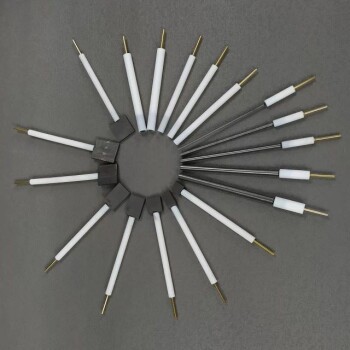
A three-electrode electrochemical cell system functions as a precision tool that isolates the specific electrochemical behavior of Titanium Nitride (TiN) films from external interference. By separating the current-carrying circuit from the voltage-measuring circuit, this configuration eliminates resistance-based errors, ensuring that the data collected reflects the true performance of the TiN sample rather than artifacts of the testing equipment.
The critical advantage of this system is the elimination of potential drops (IR drop) within the measurement circuit. This ensures that the potential applied to the TiN film is accurate and stable, which is essential for generating reliable potentiodynamic polarization curves and Electrochemical Impedance Spectroscopy (EIS) data.
The Architecture of Precision
To understand the benefit, you must understand how the three components interact to solve the problem of electrical noise and resistance.
The Role of the Working Electrode
The Working Electrode is the TiN sample itself. This is the material being stressed, tested, and evaluated.
In a simpler two-electrode setup, this electrode would have to handle both the current flow and the voltage sensing, leading to "muddied" data.
The Role of the Auxiliary (Counter) Electrode
The Auxiliary Electrode, typically made of an inert material like platinum, acts as the "sink" or "source" for current.
Its primary function is to complete the electrical circuit, carrying the full magnitude of the current required for the experiment. By designating a specific electrode for this heavy lifting, the system ensures the measurement side of the circuit remains undisturbed.
The Role of the Reference Electrode
The Reference Electrode (commonly a saturated calomel or Ag/AgCl electrode) provides a stable, unvarying potential baseline.
Because the current flows through the Auxiliary electrode, the Reference electrode experiences zero polarization. This allows it to act as a perfect "anchor" point, ensuring that any change in voltage recorded is purely a change in the TiN film, not the reference point itself.
Ensuring Data Integrity in 3.5% NaCl
When evaluating TiN films in corrosive environments like 3.5% NaCl solution, the accuracy provided by this setup is non-negotiable.
Accurate Potentiodynamic Polarization
To measure corrosion rates, researchers generate potentiodynamic polarization curves.
The three-electrode system ensures that the bias voltage applied targets the metal/electrolyte interface with absolute precision. Without this control, the resistance of the solution could distort the curve, leading to incorrect calculations of the film's corrosion lifespan.
Reliable Impedance Spectroscopy (EIS)
EIS measures how the TiN film resists electrical current over a range of frequencies.
This technique is highly sensitive. The three-electrode configuration prevents potential drops caused by current flow from influencing the impedance reading. This ensures the resulting data accurately characterizes the film's structural integrity and barrier properties.
Understanding the Trade-offs
While the three-electrode system is the standard for high-fidelity data, it introduces specific challenges that must be managed.
Increased Instrumentation Complexity
Unlike simple resistance measurements, this setup requires a potentiostat. This is a specialized electronic instrument capable of maintaining the potential of the working electrode with respect to the reference electrode, adding cost and complexity to the setup.
Reference Electrode Maintenance
The accuracy of the entire system hinges on the health of the Reference Electrode.
Whether using Calomel or Ag/AgCl, these components can drift over time, become contaminated, or dry out. If the reference potential shifts even slightly, the entire dataset collected for the TiN film becomes invalid and comparable to other studies.
Making the Right Choice for Your Goal
When designing your evaluation protocol for Titanium Nitride films, align your focus with the specific capabilities of this system.
- If your primary focus is Corrosion Resistance: Rely on the system's ability to eliminate voltage drops to generate accurate potentiodynamic polarization curves in NaCl solutions.
- If your primary focus is Coating Stability: Utilize the interference-free environment to conduct Electrochemical Impedance Spectroscopy (EIS) for detailed structural analysis.
- If your primary focus is Photo-response: Leverage the precise bias voltage control to measure photocurrent transient responses at specific film-forming potentials.
By isolating the potential of the working electrode, the three-electrode system transforms a noisy electrical environment into a source of definitive material science data.
Summary Table:
| Component | Role in Evaluation | Key Benefit |
|---|---|---|
| Working Electrode | TiN Sample | Isolates material-specific electrochemical behavior |
| Reference Electrode | Stable Baseline | Zero polarization ensures an accurate voltage anchor |
| Auxiliary Electrode | Current Sink/Source | Completes the circuit without disturbing measurement |
| Potentiostat | Control Interface | Maintains precise potential at the metal/electrolyte interface |
Elevate Your Material Analysis with KINTEK
Precision in TiN film evaluation requires high-performance hardware. KINTEK specializes in advanced laboratory equipment, providing the specialized electrolytic cells and electrodes necessary for high-fidelity electrochemical measurements.
Whether you are conducting corrosion studies in NaCl or detailed structural analysis via EIS, our comprehensive portfolio—including high-temperature reactors, vacuum furnaces, and precision crushing systems—is designed to support the most demanding research environments.
Ready to eliminate measurement errors and secure definitive data? Contact KINTEK Today for Expert Solutions
References
- Cintia de Laet Ravani Bottoni, Leonardo Cabral Gontijo. Electrochemical Behavior of Titanium Nitride Thin Films Deposited on Silicon by Plasma Discharge Technique in Cathodic Cage. DOI: 10.1590/1980-5373-mr-2015-0241
This article is also based on technical information from Kintek Solution Knowledge Base .
Related Products
- H Type Electrolytic Cell Triple Electrochemical Cell
- PTFE Electrolytic Cell Electrochemical Cell Corrosion-Resistant Sealed and Non-Sealed
- Electrolytic Electrochemical Cell with Five-Port
- Electrolytic Electrochemical Cell Gas Diffusion Liquid Flow Reaction Cell
- Multifunctional Electrolytic Electrochemical Cell Water Bath Single Layer Double Layer
People Also Ask
- What is a H type cell? A Guide to Divided Electrochemical Cells for Accurate Experiments
- How should the electrolyte be prepared and added to the H-type electrolytic cell? Best Practices for Purity and Safety
- What is the technical necessity of using an H-type electrolytic cell for NO3RR tests? Protect Your Ammonia Yields
- How does the design of an H-type electrolytic cell benefit the neutral water electrolysis process for metal recovery?
- What is the primary function of an H-type electrolytic cell in NitRR? Ensure Accurate Product Yields