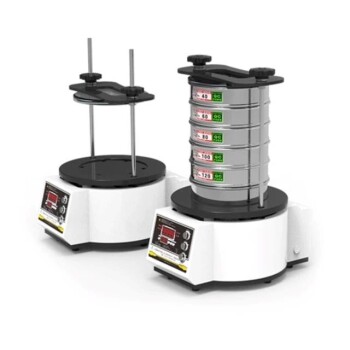
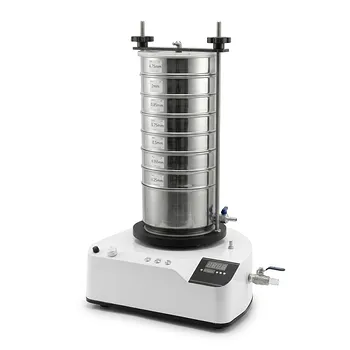
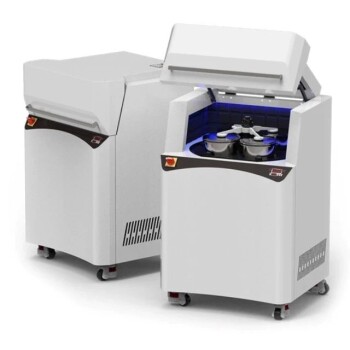
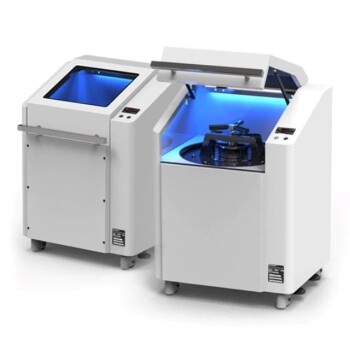
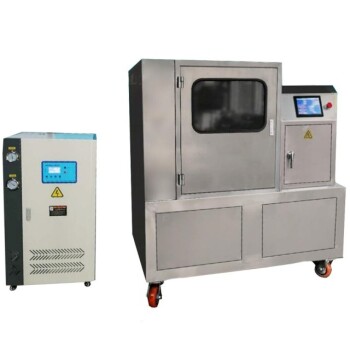
The vibrating sieve functions as the critical standardization checkpoint in the preparation of lignocellulosic biomass for autohydrolysis. Its primary role is to precisely grade mechanically crushed raw materials, strictly isolating particles within a specific size range (such as 0.25 to 0.40 mm) to ensure physical homogeneity before the material enters the reactor.
By eliminating variations in particle size, the vibrating sieve ensures that heat and moisture interact identically with every unit of biomass. This consistency is the foundation of experimental accuracy, preventing skewed data caused by physical irregularities rather than chemical properties.
The Mechanics of Standardization
Precision Grading
After biomass is mechanically crushed, the resulting material is naturally chaotic, consisting of various shapes and sizes.
Defining the Range
The vibrating sieve classifies this raw output, acting as a filter that only allows particles within a defined dimension (e.g., 0.25 to 0.40 mm or approximately 100 mesh) to pass through to the next stage.
Eliminating Physical Variables
This mechanical separation removes size as a variable in your experiment. It ensures that the only changes you observe during autohydrolysis are due to chemical reactions, not inconsistent feedstock.
Why Particle Consistency Matters for Autohydrolysis
Uniform Heat Transfer
Autohydrolysis is a thermal process. Uniform particle size allows heat to penetrate the biomass feedstock evenly across the entire batch.
Consistent Moisture Penetration
For the reaction to be effective, water (or steam) must saturate the lignocellulosic structure. Consistent particle dimensions ensure moisture penetrates every fiber at the same rate.
Maximizing Reaction Efficiency
When heat and moisture access the material uniformly, the entire batch reacts simultaneously. This prevents "hot spots" or "dead zones" within the reactor.
The Risks of Inconsistent Particle Size
The Danger of Over-Pyrolysis
If particles are too small (fines), they heat up too quickly. This can lead to localized over-pyrolysis, where valuable components degrade into unwanted byproducts before the rest of the batch is ready.
The Issue of Incomplete Degradation
If particles are too large, heat and moisture cannot penetrate to the core in time. This results in incomplete degradation, leaving unreacted raw material that lowers yield and confuses data analysis.
Compromised Repeatability
Without a vibrating sieve, two experiments run under identical conditions will yield different results. Sieving guarantees that the physical surface area available for reaction remains constant from batch to batch.
Making the Right Choice for Your Goal
To ensure the success of your autohydrolysis process, consider the following regarding particle sizing:
- If your primary focus is Experimental Accuracy: Strictly enforce a narrow particle size range (e.g., 0.25–0.40 mm) to guarantee that any variance in results is due to process conditions, not feedstock irregularity.
- If your primary focus is Process Efficiency: Use the sieve to remove fines and oversized chunks to prevent the dual inefficiencies of over-burning and under-reacting.
Standardizing your feedstock through precise sieving is the single most effective step you can take to ensure valid, reproducible autohydrolysis data.
Summary Table:
| Feature | Impact on Autohydrolysis | Benefit to Researcher |
|---|---|---|
| Precision Grading | Isolates particles (e.g., 0.25-0.40 mm) | Eliminates physical size as a variable |
| Uniform Heat Transfer | Even thermal penetration across the batch | Prevents localized over-pyrolysis/burning |
| Consistent Saturation | Simultaneous moisture/steam penetration | Ensures complete degradation of fibers |
| Size Standardization | Maintains constant reactive surface area | Guarantees batch-to-batch repeatability |
Elevate Your Biomass Research with KINTEK Precision
Achieving reproducible autohydrolysis results starts with flawless material preparation. KINTEK specializes in high-performance sieving equipment, crushing systems, and milling solutions designed to provide the physical homogeneity your experiments demand.
Beyond preparation, our comprehensive portfolio supports your entire workflow with:
- High-Temperature & High-Pressure Reactors and Autoclaves for seamless autohydrolysis.
- Rotary & Vacuum Furnaces for advanced thermal processing.
- PTFE & Ceramic Consumables to maintain sample purity.
Don't let inconsistent particle sizes compromise your data. Partner with KINTEK for laboratory equipment that delivers precision at every stage. Contact our technical experts today to optimize your lab setup!
References
- Rita Pontes, João Nunes. Comparative autohydrolysis study of two mixtures of forest and marginal land resources for co-production of biofuels and value-added compounds. DOI: 10.1016/j.renene.2018.05.055
This article is also based on technical information from Kintek Solution Knowledge Base .
Related Products
- Vibratory Sieve Shaker Machine Dry Three-Dimensional Vibrating Sieve
- Laboratory Vibratory Sieve Shaker Machine Slap Vibrating Sieve
- Laboratory Wet Three-Dimensional Vibratory Sieve Shaker Machine
- Laboratory Test Sieves and Vibratory Sieve Shaker Machine
- Laboratory Vibratory Sieve Shaker Machine for Dry and Wet Three-Dimensional Sieving
People Also Ask
- How is a vibratory sieve shaker used in the particle size analysis of mechanically alloyed powders? Expert Guide
- Why use a vibratory sieve shaker for PET powder? Achieve Precise Particle Size Control for Chemical Research
- What is the principle of vibratory sieve shaker? Achieve Accurate Particle Size Analysis
- What is the function of a vibratory sieve shaker? Achieve Precise Particle Size Analysis
- What is the use of vibratory sieve shaker? Achieve Precise Particle Size Analysis for Your Lab