Knowledge Resources What is the difference between a furnace and an oven in a laboratory? Choose the Right Tool for Your Lab's Heat Needs
Author avatar

Tech Team · Kintek Solution

Updated 2 months ago

What is the difference between a furnace and an oven in a laboratory? Choose the Right Tool for Your Lab's Heat Needs


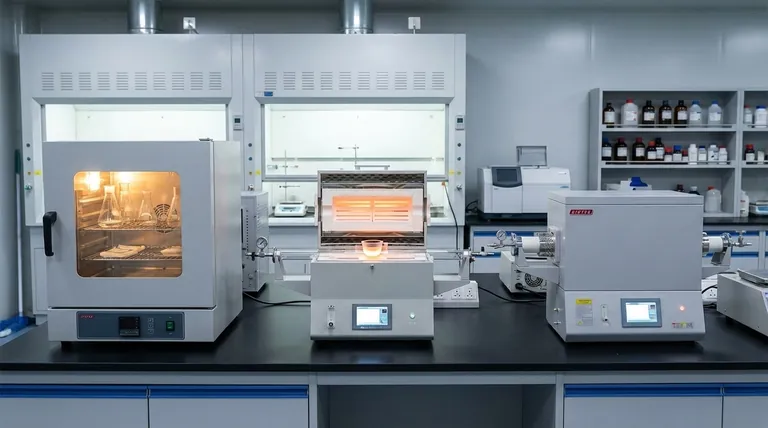
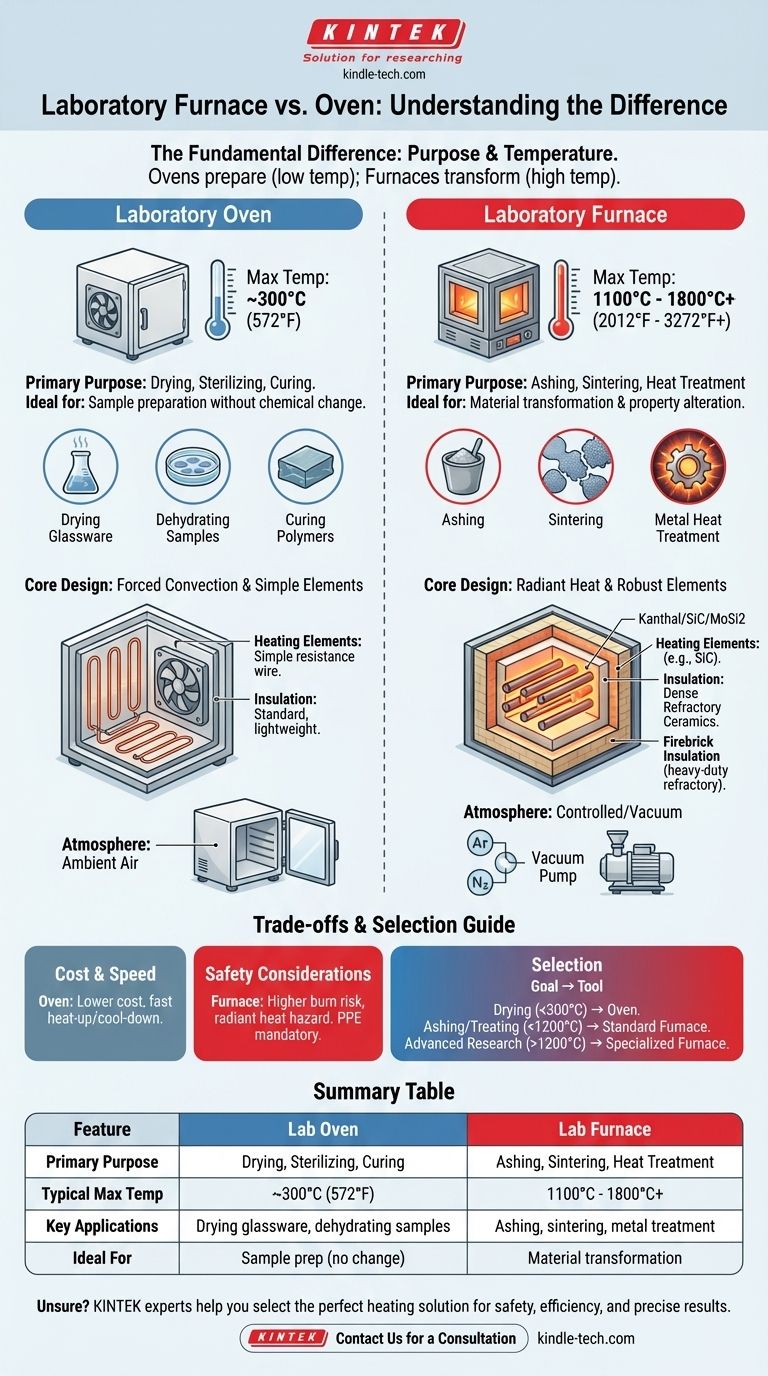
The fundamental difference between a laboratory furnace and an oven is their maximum achievable temperature and, consequently, their intended application. An oven is designed for lower-temperature tasks like drying, sterilizing, and curing, while a furnace generates the extreme heat required to fundamentally alter a material's properties, such as in metallurgy or ceramics.

While both are essentially insulated boxes that get hot, the distinction is not about degree, but about purpose. An oven uses heat to prepare a sample, whereas a furnace uses heat to transform it.
What is the difference between a furnace and an oven in a laboratory? Choose the Right Tool for Your Lab's Heat Needs

The Defining Factor: Temperature Range and Purpose

The operational temperature range is the most critical distinction. This difference in heat capability dictates the types of processes each instrument can perform.

Laboratory Ovens: Low-Temperature Precision

A laboratory oven typically operates at temperatures from just above ambient to around 300°C (572°F).

Their primary function is to remove moisture or cure materials at controlled, relatively low temperatures. Common applications include drying glassware, dehydrating samples for analysis, sterilizing equipment, or curing polymers and epoxies.

Most lab ovens use forced convection, where a fan circulates hot air to ensure uniform temperature distribution, which is critical for sensitive processes.

Laboratory Furnaces: High-Temperature Transformation

A laboratory furnace, often called a muffle furnace, is built for high-temperature work, frequently reaching 1100°C (2012°F) and with specialized models exceeding 1800°C (3272°F).

This intense heat is used for processes that change a material’s chemical or physical structure. Key applications include ashing (burning off organic matter), sintering (fusing ceramic powders), calcination (high-temperature decomposition), and the heat treatment of metals like annealing or hardening.

How They Work: Core Design Differences

The vast temperature gap between ovens and furnaces necessitates fundamentally different designs in their construction, heating elements, and insulation.

Heating Elements and Insulation

Ovens use simple resistance wire elements, which are sufficient for their temperature range. Furnaces require more robust heating elements made of materials like Kanthal (FeCrAl alloy), silicon carbide (SiC), or molybdenum disilicide (MoSi2) to withstand extreme temperatures.

Similarly, furnace insulation is far more substantial. It consists of dense refractory ceramics and firebrick designed to contain intense heat safely and efficiently, resulting in much thicker walls and greater thermal mass compared to a standard oven.

Construction and Materials

An oven is typically constructed from stainless steel and is relatively lightweight. A furnace is a heavy-duty piece of equipment with a robust, often powder-coated steel exterior and a dense ceramic interior chamber (the "muffle") that protects the heating elements from contamination.

Atmospheric Control

While most ovens operate in ambient air, many furnace applications require a controlled atmosphere to prevent oxidation at high temperatures. These furnaces may include ports for introducing inert gases like argon or nitrogen, or even be designed to operate under a vacuum.

Understanding the Trade-offs

Choosing between an oven and a furnace involves clear trade-offs in performance, cost, and safety.

Cost and Energy Consumption

Furnaces are significantly more expensive to purchase and operate than ovens. Their power consumption is substantially higher due to the energy required to reach and maintain extreme temperatures.

Heat-Up and Cool-Down Rates

An oven can heat up and cool down relatively quickly. A furnace, due to its massive thermal mass from the heavy insulation, heats up much more slowly and can take many hours, or even days, to cool back to room temperature safely.

Safety Considerations

Both instruments pose burn risks, but the hazards associated with a furnace are more severe. The extreme temperatures present a significant radiant heat hazard, and mishandling materials at over 1000°C can be catastrophic. Proper personal protective equipment (PPE), including heat-resistant gloves and face shields, is non-negotiable.

Selecting the Right Equipment for Your Application

Use your end goal to determine the correct instrument for your process.

  • If your primary focus is drying, curing, or sterilizing below 300°C: A laboratory oven offers the necessary precision and efficiency.
  • If your primary focus is ashing organic material or performing basic metal heat treating up to 1200°C: A standard muffle furnace is the correct choice.
  • If your primary focus is advanced materials research with ceramics or exotic alloys above 1200°C: You will require a specialized high-temperature furnace with appropriate heating elements and atmospheric controls.

Understanding the purpose behind the heat is the key to selecting the right tool for your scientific work.

Summary Table:

Feature Laboratory Oven Laboratory Furnace
Primary Purpose Drying, Sterilizing, Curing Ashing, Sintering, Heat Treatment
Typical Max Temp ~300°C (572°F) 1100°C to 1800°C+ (2012°F to 3272°F+)
Key Applications Drying glassware, dehydrating samples, curing polymers Ashing, sintering powders, calcination, metal treatment
Ideal For Sample preparation without chemical change Material transformation and property alteration

Unsure whether your lab needs an oven or a furnace? KINTEK specializes in lab equipment and consumables, serving laboratory needs. Our experts can help you select the perfect heating solution for your specific application, ensuring safety, efficiency, and precise results. Contact us today for a personalized consultation and discover the KINTEK difference!

Visual Guide
What is the difference between a furnace and an oven in a laboratory? Choose the Right Tool for Your Lab's Heat Needs Visual Guide

Related Products

People Also Ask

Related Products

1200℃ Muffle Furnace Oven for Laboratory

1200℃ Muffle Furnace Oven for Laboratory

Upgrade your lab with our 1200℃ Muffle Furnace. Achieve fast, precise heating with Japan alumina fibers and Molybdenum coils. Features TFT touch screen controller for easy programming and data analysis. Order now!

Vertical Laboratory Tube Furnace

Vertical Laboratory Tube Furnace

Elevate your experiments with our Vertical Tube Furnace. Versatile design allows for operation under various environments and heat treatment applications. Order now for precise results!

1700℃ Laboratory High Temperature Tube Furnace with Alumina Tube

1700℃ Laboratory High Temperature Tube Furnace with Alumina Tube

Looking for a high-temperature tube furnace? Check out our 1700℃ Tube Furnace with Alumina Tube. Perfect for research and industrial applications up to 1700C.

Laboratory Vacuum Tilt Rotary Tube Furnace Rotating Tube Furnace

Laboratory Vacuum Tilt Rotary Tube Furnace Rotating Tube Furnace

Discover the versatility of Laboratory Rotary Furnace: Ideal for calcination, drying, sintering, and high-temperature reactions. Adjustable rotating and tilting functions for optimal heating. Suitable for vacuum and controlled atmosphere environments. Learn more now!

1200℃ Split Tube Furnace with Quartz Tube Laboratory Tubular Furnace

1200℃ Split Tube Furnace with Quartz Tube Laboratory Tubular Furnace

KT-TF12 split tube furnace: high-purity insulation, embedded heating wire coils, and max. 1200C. Widely used for new materials and chemical vapour deposition.

1700℃ Muffle Oven Furnace for Laboratory

1700℃ Muffle Oven Furnace for Laboratory

Get superior heat control with our 1700℃ Muffle Furnace. Equipped with intelligent temperature microprocessor, TFT touch screen controller & advanced insulation materials for precise heating up to 1700C. Order now!

1400℃ Muffle Oven Furnace for Laboratory

1400℃ Muffle Oven Furnace for Laboratory

Get precise high-temperature control up to 1500℃ with KT-14M Muffle furnace. Equipped with a smart touch screen controller and advanced insulation materials.

High Temperature Muffle Oven Furnace for Laboratory Debinding and Pre Sintering

High Temperature Muffle Oven Furnace for Laboratory Debinding and Pre Sintering

KT-MD High temperature debinding and pre-sintering furnace for ceramic materials with various molding processes. Ideal for electronic components such as MLCC and NFC.

Lab-Scale Vacuum Induction Melting Furnace

Lab-Scale Vacuum Induction Melting Furnace

Get precise alloy composition with our Vacuum Induction Melting Furnace. Ideal for aerospace, nuclear energy, and electronic industries. Order now for effective smelting and casting of metals and alloys.

Multi-zone Laboratory Tube Furnace

Multi-zone Laboratory Tube Furnace

Experience precise, efficient thermal testing with our Multi Zone Tube Furnace. Independent heating zones and temperature sensors allow for controlled high-temperature gradient heating fields. Order now for advanced thermal analysis!

Laboratory Rapid Thermal Processing (RTP) Quartz Tube Furnace

Laboratory Rapid Thermal Processing (RTP) Quartz Tube Furnace

Get lightning-fast heating with our RTP Rapid Heating Tube Furnace. Designed for precise, high-speed heating and cooling with convenient sliding rail and TFT touch screen controller. Order now for ideal thermal processing!

Laboratory Muffle Oven Furnace Bottom Lifting Muffle Furnace

Laboratory Muffle Oven Furnace Bottom Lifting Muffle Furnace

Efficiently produce batches with excellent temperature uniformity using our Bottom Lifting Furnace. Features two electric lifting stages and advanced temperature control up to 1600℃.

Graphite Vacuum Furnace IGBT Experimental Graphitization Furnace

Graphite Vacuum Furnace IGBT Experimental Graphitization Furnace

IGBT experimental graphitization furnace, a tailored solution for universities and research institutions, with high heating efficiency, user-friendliness, and precise temperature control.

Small Vacuum Heat Treat and Tungsten Wire Sintering Furnace

Small Vacuum Heat Treat and Tungsten Wire Sintering Furnace

The small vacuum tungsten wire sintering furnace is a compact experimental vacuum furnace specially designed for universities and scientific research institutes. The furnace features a CNC welded shell and vacuum piping to ensure leak-free operation. Quick-connect electrical connections facilitate relocation and debugging, and the standard electrical control cabinet is safe and convenient to operate.

Vertical High Temperature Graphite Vacuum Graphitization Furnace

Vertical High Temperature Graphite Vacuum Graphitization Furnace

Vertical high temperature graphitization furnace for carbonization and graphitization of carbon materials up to 3100℃.Suitable for shaped graphitization of carbon fiber filaments and other materials sintered in a carbon environment.Applications in metallurgy, electronics, and aerospace for producing high-quality graphite products like electrodes and crucibles.

1700℃ Controlled Atmosphere Furnace Nitrogen Inert Atmosphere Furnace

1700℃ Controlled Atmosphere Furnace Nitrogen Inert Atmosphere Furnace

KT-17A Controlled atmosphere furnace: 1700℃ heating, vacuum sealing technology, PID temperature control, and versatile TFT smart touch screen controller for laboratory and industrial use.

Controlled Nitrogen Inert Hydrogen Atmosphere Furnace

Controlled Nitrogen Inert Hydrogen Atmosphere Furnace

KT-AH Hydrogen atmosphere furnace - induction gas furnace for sintering/annealing with built-in safety features, dual housing design, and energy-saving efficiency. Ideal for lab and industrial use.

Ultra-High Temperature Graphite Vacuum Graphitization Furnace

Ultra-High Temperature Graphite Vacuum Graphitization Furnace

The ultra-high temperature graphitization furnace utilizes medium frequency induction heating in a vacuum or inert gas environment. The induction coil generates an alternating magnetic field, inducing eddy currents in the graphite crucible, which heats up and radiates heat to the workpiece, bringing it to the desired temperature. This furnace is primarily used for graphitization and sintering of carbon materials, carbon fiber materials, and other composite materials.

1200℃ Controlled Atmosphere Furnace Nitrogen Inert Atmosphere Furnace

1200℃ Controlled Atmosphere Furnace Nitrogen Inert Atmosphere Furnace

Discover our KT-12A Pro Controlled atmosphere furnace - high precision, heavy duty vacuum chamber, versatile smart touch screen controller, and excellent temperature uniformity up to 1200C. Ideal for both laboratory and industrial application.

Graphite Vacuum Furnace Bottom Discharge Graphitization Furnace for Carbon Materials

Graphite Vacuum Furnace Bottom Discharge Graphitization Furnace for Carbon Materials

Bottom-out graphitization furnace for carbon materials, ultra-high temperature furnace up to 3100°C, suitable for graphitization and sintering of carbon rods and carbon blocks. Vertical design, bottom discharging, convenient feeding and discharging, high temperature uniformity, low energy consumption, good stability, hydraulic lifting system, convenient loading and unloading.


Leave Your Message



















