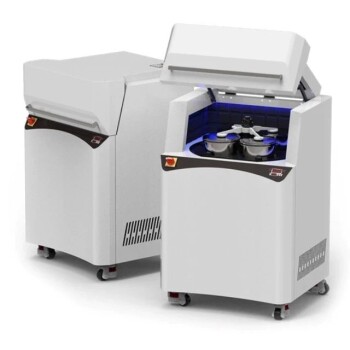
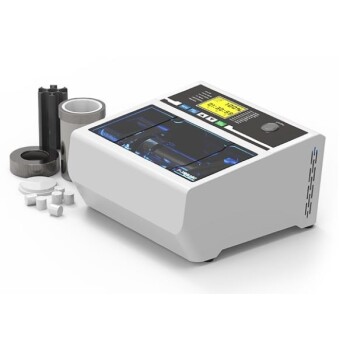
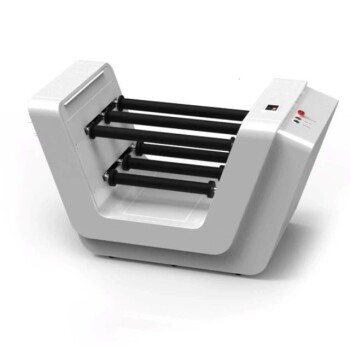
The fundamental difference between a bead mill and a ball mill lies in the size of the grinding media they use and, consequently, the final particle size they can achieve. Bead mills use very small media (beads, <2 mm) to produce sub-micron or nano-sized particles, whereas ball mills use much larger media (balls, >3 mm) for grinding materials down to the micron scale. This single distinction in media dictates their design, operating principle, and ideal applications.
Your choice between a bead mill and a ball mill is determined by your target particle size. Use a ball mill for coarse grinding to produce micron-sized powders, and use a bead mill for fine grinding to create sub-micron or nanoscale dispersions.
The Core Principle: Mechanical Attrition
Both bead and ball mills operate on the same fundamental principle: reducing particle size through mechanical forces. Inside a chamber, grinding media (balls or beads) are agitated with the material to be milled.
How It Works: Impact and Shear
The particles are broken down by two primary forces. Impact occurs when media collide with the particles, shattering them. Shear (or attrition) occurs when particles are caught and crushed between moving media.
The size, density, and speed of the media determine the balance of these forces and the efficiency of the grinding process.
The Defining Factor: Grinding Media
The single most important differentiator between these two technologies is the media. Everything about the mill's design and function flows from this choice.
Ball Mills: The Power of Mass
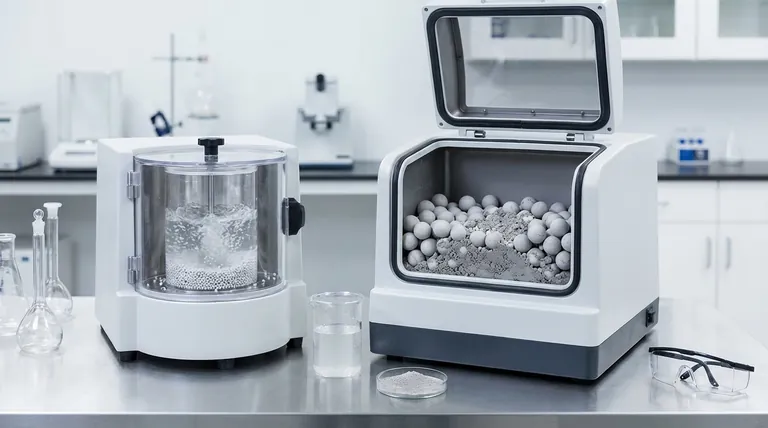
A ball mill is typically a rotating cylindrical drum filled with large grinding media—the "balls." These balls can be made of steel, ceramic, or rubber.
As the drum rotates, the balls are lifted up the side and then cascade down, crushing the material through high-impact forces. This makes them ideal for breaking down larger, harder materials from scratch. The different types, such as planetary or horizontal rolling mills, simply alter how this motion is generated.
Bead Mills: The Finesse of Surface Area
A bead mill does not tumble. Instead, it uses a high-speed agitator shaft to churn a chamber filled with vast quantities of tiny grinding media—the "beads."
These beads are typically 0.1 mm to 2 mm in diameter and made of ceramic materials like zirconia or glass. The high speed and small media size create an intense zone of high-energy shear and countless low-energy impacts, which is perfect for dispersing and grinding pre-milled materials into a very fine liquid slurry.
Key Operational Differences
The difference in media and agitation method leads to very different operational characteristics and applications.
Achievable Particle Size
This is the most critical difference. Ball mills are effective for grinding down to a few microns (~5-10 µm). Bead mills are specifically designed for fine grinding, routinely achieving particle sizes in the sub-micron and nanometer range (<1 µm).
Process Type: Batch vs. Continuous
Ball mills are very well-suited for batch processing. You load the material and media, run the mill for a set time, and then discharge the entire batch.
Bead mills are designed for continuous or recirculation processing. A slurry (pre-mix) is continuously pumped through the grinding chamber, allowing for tight control over the final particle size distribution and high-volume production.
Energy and Agitation
A ball mill's energy comes from the gravitational force of the large, tumbling balls. The process is relatively low-speed and low-energy compared to its counterpart.
A bead mill's energy is imparted by a high-speed agitator shaft, creating a very high-energy-density environment. This intense agitation is necessary to activate the tiny beads.
Understanding the Trade-offs
Choosing the wrong mill for your application will lead to inefficiency, contamination, or failure to meet product specifications.
Feed Material Requirements
A ball mill's high-impact force allows it to handle coarse, dry, or hard raw materials. You can often feed it large particles directly.
A bead mill requires the feed material to be a low-viscosity liquid slurry or pre-dispersion. The particles must already be small enough to fit between the tiny beads, otherwise the mill will clog instantly.
Heat Generation and Control
The intense energy in a bead mill generates significant heat, which can damage sensitive products. Because of this, bead mills almost always require an integrated cooling system, such as a cooling jacket.
While ball mills do generate heat, it is far less concentrated and often dissipates without the need for active cooling, especially in smaller lab models.
Contamination Risk
In any milling process, the media and chamber walls wear down, potentially contaminating the product. In ball mills using steel media, metal contamination is a common concern. Bead mills typically use highly durable ceramic media (like yttria-stabilized zirconia) to minimize this, which is critical for applications like inks, pharmaceuticals, and cosmetics.
Making the Right Choice for Your Goal
Select your milling technology based on your starting material and, most importantly, your desired final product characteristics.
- If your primary focus is breaking down raw ore or hard ceramics into a fine powder (micron-sized): A ball mill is the correct tool due to its high impact force.
- If your primary focus is creating a stable, high-performance nano-dispersion for inks, coatings, or pharmaceuticals: A bead mill is the only technology that can efficiently achieve this goal.
- If your primary focus is processing a dry powder in a batch operation: A ball mill is almost always the appropriate choice.
- If your primary focus is high-volume, continuous production of a liquid-based product: The process design of a bead mill is engineered for this exact purpose.
Ultimately, understanding that the size of your grinding media directly dictates the achievable particle size is the key to selecting the correct milling technology for your specific outcome.
Summary Table:
| Feature | Bead Mill | Ball Mill |
|---|---|---|
| Grinding Media Size | Small beads (0.1 - 2 mm) | Large balls (>3 mm) |
| Primary Force | High-Energy Shear | High-Impact Force |
| Achievable Particle Size | Sub-micron / Nanometer (<1 µm) | Micron scale (~5-10 µm) |
| Typical Process | Continuous / Recirculation | Batch |
| Ideal For | Liquid slurries, nano-dispersions | Dry or wet powders, coarse grinding |
Still Unsure Which Mill is Right for Your Application?
Choosing the correct milling technology is critical for achieving your target particle size and product quality. The experts at KINTEK are here to help. We specialize in providing high-quality lab equipment, including both bead mills and ball mills, tailored to your specific research and production needs in pharmaceuticals, materials science, and chemical processing.
Let us help you optimize your process. Contact our technical team today for a personalized consultation and discover the KINTEK difference in precision and performance.
Visual Guide

Related Products
- Laboratory High Throughput Tissue Grinding Mill Grinder
- Vibrating Disc Mill Small Laboratory Grinding Machine
- Laboratory Hybrid Tissue Grinding Mill
- Laboratory Micro Tissue Grinding Mill Grinder
- Laboratory Ball Mill Jar Mill with Metal Alloy Grinding Jar and Balls
People Also Ask
- What are the components of a grinding mill? Understand the Core Systems for Efficient Comminution
- Why is laboratory crushing or grinding equipment necessary for fluoride waste? Optimize Glass Matrix Vitrification
- What is the role of laboratory-grade grinders and sieves in sample prep? Ensure High-Precision Corrosion Analysis
- What does a grinder do in a laboratory? Achieve Homogeneous Sample Preparation for Accurate Analysis
- What is the purpose of using a laboratory grinder and standard sieves? Unlock Precise Rice Husk Pretreatment