Knowledge What is the difference between hot air oven and laboratory incubator? Choose the Right Thermal Instrument
Author avatar

Tech Team · Kintek Solution

Updated 6 days ago

What is the difference between hot air oven and laboratory incubator? Choose the Right Thermal Instrument


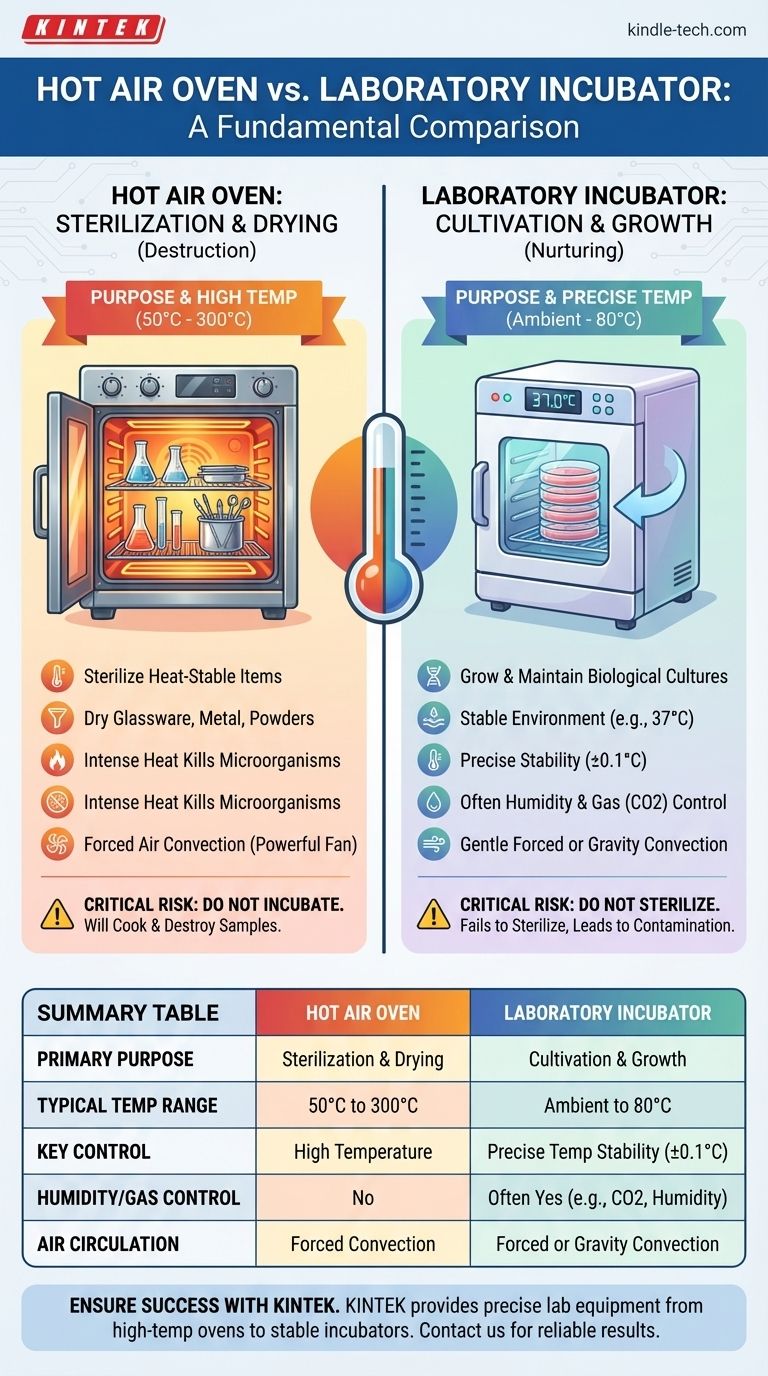
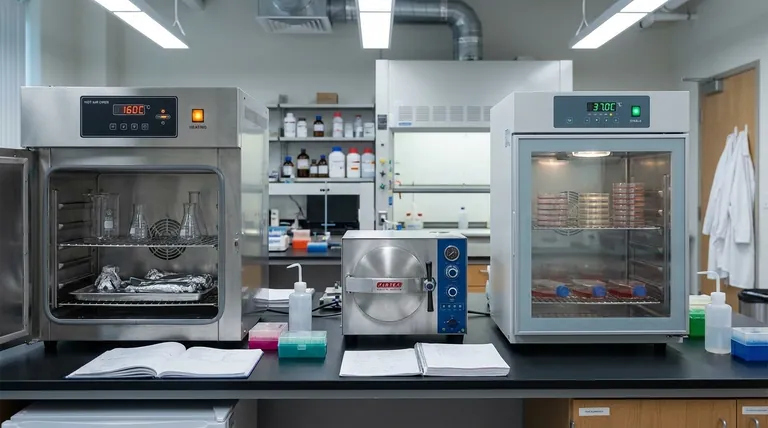
At a fundamental level, the difference between a hot air oven and a laboratory incubator is their intended purpose, which dictates their operating temperature range. A hot air oven uses very high temperatures (typically 50°C to 300°C) for sterilization and drying. In contrast, a laboratory incubator uses a much lower, precisely controlled temperature range (often near ambient to 80°C) to grow and maintain biological cultures.

Choosing between them isn't about which is "better," but about their opposing functions. Ovens use high heat to destroy microorganisms and remove moisture, while incubators use gentle, stable heat to nurture and cultivate life.
What is the difference between hot air oven and laboratory incubator? Choose the Right Thermal Instrument

The Core Functional Difference: Purpose and Temperature

While both instruments are insulated boxes that generate heat, their applications are mutually exclusive. Using one for the other's task will lead to complete failure of the procedure.

Hot Air Ovens: The Power of High Temperatures

A hot air oven is designed for sterilization and drying. It uses forced air circulation to distribute high-temperature dry heat uniformly.

The primary applications include sterilizing heat-stable items like glassware, metal instruments, and powders. The intense heat (e.g., 160°C for 2 hours) denatures proteins and effectively kills all forms of life, including resilient bacterial spores.

Laboratory Incubators: The Art of Stable Cultivation

A laboratory incubator is designed to provide a controlled, stable environment for cultivation. Its goal is to mimic the conditions necessary for organisms or cells to grow.

For most biological applications, this means maintaining a constant temperature, often around human body temperature (37°C). Incubators are used for growing bacterial cultures, cell and tissue cultures, and for biochemical or enzymatic studies that require a specific, stable thermal environment over long periods.

Key Differences in Design and Control

The opposing functions of destroying versus nurturing lead to significant differences in how these instruments are designed and what parameters they control.

Temperature Range and Precision

The most obvious difference is the temperature range. A hot air oven must achieve very high temperatures, while an incubator operates in a much lower range.

More importantly, an incubator's value lies in its thermal stability. It must maintain a set point with extreme precision (e.g., ±0.1°C), as even small fluctuations can stress or kill sensitive cell cultures. An oven's precision is less critical than its ability to reach and sustain a high sterilizing temperature.

Humidity and Gas Control

Many advanced incubators, particularly CO2 incubators, also control humidity and atmospheric gas composition. They maintain high humidity to prevent samples from drying out and regulate CO2 levels to maintain the pH of the cell culture media.

Hot air ovens do not have these features. In fact, their function is often to drive moisture out of objects.

Air Circulation

Hot air ovens typically use powerful fans for forced air convection to ensure even heat distribution and rapid heating.

Incubators may use either forced (fan-assisted) convection for uniformity or gentler gravity convection, where air circulates naturally as it's heated. Gravity convection is often preferred for applications where the airflow from a fan could dry out samples or disturb cell cultures.

Understanding the Critical Risks: Why You Can't Swap Them

Confusing these two instruments is one of the most common and costly mistakes in a lab setting. The consequences are absolute and predictable.

Using an Oven for Incubation

Attempting to grow cell cultures in a hot air oven, even at its lowest setting, will fail. The temperature control is not precise enough, the environment is too dry, and the forced airflow is too harsh. You will invariably cook and destroy your samples.

Using an Incubator for Sterilization

Attempting to sterilize glassware or instruments in an incubator is equally futile and dangerous. The maximum temperature of an incubator is far too low to achieve sterilization. This will result in contaminated equipment, leading to failed experiments and the potential spread of microorganisms.

Making the Right Choice for Your Application

Selecting the correct instrument is a simple decision once you define your primary goal.

  • If your primary focus is sterilization, drying glassware, or heat-testing materials: You must use a hot air oven for its high-temperature capabilities.
  • If your primary focus is growing and maintaining cell cultures, bacteria, or tissue: You must use a laboratory incubator for its precise, stable, and life-sustaining environment.
  • If your procedure requires humidity or CO2 control: A specialized incubator is your only option.

Choosing the correct thermal instrument is the foundational step toward achieving reliable and repeatable scientific results.

Summary Table:

Feature Hot Air Oven Laboratory Incubator
Primary Purpose Sterilization & Drying Cultivation & Growth
Typical Temp Range 50°C to 300°C Ambient to 80°C
Key Control High Temperature Precise Temperature Stability (±0.1°C)
Humidity/Gas Control No Often Yes (e.g., CO2, Humidity)
Air Circulation Forced Convection (Powerful Fan) Forced or Gravity Convection (Gentle)

Ensure Your Lab's Success with the Right Equipment

Choosing between a hot air oven and an incubator is critical for your experiments' success. KINTEK specializes in providing the precise lab equipment you need, from high-temperature ovens for sterilization to stable incubators for sensitive cell cultures.

Let our experts help you select the perfect instrument for your application. Contact us today to discuss your specific requirements and ensure reliable, repeatable results.

#ContactForm

Visual Guide

What is the difference between hot air oven and laboratory incubator? Choose the Right Thermal Instrument Visual Guide

Related Products

People Also Ask

Related Products

Laboratory Sterilizer Lab Autoclave Pulsating Vacuum Desktop Steam Sterilizer

Laboratory Sterilizer Lab Autoclave Pulsating Vacuum Desktop Steam Sterilizer

The pulsating vacuum desktop steam sterilizer is a compact and reliable device used for rapid sterilization of medical, pharmaceutical, and research items.

Laboratory Scientific Electric Heating Blast Drying Oven

Laboratory Scientific Electric Heating Blast Drying Oven

The desktop fast autoclave sterilizer is a compact and reliable device used for rapid sterilization of medical, pharmaceutical, and research items.

1200℃ Muffle Furnace Oven for Laboratory

1200℃ Muffle Furnace Oven for Laboratory

Upgrade your lab with our 1200℃ Muffle Furnace. Achieve fast, precise heating with Japan alumina fibers and Molybdenum coils. Features TFT touch screen controller for easy programming and data analysis. Order now!

Vacuum Heat Treat and Pressure Sintering Furnace for High Temperature Applications

Vacuum Heat Treat and Pressure Sintering Furnace for High Temperature Applications

Vacuum pressure sintering furnaces are designed for high temperature hot pressing applications in metal and ceramic sintering. Its advanced features ensure precise temperature control, reliable pressure maintenance, and a robust design for seamless operation.

Graphite Vacuum Furnace Negative Material Graphitization Furnace

Graphite Vacuum Furnace Negative Material Graphitization Furnace

Graphitization furnace for battery production has uniform temperature and low energy consumption. Graphitization furnace for negative electrode materials: an efficient graphitization solution for battery production and advanced functions to enhance battery performance.

Vacuum Hot Press Furnace Machine for Lamination and Heating

Vacuum Hot Press Furnace Machine for Lamination and Heating

Experience clean and precise lamination with Vacuum Lamination Press. Perfect for wafer bonding, thin-film transformations, and LCP lamination. Order now!

Custom PTFE Teflon Parts Manufacturer PTFE Beaker and Lids

Custom PTFE Teflon Parts Manufacturer PTFE Beaker and Lids

The PTFE beaker is a laboratory container that is resistant to acid, alkali, high and low temperatures and is suitable for temperatures ranging from -200ºC to +250ºC. This beaker has excellent chemical stability and is widely used for heat treatment samples and volume analysis.

Laboratory Hybrid Tissue Grinding Mill

Laboratory Hybrid Tissue Grinding Mill

KT-MT20 is a versatile laboratory device used for rapid grinding or mixing of small samples, whether dry, wet, or frozen. It comes with two 50ml ball mill jars and various cell wall breaking adapters for biological applications such as DNA/RNA and protein extraction.

Laboratory Vibratory Sieve Shaker Machine Slap Vibrating Sieve

Laboratory Vibratory Sieve Shaker Machine Slap Vibrating Sieve

KT-T200TAP is a slapping and oscillating sieving instrument for laboratory desktop use, with 300 rpm horizontal circular motion and 300 vertical slapping motions to simulate manual sieving to help sample particles pass through better.

Laboratory Vortex Mixer Orbital Shaker Multifunctional Rotation Oscillation Mixer

Laboratory Vortex Mixer Orbital Shaker Multifunctional Rotation Oscillation Mixer

The inching mixer is small in size, mixes quickly and thoroughly, and the liquid is in a vortex shape, which can mix all the test solutions attached to the tube wall.

Horizontal High Temperature Graphite Vacuum Graphitization Furnace

Horizontal High Temperature Graphite Vacuum Graphitization Furnace

Horizontal Graphitization Furnace: This type of furnace is designed with the heating elements placed horizontally, allowing for uniform heating of the sample. It's well-suited for graphitizing large or bulky samples that require precise temperature control and uniformity.

Large Vertical Graphite Vacuum Graphitization Furnace

Large Vertical Graphite Vacuum Graphitization Furnace

A large vertical high-temperature graphitization furnace is a type of industrial furnace used for the graphitization of carbon materials, such as carbon fiber and carbon black. It is a high-temperature furnace that can reach temperatures of up to 3100°C.

Graphite Vacuum Furnace Bottom Discharge Graphitization Furnace for Carbon Materials

Graphite Vacuum Furnace Bottom Discharge Graphitization Furnace for Carbon Materials

Bottom-out graphitization furnace for carbon materials, ultra-high temperature furnace up to 3100°C, suitable for graphitization and sintering of carbon rods and carbon blocks. Vertical design, bottom discharging, convenient feeding and discharging, high temperature uniformity, low energy consumption, good stability, hydraulic lifting system, convenient loading and unloading.

Engineering Advanced Fine Ceramics Alumina Crucibles (Al2O3) for Thermal Analysis TGA DTA

Engineering Advanced Fine Ceramics Alumina Crucibles (Al2O3) for Thermal Analysis TGA DTA

TGA/DTA thermal analysis vessels are made of aluminum oxide (corundum or aluminum oxide). It can withstand high temperature and is suitable for analyzing materials that require high temperature testing.

Laboratory Multifunctional Small Speed-Adjustable Horizontal Mechanical Shaker for Lab

Laboratory Multifunctional Small Speed-Adjustable Horizontal Mechanical Shaker for Lab

The laboratory multifunctional speed-regulating oscillator is a constant-speed experimental equipment specially developed for modern bioengineering production units.

Custom PTFE Teflon Parts Manufacturer for PTFE Measuring Cylinder 10/50/100ml

Custom PTFE Teflon Parts Manufacturer for PTFE Measuring Cylinder 10/50/100ml

PTFE measuring cylinder are a rugged alternative to traditional glass cylinders. They are chemically inert over a wide temperature range (up to 260º C), have excellent corrosion resistance and maintain a low coefficient of friction, ensuring ease of use and cleaning.

Metallographic Specimen Mounting Machine for Laboratory Materials and Analysis

Metallographic Specimen Mounting Machine for Laboratory Materials and Analysis

Precision metallographic mounting machines for labs—automated, versatile, and efficient. Ideal for sample prep in research and quality control. Contact KINTEK today!

Custom PTFE Teflon Parts Manufacturer for Culture Dish and Evaporation Dish

Custom PTFE Teflon Parts Manufacturer for Culture Dish and Evaporation Dish

The PTFE culture dish evaporating dish is a versatile laboratory tool known for its chemical resistance and high-temperature stability. PTFE, a fluoropolymer, offers exceptional non-stick properties and durability, making it ideal for various applications in research and industry, including filtration, pyrolysis, and membrane technology.

Lab Internal Rubber Mixer Rubber Kneader Machine for Mixing and Kneading

Lab Internal Rubber Mixer Rubber Kneader Machine for Mixing and Kneading

Lab internal rubber mixer is suitable for mixing, kneading and dispersing various chemical raw materials such as plastics, rubber, synthetic rubber, hot melt adhesive and various low-viscosity materials.

Vibratory Sieve Shaker Machine Dry Three-Dimensional Vibrating Sieve

Vibratory Sieve Shaker Machine Dry Three-Dimensional Vibrating Sieve

The KT-V200 product focuses on solving common sieving tasks in the laboratory. It is suitable for sieving 20g-3kg dry samples.


Leave Your Message