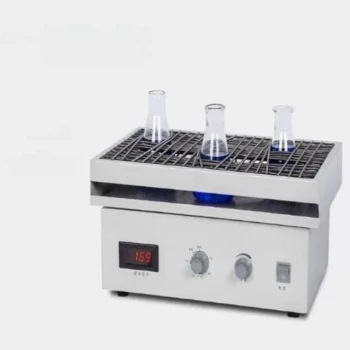
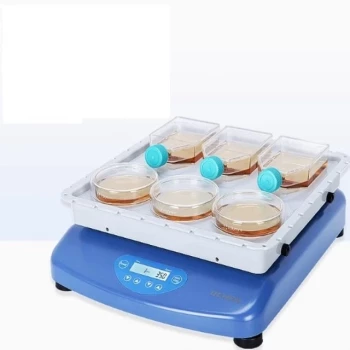
A constant temperature shaker functions as a critical elution device during the washing of pretreated wheat straw fibers, utilizing both thermal and mechanical energy to clean the biomass. By maintaining a steady environment—typically 50°C at 150 rpm—it provides the necessary hydrodynamic shear force to dislodge stubborn contaminants. This process ensures the complete removal of soluble minerals like potassium and sodium, which are often adhered to the fiber surface or trapped within the biomass's microporous structures.
Washing pretreated biomass is not merely a rinsing step; it is an extraction process. The shaker is essential for forcing trapped minerals out of the fiber structure, ensuring that subsequent data regarding mineral distribution is scientifically accurate and not skewed by residual surface contaminants.
The Mechanisms of Effective Elution
Hydrodynamic Shear Force
The rotation of the shaker (typically at 150 rpm) generates hydrodynamic shear force within the washing solution.
This mechanical agitation is far more effective than static soaking. It physically scours the surface of the wheat straw fibers to detach minerals that have adhered during pretreatment.
Thermal Consistency
Operating at a constant temperature, usually 50°C, increases the efficiency of the washing process.
The elevated temperature helps dissolve soluble minerals and increases the diffusion rate of ions. This ensures that the washing medium can effectively penetrate the biomass rather than just interacting with the outer layer.
Solving the Micropore Problem
Reaching Trapped Contaminants
Biomass fibers are not smooth solids; they possess complex, microporous structures.
Soluble minerals, specifically potassium and sodium, often get trapped deep inside these microscopic pores. A simple rinse cannot reach these sequestered elements.
Ensuring Complete Removal
The combination of heat and shear force drives the washing fluid into these pores and forces the minerals out.
This is defined as complete elution. Without this active mechanical intervention, these minerals would remain "hidden" within the fiber, leading to incorrect assumptions about the chemical composition of the fiber.
Critical Considerations for Accuracy
The Risk of Passive Washing
If you rely on passive washing (soaking without agitation) or ambient temperatures, you risk incomplete elution.
This results in a "dirty" sample where soluble minerals remain mistakenly associated with the insoluble fiber fraction.
Impact on Data Integrity
The primary goal of using this equipment is the accurate assessment of mineral element distribution.
If the washing step fails to remove these trapped minerals, your data will reflect a false concentration of elements in the fiber. This compromises the validity of the entire pretreatment analysis.
Ensuring Methodological Rigor
To ensure your assessment of mineral distribution is accurate, apply the following standards to your washing protocol:
- If your primary focus is standardizing results: strictly adhere to the 50°C and 150 rpm parameters to ensure comparable hydrodynamic shear across all samples.
- If your primary focus is data accuracy: view the shaker not as a mixer, but as an extraction tool necessary to remove minerals trapped in micropores.
The constant temperature shaker is the only reliable method to guarantee that soluble minerals are fully separated from the fiber matrix.
Summary Table:
| Mechanism | Operating Parameter | Key Function |
|---|---|---|
| Hydrodynamic Shear | 150 rpm Agitation | Physically detaches minerals from fiber surfaces via mechanical scouring. |
| Thermal Consistency | 50°C Stable Temp | Increases ion diffusion rates and solubility to penetrate biomass layers. |
| Deep Elution | Active Extraction | Forces trapped potassium and sodium out of complex microporous structures. |
| Data Integrity | Standardized Protocol | Prevents false mineral concentration readings by ensuring complete cleaning. |
Elevate Your Biomass Research with KINTEK Precision
Achieve unmatched data integrity in your pretreatment analysis with KINTEK’s high-performance laboratory solutions. From advanced shakers and homogenizers that ensure complete mineral elution to our specialized high-temperature furnaces, reactors, and cooling solutions, we provide the tools necessary for rigorous scientific accuracy.
Whether you are focusing on mineral distribution, chemical composition, or structural analysis, KINTEK specializes in laboratory equipment and consumables tailored for the most demanding research environments. Our portfolio includes everything from PTFE products and ceramics to crushing systems and hydraulic presses, supporting every stage of your workflow.
Ready to optimize your laboratory efficiency? Contact us today to find the perfect equipment for your research needs!
References
- Duy Michael Le, Anne S. Meyer. Biorefining of wheat straw: accounting for the distribution of mineral elements in pretreated biomass by an extended pretreatment-severity equation. DOI: 10.1186/s13068-014-0141-7
This article is also based on technical information from Kintek Solution Knowledge Base .
Related Products
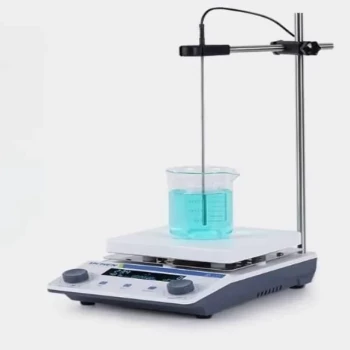
- Laboratory Small Constant Temperature Heated Magnetic Stirrer Heater and Stirrer
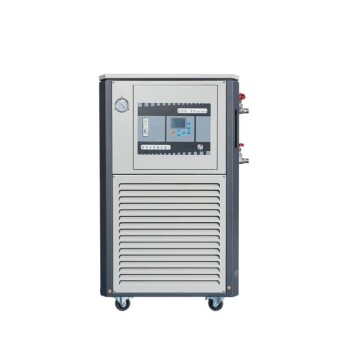
- High Temperature Constant Temperature Heating Circulator Water Bath Chiller Circulator for Reaction Bath
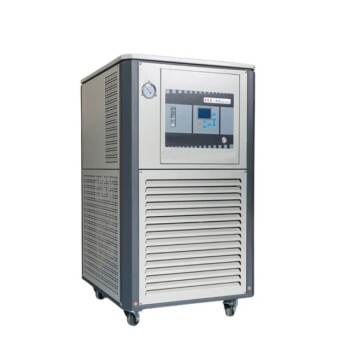
- 5L Heating Chilling Circulator Cooling Water Bath Circulator for High and Low Temperature Constant Temperature Reaction
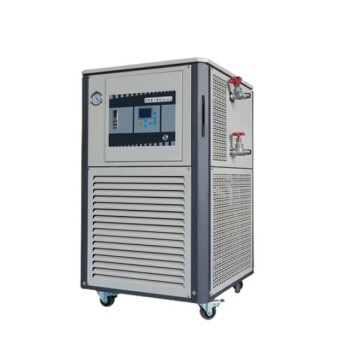
- 50L Chiller Water Bath Cooling Circulator Low Temperature Constant Temperature Reaction Bath
- 10L Heating Chilling Circulator Cooling Water Bath Circulator for High and Low Temperature Constant Temperature Reaction
People Also Ask
- What role does a magnetic stirrer with heating play in ZnO nanoparticle synthesis? Precision Control for Quality Results
- What role does a constant temperature heating magnetic stirrer play in MFC-HAp synthesis? Achieve Material Homogeneity
- What is the function of a laboratory magnetic stirrer in Ni–Cr–P electrodeposition? Optimize Ion Transport & Coating
- Why is a laboratory magnetic stirrer required for benzoic acid esters? Boost Reaction Speed & Yield with High RPM
- What role does a laboratory magnetic stirrer play in TiO2 and TiO2-Ag sol preparation? Master Chemical Kinetics