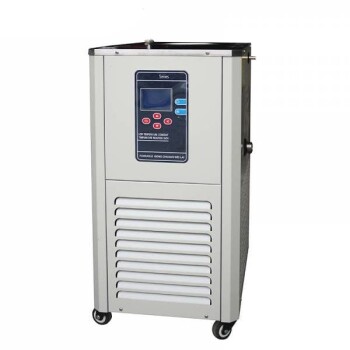
The Drop Tube Reactor functions as a high-precision simulation tool designed to replicate the conditions of flash ironmaking. It operates by maintaining fine mineral powder particles in a suspended state while they are exposed to reducing gases. This unique environment enables the rapid production of flash-reduced iron powder, serving as a critical step in studying the material's behavior and properties.
The reactor's ability to provide a uniform thermal field and extremely high heating rates allows it to complete iron ore reduction in seconds, creating highly reactive samples essential for industrial re-oxidation kinetics research.
Simulating Industrial Conditions
Achieving Particle Suspension
The core mechanic of the Drop Tube Reactor is its ability to keep material airborne. It maintains fine mineral powder particles in a suspended state throughout the process. This suspension ensures that the particles have maximum surface area contact with the reducing gases.
Rapid Heating Capability
Efficiency in this system is driven by temperature management. The reactor provides extremely high heating rates, which are necessary to mimic the intense conditions found in industrial flash ironmaking.
Uniform Thermal Environment
Consistency is vital for accurate research data. The reactor establishes a uniform thermal field, ensuring that every suspended particle is subjected to the same temperature profile during the reduction process.
The Impact on Material Properties
Acceleration of Reduction
The combination of suspension and high heat dramatically speeds up the chemical reaction. Consequently, the iron ore powder allows for complete reduction in a very short time.
Creation of Representative Samples
The output of this process is not generic iron; it is a specialized material. The reactor produces flash-reduced iron powder with specific morphology and high reactivity.
Enabling Kinetics Research
The specific properties of the output material are designed for a purpose. These samples serve as representative models for industrial re-oxidation kinetics research, allowing scientists to predict how the material will behave in larger-scale operations.
Understanding the Operational Constraints
Reliance on Fine Particles
The system is engineered specifically for fine mineral powder. This indicates that the reactor is optimized for specific particle sizes and may not be suitable for processing coarser raw materials without prior processing.
Research vs. Production Scale
While the reactor produces reduced iron, its defined purpose is to simulate processes and provide samples. It is an experimental instrument used to understand kinetics and morphology, rather than a tool for mass industrial throughput.
Making the Right Choice for Your Research
To effectively utilize a Drop Tube Reactor, you must align its capabilities with your specific investigative goals.
- If your primary focus is process simulation: Leverage the reactor's high heating rates and uniform thermal field to accurately replicate the suspended state of flash ironmaking.
- If your primary focus is kinetic analysis: Utilize the reactor to generate high-reactivity samples with specific morphology to study re-oxidation behavior.
The Drop Tube Reactor is the bridge between raw theory and industrial application, providing the precise conditions needed to understand the rapid reduction of iron ore.
Summary Table:
| Feature | Function in Drop Tube Reactor | Impact on Iron Powder |
|---|---|---|
| Suspension State | Keeps fine powder airborne during reduction | Maximizes surface area contact with gases |
| Thermal Field | Provides uniform and extremely high heating rates | Completes reduction in seconds for high efficiency |
| Morphology | Controls particle shape and structure | Produces highly reactive samples for kinetics study |
| Simulation | Replicates industrial flash ironmaking conditions | Provides accurate data for scaling up operations |
Elevate Your Material Research with KINTEK Precision Solutions
Unlock the full potential of your metallurgical studies with KINTEK’s advanced laboratory equipment. Whether you are analyzing re-oxidation kinetics or perfecting flash ironmaking, our high-performance high-temperature furnaces, crushing and milling systems, and high-pressure reactors provide the precision and reliability your research demands.
From specialized ceramics and crucibles to comprehensive battery research tools, KINTEK is committed to supporting your lab with cutting-edge technology and durable consumables. Contact us today to discover how our tailored solutions can streamline your workflows and deliver representative results for your next breakthrough.
References
- Zhixue Yuan, Hong Yong Sohn. Re-Oxidation Kinetics of Flash Reduced Iron Particles in O2–N2 Gas Mixtures Relevant to a Novel Flash Ironmaking Process. DOI: 10.2355/isijinternational.54.1235
This article is also based on technical information from Kintek Solution Knowledge Base .
Related Products
- Customer Made Versatile CVD Tube Furnace Chemical Vapor Deposition Chamber System Equipment
- Customizable Laboratory High Temperature High Pressure Reactors for Diverse Scientific Applications
- Laboratory Rapid Thermal Processing (RTP) Quartz Tube Furnace
- Electric Rotary Kiln Small Rotary Furnace Biomass Pyrolysis Plant
- Stainless High Pressure Autoclave Reactor Laboratory Pressure Reactor
People Also Ask
- What is a CVD tube furnace? A Complete Guide to Thin-Film Deposition
- What is the function of a high-temperature CVD tube furnace in 3D graphene foam prep? Master 3D Nanomaterial Growth
- What are the technical advantages of using a CVD tube furnace? Optimize Silicon-Carbon Battery Anodes
- How does a CVD tube furnace inhibit the sintering of silver supports? Boost Membrane Durability and Performance
- What is the function of a tube furnace in CVD SiC synthesis? Achieving Ultra-Pure Silicon Carbide Powders