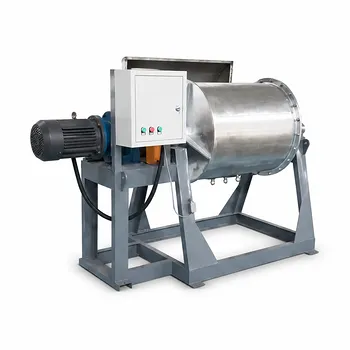
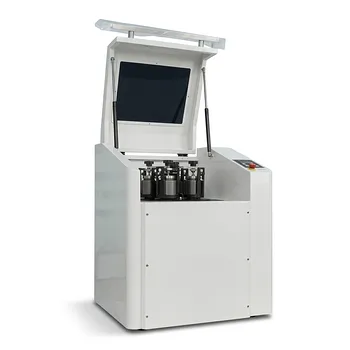
A high-energy ball mill functions as a mechanical engine of reduction, utilizing intense kinetic energy to crush bulk raw materials down to the nanometer scale. In the context of environmental nanomaterials, this process does not merely shrink particles; it fundamentally alters their physical properties by utilizing impact and friction to maximize specific surface area. This physical transformation is the prerequisite for enhancing the chemical reactivity necessary for applications like soil remediation and wastewater treatment.
The Core Mechanism The ball mill facilitates a "top-down" synthesis approach, where macroscopic materials are mechanically refined into nanopowders. By converting kinetic energy into fracture and shear forces, the process exposes new active surfaces, making inert bulk materials chemically aggressive enough to degrade environmental pollutants.
The Mechanics of Top-Down Reduction
Generating Mechanical Force
The process relies on a mill chamber filled with grinding media—small, hard balls made of materials like iron, hardened steel, or tungsten carbide.
In high-energy systems, such as planetary ball mills, the chamber rotates at high speeds to generate powerful mechanical impact and shear forces. These forces are transferred through high-frequency collisions between the grinding balls and the raw material.
Physical Refinement and Surface Area
The primary physical outcome of this bombardment is the fragmentation of initial powders along their grain boundaries.
This acts as a brute-force method to reduce particle size from the macro-scale to the nano-scale. As the particle size decreases, the specific surface area significantly increases, which is the defining characteristic of effective environmental nanomaterials.
Driving Chemical Reactivity
Creating Active Sites for Remediation
For environmental applications, physical size reduction serves a chemical goal: increasing the material's ability to react with contaminants.
In the synthesis of heterogeneous Fenton catalysts (such as magnetite), ball milling exposes active sites on the catalyst surface. This exposure directly enhances the adsorption and degradation efficiency of recalcitrant pollutants, such as antibiotics in wastewater.
Enabling Mechanochemical Synthesis
Beyond simple grinding, high-energy milling can drive mechanochemistry—chemical reactions induced by mechanical energy.
The mechanical stress fields generated during milling can force atoms (such as carbon) to penetrate metal lattices. This allows for solid-state reactions at relatively low temperatures, creating complex nanostructures like transition metal carbides that might otherwise require extreme heat.
Structural Amorphization
The continuous impact does not just break particles apart; it can alter their internal crystalline structure.
High-energy milling provides the energy necessary for the amorphization of structures like multi-walled carbon nanotubes. This disruption of the ordered lattice structure further contributes to the material's reactivity and surface availability.
Understanding Process Dependencies
The Role of Processing Time
The transformation from bulk powder to active nanomaterial is highly dependent on the duration of the mechanical stress.
Mechanochemical reactions, such as the synthesis of nanoscale carbides, occur progressively as processing time increases. The energy transfer required to drive mass transfer and lattice penetration is a cumulative result of sustained milling.
Grinding Media Hardness
The efficiency of the "top-down" approach is strictly limited by the hardness of the grinding media relative to the target material.
To generate the necessary shear and impact forces without destroying the media itself, the balls must be composed of extremely hard materials like silicon carbide or tungsten carbide. The selection of compatible media is critical to ensure effective energy transfer to the powder.
Making the Right Choice for Your Goal
When employing high-energy ball milling for environmental nanomaterials, your operational focus should shift based on the desired material property:
- If your primary focus is Physical Surface Area: Prioritize the generation of shear forces to fracture grain boundaries and maximize the exposure of active sites for adsorption tasks.
- If your primary focus is Chemical Synthesis: Focus on extended processing times to generate the cumulative mechanical stress fields required for lattice penetration and solid-state reactions.
High-energy ball milling is not just a crushing process; it is a method of activating materials through kinetic energy to solve complex environmental challenges.
Summary Table:
| Feature | Function in Top-Down Synthesis | Impact on Environmental Nanomaterials |
|---|---|---|
| Mechanical Impact | High-speed collisions & shear forces | Fractures grain boundaries to achieve nano-scale reduction |
| Surface Area | Drastic particle size reduction | Maximizes specific surface area for pollutant adsorption |
| Active Sites | Exposure of internal surfaces | Enhances catalytic efficiency for soil/water remediation |
| Mechanochemistry | Solid-state reaction induction | Enables synthesis of complex structures at lower temperatures |
| Structural Change | Amorphization of lattices | Increases material reactivity and chemical aggressiveness |
Revolutionize Your Material Synthesis with KINTEK Precision
Unlock the full potential of your environmental research with KINTEK’s advanced crushing and milling systems. Whether you are synthesizing catalysts for wastewater treatment or engineering carbon-based nanomaterials, our high-energy planetary ball mills and premium grinding media (Tungsten Carbide, Silicon Carbide, Zirconia) provide the mechanical force necessary for superior surface activation.
Why choose KINTEK?
- High-Energy Efficiency: Achieve nanometer reduction faster with our robust planetary systems.
- Comprehensive Lab Solutions: From high-temperature furnaces and hydraulic presses to PTFE consumables and cooling solutions, we equip your entire workflow.
- Tailored for Innovation: Perfect for battery research, chemical engineering, and environmental remediation.
Ready to enhance your lab's efficiency and material performance? Contact our technical experts today to find the perfect milling solution!
References
- Ramona Kuhn, Jörg Böllmann. Applications of Environmental Nanotechnologies in Remediation, Wastewater Treatment, Drinking Water Treatment, and Agriculture. DOI: 10.3390/applnano3010005
This article is also based on technical information from Kintek Solution Knowledge Base .
Related Products
- High Energy Planetary Ball Mill Milling Machine for Laboratory
- High Energy Planetary Ball Mill for Laboratory Horizontal Tank Type Milling Machine
- High-Energy Omnidirectional Planetary Ball Mill Milling Machine for Laboratory
- High Energy Planetary Ball Mill Milling Machine for Laboratory
- High Energy Planetary Ball Mill Machine for Laboratory Horizontal Tank Type
People Also Ask
- How does a planetary ball mill provide mechanical activation for scandium recovery? Maximize Your Leaching Efficiency
- What role do planetary ball mills and zirconia media play in LLZT preparation? Optimize Your Solid Electrolyte Research
- What is the function of a planetary ball mill in the preparation of high-entropy rare earth silicate multi-phase ceramics?
- What is the purpose of using a planetary ball mill for cathode material regeneration? Achieve Atomic-Level Mixing
- What is the primary function of a planetary ball mill? Mastering SiC/Al Composite Mixing for Homogeneity