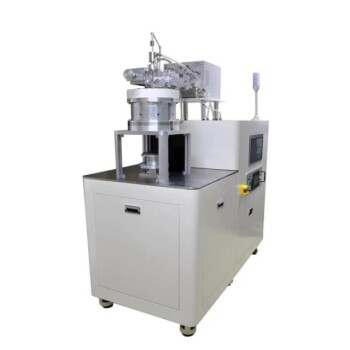
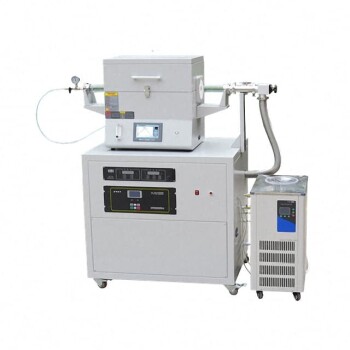
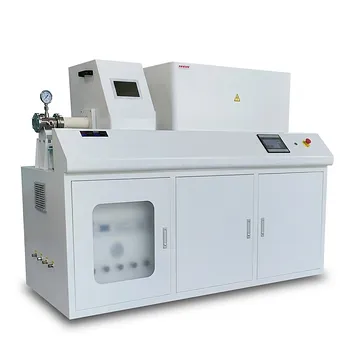
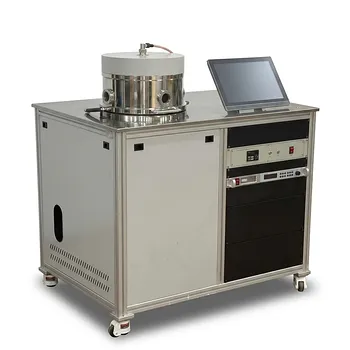
The high-temperature Chemical Vapor Deposition (CVD) reactor serves as a precise thermal and chemical control chamber. Its primary function in synthesizing TiN/TiC multilayer coatings is to maintain a specific environment—typically between 980 and 1020 °C under reduced pressure—that forces precursor gases to decompose and chemically react on the substrate surface. This process transforms volatile gases into a solid, high-density, wear-resistant film.
By strictly regulating gas flow and thermal conditions, the reactor ensures uniform coating growth even on complex geometries, promoting a dense grain structure that is essential for achieving high hardness.
Creating the Conditions for Synthesis
To successfully deposit TiN (Titanium Nitride) and TiC (Titanium Carbide) layers, the reactor must establish a thermodynamic environment that is impossible to achieve at room temperature.
Precise Thermal Regulation
The reactor heats the processing zone to a narrow range of 980 to 1020 °C.
This extreme heat is required to activate the thermal decomposition of the precursor gases. Without this thermal energy, the chemical bonds in the gases would not break, and the coating would not form.
Controlled Atmosphere and Pressure
The system operates under reduced pressure while managing the introduction of specific gases.
For TiN/TiC coatings, the reactor regulates a mixture of TiCl4 (Titanium Tetrachloride), CH4 (Methane), N2 (Nitrogen), and H2 (Hydrogen). The reduced pressure aids in the uniform transport of these gases to the workpiece surface.
Facilitating Surface Chemistry
The core function of the reactor is to transition from gas-phase transport to solid-phase deposition through specific chemical mechanisms.
Heterogeneous Chemical Reactions
The reactor is designed to facilitate heterogeneous reactions, meaning the reaction occurs at the interface between the gas and the solid substrate.
Rather than the gases reacting in mid-air (which would create dust), the reactor conditions ensure the reaction happens directly on the surface of the tool or component.
Precursor Decomposition
Inside the heated zone, the precursor gases break down (decompose).
The titanium from TiCl4 reacts with nitrogen (from N2) or carbon (from CH4) to build the coating layer by layer. Hydrogen often acts as a reducing agent and carrier gas, helping to remove byproducts like HCl (as noted in general CVD principles).
Ensuring Structural Integrity and Performance
Beyond just "adding material," the reactor's design directly influences the physical properties of the final coating.
Uniformity on Complex Geometries
One of the reactor's most critical functions is ensuring non-line-of-sight coverage.
Because the process relies on gas flow rather than a directional spray, the reactor ensures the coating grows evenly on complex-shaped workpieces, such as gear teeth or cutting tools with intricate flutes.
Densification and Hardness
The high-temperature environment promotes a dense grain arrangement.
This tight microstructural organization is what gives TiN/TiC multilayer coatings their characteristic high hardness and wear resistance. A poorly controlled reactor would result in a porous, weak coating.
Understanding the Trade-offs
While high-temperature CVD offers superior adhesion and uniformity, it introduces specific constraints that you must consider.
Substrate Limitations
The high operating temperature (approx. 1000 °C) severely limits which materials can be coated.
You cannot use this process for substrates that lose their temper or melt at these temperatures; it is primarily reserved for temperature-resistant materials like cemented carbides.
Dimensional Changes
The high heat can induce thermal stress or minor dimensional changes in the substrate.
While the reactor controls the coating growth, the cooling phase must be managed carefully to prevent the coating from cracking due to thermal expansion mismatches between the coating and the substrate.
Making the Right Choice for Your Application
When deciding if high-temperature CVD is the right solution for your TiN/TiC needs, consider your component's geometry and material limits.
- If your primary focus is Complex Geometry: The CVD reactor is ideal because it ensures uniform thickness on threads, blind holes, and undercuts where line-of-sight methods fail.
- If your primary focus is Extreme Hardness: The high-temperature processing guarantees the dense grain structure required for heavy-duty wear resistance.
- If your primary focus is Temperature Sensitivity: You must verify that your substrate can withstand 1000 °C without metallurgical degradation before proceeding.
The high-temperature CVD reactor is the definitive tool for converting volatile gases into the hardened armor that extends the life of industrial tools.
Summary Table:
| Feature | CVD Reactor Specification/Function |
|---|---|
| Temperature Range | 980 - 1020 °C (Precise Thermal Regulation) |
| Pressure Environment | Reduced Pressure (Controlled Atmosphere) |
| Key Precursors | TiCl4, CH4, N2, H2 |
| Coating Type | High-density TiN/TiC Multilayer |
| Key Advantage | Non-line-of-sight coverage for complex geometries |
| Primary Substrate | Cemented carbides & temperature-resistant materials |
Elevate Your Material Performance with KINTEK
Ready to achieve extreme hardness and precision for your industrial tools? KINTEK specializes in advanced laboratory and production solutions, offering high-performance high-temperature CVD and PECVD reactors designed to deliver dense, wear-resistant TiN/TiC coatings.
Our extensive portfolio supports every stage of your research and manufacturing process, featuring:
- Thermal Processing: Muffle, tube, and vacuum furnaces.
- Material Preparation: Crushing, milling, and hydraulic pellet presses.
- Advanced Research Tools: High-pressure reactors, electrolytic cells, and battery testing consumables.
Don't let complex geometries or harsh environments compromise your tool life. Contact our technical experts today to find the perfect CVD reactor or high-temperature system tailored to your specific application.
References
- Miklós Jakab, J. Telegdi. The Tribological Behavior of TiN/TiC CVD Coatings under Dry Sliding Conditions against Zirconia and Steel Counterparts. DOI: 10.3390/coatings13050832
This article is also based on technical information from Kintek Solution Knowledge Base .
Related Products
- Customizable Laboratory High Temperature High Pressure Reactors for Diverse Scientific Applications
- Microwave Plasma Chemical Vapor Deposition MPCVD Machine System Reactor for Lab and Diamond Growth
- Customer Made Versatile CVD Tube Furnace Chemical Vapor Deposition Chamber System Equipment
- Split Chamber CVD Tube Furnace with Vacuum Station Chemical Vapor Deposition System Equipment Machine
- High Temperature Constant Temperature Heating Circulator Water Bath Chiller Circulator for Reaction Bath
People Also Ask
- How do high-pressure and high-temperature reactors ensure the effective treatment of lignocellulosic wastewater in WAO?
- What equipment is required for high-pressure high-temperature reactions? Master Extreme Chemistry Safely
- How do you control high pressure in a reactor? A Guide to Safe & Stable Operation
- Why is argon better than nitrogen for inert atmosphere? Ensure Absolute Reactivity & Stability
- How does initial oxygen pressure affect the wet oxidation of pharmaceutical sludge? Master Your Oxidation Depth