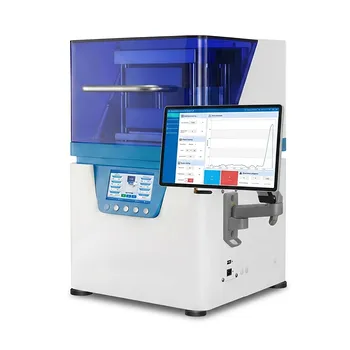
The primary function of a laboratory hydraulic press and steel die in solid-state synthesis is the mechanical consolidation of raw material powders into dense pellets. This process minimizes inter-particle voids and maximizes the surface contact area between the reactants. By creating these "green bodies," the equipment facilitates efficient elemental diffusion and chemical homogeneity during the subsequent high-temperature sintering phase required to form layered manganese oxychalcogenides.
The laboratory hydraulic press and steel die serve as the critical bridge between raw powders and a reacted solid, using high-intensity pressure to overcome the diffusion barriers inherent in solid-state chemistry. This compaction is essential for achieving a uniform, high-density final product with the desired stoichiometric precision.
Enhancing Reaction Kinetics through Densification
Minimizing Inter-particle Voids
In a loose powder state, particles are separated by significant air gaps that act as barriers to atomic movement. The hydraulic press applies uniaxial pressure to force these particles together, eliminating voids and increasing the relative density of the sample.
Increasing Effective Contact Area
Solid-state reactions occur at the interfaces where different material particles meet. By using a steel die to constrain the powder under pressure, the total contact area is significantly increased, which provides more pathways for atoms to migrate between different chemical species.
Accelerating Elemental Diffusion
Because manganese oxychalcogenides require the movement of heavy elements through a crystal lattice, shortening the distance between particles is vital. Physical compaction ensures that during high-temperature annealing, the elements can diffuse across boundaries quickly enough to complete the reaction within a reasonable timeframe.
Ensuring Structural and Chemical Integrity
Promoting Chemical Homogeneity
A common challenge in synthesizing layered materials is the formation of secondary phases or "pockets" of unreacted material. The uniform pressure provided by the hydraulic press ensures that the chemical composition remains consistent throughout the entire volume of the pellet.
Creating the "Green Body"
The term "green body" refers to the compacted powder before it has been fired or sintered. The steel die defines the geometric shape and provides the initial mechanical strength needed for the sample to be handled and placed into a furnace without crumbling.
Facilitating Ion Transport Channels
For materials intended for electrochemical or electronic applications, such as certain oxychalcogenides, densification is critical for performance. High-pressure consolidation helps establish continuous transport channels, which are necessary for efficient ion or electron movement in the final synthesized lattice.
Understanding the Trade-offs and Limitations
Risk of Material Contamination
While steel dies are highly durable, the high pressures involved can cause microscopic flakes of the die material to rub off into the sample. For high-purity synthesis, researchers must often use liners or ensure the die is meticulously cleaned to prevent iron contamination.
Pressure-Induced Stress and Cracking
Applying too much pressure or releasing it too quickly can lead to "capping" or delamination, where the pellet cracks into horizontal layers. Finding the optimal pressure—often ranging from 30 MPa to over 500 MPa depending on the material—is a delicate balance between density and structural integrity.
Non-Uniform Density Gradients
In tall pellets, friction between the powder and the walls of the steel die can lead to uneven pressure distribution. This results in a density gradient where the center of the pellet is less dense than the ends, potentially leading to non-uniform reaction rates during sintering.
How to Apply This to Your Synthesis Project
When utilizing a hydraulic press for the synthesis of layered manganese oxychalcogenides, your technical approach should vary based on your specific research requirements.
- If your primary focus is maximum chemical purity: Use a high-strength tungsten carbide die or a specialized liner to prevent the manganese or chalcogenide powders from reacting with or being contaminated by the steel.
- If your primary focus is rapid reaction completion: Aim for the highest possible pressure that the material can sustain without cracking to maximize the interfacial contact between the raw precursors.
- If your primary focus is structural characterization: Ensure the pellet thickness is minimized relative to its diameter to promote a more uniform density distribution throughout the sample.
By precisely controlling the compaction environment, you transform a simple mixture of powders into a high-performance solid-state material.
Summary Table:
| Key Function | Mechanism | Impact on Synthesis |
|---|---|---|
| Mechanical Consolidation | Minimizes inter-particle voids | Increases the relative density of the "green body." |
| Maximized Contact Area | Increases interface between particles | Provides more pathways for atoms to migrate and react. |
| Accelerated Diffusion | Shortens distances between atoms | Shortens the high-temperature annealing time required. |
| Chemical Homogeneity | Uniform pressure application | Prevents secondary phases and ensures consistent composition. |
| Structural Integrity | Forms stable geometric shapes | Allows safe handling and transport of samples to furnaces. |
Elevate Your Material Synthesis with KINTEK Precision
Achieving stoichiometric precision in layered manganese oxychalcogenides requires more than just a reaction—it requires perfect preparation. KINTEK specializes in high-performance laboratory equipment designed to bridge the gap between raw powders and advanced materials.
Whether you need hydraulic pellet presses (manual, electric, or isostatic) for superior densification or precision-engineered steel and tungsten carbide dies to prevent contamination, we provide the tools to ensure your synthesis success. Combine our compaction systems with our high-temperature muffle, vacuum, or tube furnaces and ball milling systems for a complete, high-efficiency research workflow.
Ready to optimize your solid-state reaction results? Contact KINTEK today to consult with our experts on the best equipment for your specific laboratory needs!
References
- Shunsuke Sasaki, Simon J. Clarke. Anion redox as a means to derive layered manganese oxychalcogenides with exotic intergrowth structures. DOI: 10.1038/s41467-023-38489-3
This article is also based on technical information from Kintek Solution Knowledge Base .
Related Products
- Laboratory Hydraulic Press Lab Pellet Press Machine for Glove Box
- Laboratory Hydraulic Press Split Electric Lab Pellet Press
- Fully Automatic Heated Hydraulic Lab Press for Materials Sintering and Sample Preparation
- Laboratory Hydraulic Press Lab Pellet Press for Button Battery
- Automatic Laboratory Hydraulic Press for XRF & KBR Pellet Press
People Also Ask
- How do laboratory hydraulic presses contribute to zero-gap electrolyzers? Optimize Performance & Safety
- Why is a laboratory hydraulic press necessary for ZrO2/Cr2O3 interface analysis? Optimize Sample Density and Accuracy
- How do a precision laboratory hydraulic press and specialized molds contribute to the fabrication of spherical ceramic samples? Achieving High-Density Material Precision
- What is the role of a laboratory hydraulic press in the preparation of rare earth denitrification catalysts?
- How does pressure control of a laboratory hydraulic press affect W-Ti alloys? Optimize Grain Structure & Density