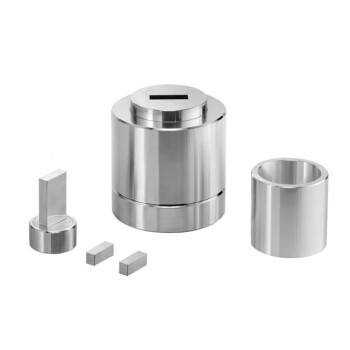
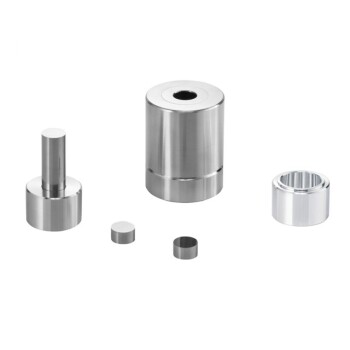
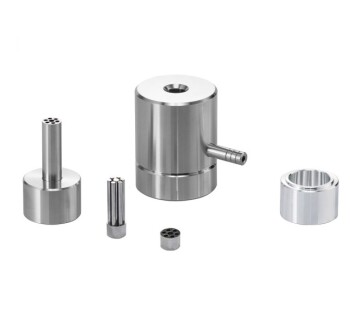
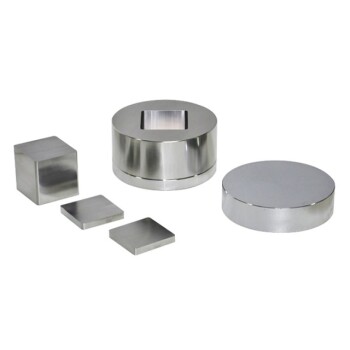
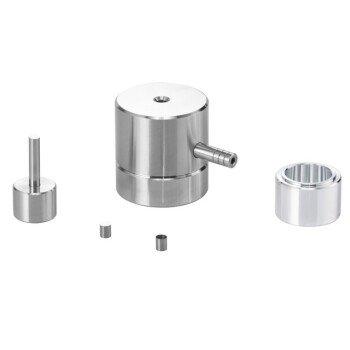
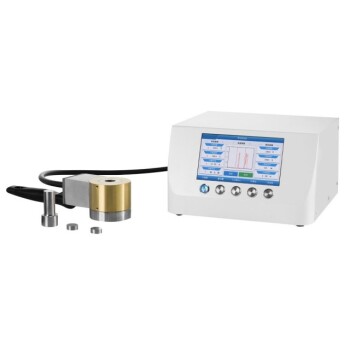
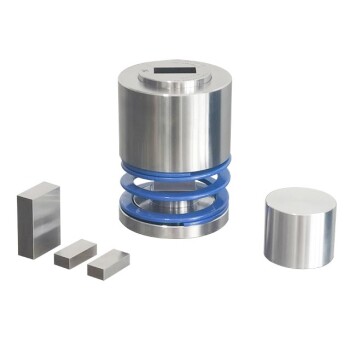
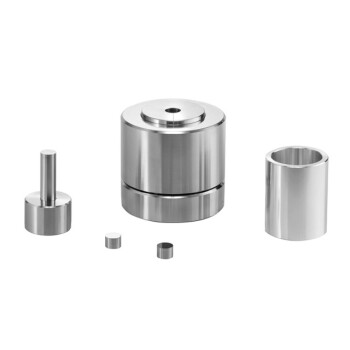
A laboratory hydraulic press paired with precision molds serves the critical function of standardizing the physical geometry of coating specimens, specifically ensuring uniform thickness and density. By applying controlled pressure, this setup ensures that every sample meets identical physical parameters, eliminating geometric variations that would otherwise skew electrochemical test results.
Core Takeaway Reliable electrochemical data, particularly in Impedance Spectroscopy (EIS), depends entirely on the physical consistency of the test subject. The hydraulic press transforms variable coating materials into uniform specimens, ensuring that performance data reflects the material's true chemistry rather than inconsistencies in preparation.
Ensuring Data Integrity through Physical Consistency
The Criticality of Uniform Thickness
In electrochemical testing, the geometry of the sample directly influences the results.
A laboratory hydraulic press allows for the production of specimens with specific, repeatable thickness, such as 150 ± 4 μm.
Without this mechanical precision, variations in thickness would create artificial fluctuations in resistance and capacitance readings.
Reliable Anti-Corrosion Evaluation
For tests like Electrochemical Impedance Spectroscopy (EIS), the coating acts as a barrier to ionic movement.
If the thickness varies across the sample or between different samples, the "barrier effect" cannot be accurately compared.
Uniform pressing ensures that the anti-corrosion data derived from the test is statistically valid and reproducible.
Optimizing Material Dispersion
The press is essential when evaluating advanced additives, such as graphene dispersion within a coating.
Controlled pressure helps orient and pack these particles consistently.
This allows researchers to accurately evaluate how well the dispersed material blocks ionic penetration, rather than measuring artifacts caused by loose packing.
Enhancing the Microstructural Interface
Eliminating Air Pores and Voids
A major function of the hydraulic press is to densify the specimen material.
By compressing the coating components, the press removes air pores that would otherwise act as fast-tracks for corrosion or alter the dielectric constant.
A denser, pore-free structure ensures the coating is tested on its material merits, not its structural defects.
Reducing Interfacial Contact Resistance
In electrochemical setups, the connection between the electrode and the material is a common source of error.
Uniform axial pressure ensures tight physical contact at the electrode-electrolyte interface.
This minimizes interfacial contact resistance, preventing voltage drops that could obscure the true electrochemical behavior of the coating.
Understanding the Trade-offs
The Risk of Over-Compression
While density is desired, excessive pressure can alter the morphology of certain coating particles or damage the substrate.
It is vital to determine the optimal pressure limit that achieves density without crushing the active material or altering its fundamental chemical properties.
Dependency on Mold Precision
The hydraulic press is only as effective as the mold it drives.
If the precision mold has surface imperfections or lacks parallelism, the press will simply replicate these errors with high force.
Regular maintenance and calibration of the mold surfaces are just as critical as the pressure settings on the press itself.
Making the Right Choice for Your Goal
To ensure your electrochemical testing yields publication-grade data, apply the hydraulic press according to your specific analytical needs:
- If your primary focus is Anti-Corrosion (EIS): Prioritize thickness uniformity (e.g., ± 4 μm) to ensure impedance values reflect true barrier properties, not geometric variables.
- If your primary focus is Conductivity/Resistivity: Prioritize high-pressure densification to eliminate air voids and maximize particle-to-particle contact for accurate resistance data.
Consistency in sample preparation is the invisible variable that determines the reproducibility of your electrochemical research.
Summary Table:
| Feature | Function in Sample Preparation | Impact on Electrochemical Testing |
|---|---|---|
| Uniform Thickness | Eliminates geometric variations (e.g., ± 4 μm) | Ensures accurate resistance and capacitance readings |
| High-Pressure Densification | Removes air pores and voids from the coating | Prevents artificial ion pathways and structural defects |
| Material Packing | Optimizes dispersion of additives like graphene | Provides a true measure of material barrier properties |
| Interface Optimization | Minimizes interfacial contact resistance | Prevents voltage drops and obscures measurement errors |
Elevate Your Electrochemical Research with KINTEK Precision
Don't let sample inconsistency compromise your data. KINTEK specializes in advanced laboratory equipment designed to deliver the physical consistency required for publication-grade results. Whether you are conducting Electrochemical Impedance Spectroscopy (EIS) or researching advanced battery materials, our high-precision hydraulic presses (pellet, hot, isostatic) and precision molds ensure your specimens are uniform, dense, and defect-free.
From high-temperature furnaces and high-pressure reactors to specialized electrolytic cells and electrodes, KINTEK provides the comprehensive tools needed for rigorous material science.
Ready to standardize your sample preparation? Contact our technical experts today to find the perfect pressing and molding solution for your laboratory.
References
- Youwei Guo, Yi He. One-Step Method for Preparing Dispersive Tea Polyphenol/Graphene Nanosheets Enhanced with Anticorrosion Performance. DOI: 10.3390/coatings9110731
This article is also based on technical information from Kintek Solution Knowledge Base .
Related Products
- Ball Press Mold for Lab
- Assemble Square Lab Press Mold for Laboratory Applications
- Carbide Lab Press Mold for Laboratory Applications
- Special Shape Press Mold for Lab
- Square Lab Press Mold for Laboratory Applications
People Also Ask
- What are the advantages of using a laboratory hydraulic press for hot pressing? Achieve Peak Nano-Composite Density
- How to use a press mold? Master the Art of Creating Consistent Ceramic Forms
- What is the press mould method? A Guide to Consistent, Detailed Ceramic Forms
- What is the purpose of specialized pressure devices in sulfide solid-state batteries? Ensure Chemo-Mechanical Stability
- Why are pressure molds with non-conductive resin inner walls required for battery testing? Ensure Data Accuracy