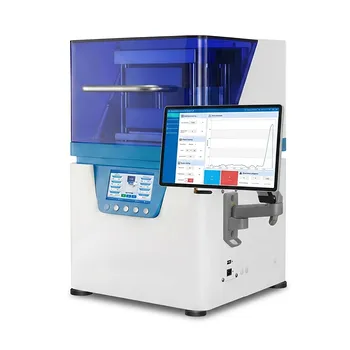
The laboratory hydraulic press is a critical tool for densifying precursor materials. In the synthesis of $MnBi_6Te_{10}$ single crystals, the press compacts mixed $MnTe$ and $Bi_2Te_3$ powders into solid pellets. This physical transformation is essential because it maximizes the contact area between particles, facilitating the efficient solid-state diffusion required for high-temperature chemical reactions within a quartz tube.
By transforming loose powder into a dense "green body," the hydraulic press ensures that chemical reactions occur uniformly across the sample, directly influencing the phase purity and compositional integrity of the final $MnBi_6Te_{10}$ crystal.
Enhancing Chemical Reaction Kinetics
The primary function of the hydraulic press is to overcome the physical limitations of loose powder during the heating process.
Maximizing Interfacial Contact Area
Solid-state reactions depend entirely on the points of contact between different chemical species. By applying high pressure, the press forces $MnTe$ and $Bi_2Te_3$ particles into intimate contact, reducing the distance atoms must travel to react.
Accelerating Solid-State Diffusion
Diffusion is the driving force behind the formation of complex ternary compounds like $MnBi_6Te_{10}$. A compacted pellet allows for a much higher rate of atomic exchange at high temperatures compared to loose powder, where air gaps or voids act as barriers to movement.
Promoting Compositional Uniformity
Without high-pressure compaction, the resulting crystal may suffer from "pockets" of unreacted precursors. The uniform density achieved by the press ensures that the ratio of Manganese, Bismuth, and Tellurium remains consistent throughout the entire volume of the material.
Structural Integrity and Phase Purity
Beyond chemical kinetics, the hydraulic press provides the mechanical foundation necessary for successful crystal growth.
Establishing Phase Purity
Phase purity refers to the absence of unwanted secondary compounds or unreacted starting materials. By ensuring a complete and efficient reaction through compaction, the hydraulic press minimizes the risk of producing "impurity phases" that could degrade the properties of the $MnBi_6Te_{10}$ crystal.
Preventing Sample Deformation
During high-temperature synthesis, internal gases or thermal gradients can cause loose powder to shift or crack. A dense pellet acts as a stable "green body" that maintains its geometric shape and structural consistency even under intense thermal stress.
Eliminating Internal Voids
Internal pores or air pockets can trap contaminants or cause uneven heating. The application of precise, unidirectional pressure eliminates these voids, creating a homogenous medium that responds predictably to the heat treatment within the sealed quartz tube.
Understanding the Trade-offs
While high pressure is beneficial, it must be carefully controlled to avoid negative outcomes in the synthesis process.
Managing Density Gradients
Applying pressure from only one direction can sometimes lead to uneven density within the pellet, where the center is less dense than the edges. This can cause the pellet to warp or react unevenly if the pressure is not applied with high precision.
Risk of Mechanical Damage
If the pressure is too high or released too quickly, the "green body" can suffer from delamination or internal cracking. These micro-cracks can interrupt diffusion paths, potentially leading to a lack of chemical homogeneity in the final synthesized product.
Applying Compaction to Your Synthesis Goals
To achieve the best results when preparing $MnBi_6Te_{10}$ precursors, the use of the hydraulic press should be tailored to your specific research objectives.
- If your primary focus is Phase Purity: Ensure maximum compaction to eliminate voids, as this allows for the most complete solid-state reaction between $MnTe$ and $Bi_2Te_3$.
- If your primary focus is Mechanical Stability: Use a precision mold and gradual pressure release to prevent the formation of internal cracks that could lead to sample failure during heating.
- If your primary focus is Electrical Characterization: Aim for a highly uniform density to ensure that the resulting crystal exhibits consistent anisotropic properties across its entire structure.
Through the precise application of pressure, the laboratory hydraulic press transforms simple raw materials into a highly reactive, homogenous precursor optimized for advanced crystal growth.
Summary Table:
| Function | Impact on Synthesis | Key Benefit |
|---|---|---|
| Powder Densification | Creates a dense "green body" from loose MnTe/Bi2Te3 | Maximizes particle contact area |
| Diffusion Enhancement | Facilitates atomic exchange at high temperatures | Accelerates solid-state reaction kinetics |
| Homogenization | Ensures consistent Mn:Bi:Te ratios throughout sample | Prevents unreacted precursor pockets |
| Structural Integrity | Eliminates internal voids and air pockets | Prevents deformation during heat treatment |
| Phase Control | Minimizes secondary impurity compounds | Guarantees high phase purity of final crystal |
Elevate Your Material Synthesis with KINTEK Precision
Achieving the perfect $MnBi_6Te_{10}$ single crystal starts with flawless precursor preparation. KINTEK specializes in high-performance laboratory equipment designed for the rigorous demands of material science. Our range of hydraulic presses (pellet, hot, and isostatic) ensures the uniform density and structural integrity required for superior solid-state diffusion.
Beyond compaction, KINTEK offers a complete ecosystem for crystal growth, including:
- High-Temperature Furnaces: Muffle, tube, and vacuum systems for precise heat treatment.
- Sample Preparation: Advanced crushing, milling, and sieving equipment.
- Specialized Labware: High-purity ceramics, crucibles, and PTFE products.
Ready to optimize your research outcomes? Contact KINTEK today to consult with our experts and find the ideal equipment solutions for your laboratory.
References
- A. Tcakaev, V. Hinkov. Intermixing‐Driven Surface and Bulk Ferromagnetism in the Quantum Anomalous Hall Candidate MnBi<sub>6</sub>Te<sub>10</sub>. DOI: 10.1002/advs.202203239
This article is also based on technical information from Kintek Solution Knowledge Base .
Related Products
- Laboratory Hydraulic Press Lab Pellet Press Machine for Glove Box
- Laboratory Hydraulic Press Split Electric Lab Pellet Press
- Fully Automatic Heated Hydraulic Lab Press for Materials Sintering and Sample Preparation
- Laboratory Hydraulic Press Lab Pellet Press for Button Battery
- Automatic Laboratory Hydraulic Press for XRF & KBR Pellet Press
People Also Ask
- How do laboratory hydraulic presses contribute to zero-gap electrolyzers? Optimize Performance & Safety
- Why is a laboratory hydraulic press necessary for ZrO2/Cr2O3 interface analysis? Optimize Sample Density and Accuracy
- How do a precision laboratory hydraulic press and specialized molds contribute to the fabrication of spherical ceramic samples? Achieving High-Density Material Precision
- What is the role of a laboratory hydraulic press in the preparation of rare earth denitrification catalysts?
- How does pressure control of a laboratory hydraulic press affect W-Ti alloys? Optimize Grain Structure & Density