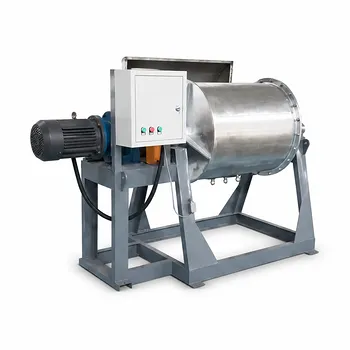
The planetary ball mill serves as the primary engine for mechanical activation during the raw material mixing stage of cubic garnet-type LLZO electrolyte synthesis. Its specific function is to utilize high-energy impact forces generated by planetary motion to intensively grind and mix precursor powders—typically lithium carbonate, lanthanum hydroxide, and zirconium oxide—into a microscopically uniform blend.
The core purpose of this process is not merely to mix ingredients, but to increase the specific surface area and reactivity of the precursors. This mechanical activation ensures the uniform distribution required to form a single-phase cubic structure during subsequent high-temperature solid-state reactions.
The Mechanism of Action
High-Energy Planetary Motion
Unlike standard mixing, a planetary ball mill subjects materials to intense kinetic energy. The planetary motion creates high-energy impact forces that pulverize the precursor materials.
Deep Homogenization
This intensive grinding achieves "deep homogenization" of the multi-component raw materials. It ensures that precursors like lithium, lanthanum, and zirconium sources are distributed evenly at a microscopic scale.
Particle Refinement
The process significantly refines the powder particles. By reducing the particle size, the mill increases the material's specific surface area, which is a prerequisite for efficient chemical reactions in the solid state.
The Impact on LLZO Crystallization
Enabling Solid-State Reactivity
Solid-state reactions are diffusion-limited, meaning the atoms must physically travel across particle boundaries to react. The high surface area created by the ball mill promotes these solid-phase reactions.
Facilitating the Cubic Phase
Achieving the pure cubic garnet structure often requires high temperatures. However, the highly reactive precursors created by planetary milling can enable the successful synthesis of this structure at significantly lower temperatures.
Ensuring Compositional Uniformity
The mechanical mixing ensures that the chemical composition is uniform throughout the batch. This prevents the formation of secondary phases and ensures the final material maintains the correct stoichiometry.
Critical Considerations for Process Success
The Factor of Time
This is not an instantaneous process; effective refinement typically requires extended milling durations, often around 12 hours. Cutting this time short can lead to incomplete activation and a failure to form the cubic phase.
Stoichiometric Precision
The impact forces must ensure the correct stoichiometric conditions are met locally between particles. If the distribution is not uniform at the microscopic level, the subsequent thermal processing will yield impure phases rather than the desired garnet structure.
Making the Right Choice for Your Goal
To optimize your LLZO synthesis, align your milling parameters with your specific structural requirements.
- If your primary focus is achieving a Pure Cubic Phase: Prioritize high-energy impact settings to ensure the deep homogenization necessary to prevent secondary phase formation.
- If your primary focus is Lowering Synthesis Temperature: Focus on maximizing the duration of the milling process to refine particle size and increase specific surface area for higher reactivity.
The planetary ball mill is not just a mixer; it is the tool that defines the reactivity and ultimate success of your solid-state electrolyte synthesis.
Summary Table:
| Function | Key Mechanism | Impact on LLZO Synthesis |
|---|---|---|
| Mechanical Activation | High-energy impact & kinetic forces | Increases specific surface area & reactivity |
| Deep Homogenization | Planetary motion grinding | Ensures microscopic distribution of Li, La, and Zr |
| Particle Refinement | Intensive pulverization | Promotes solid-state diffusion & lowers reaction temp |
| Phase Control | Stoichiometric precision | Prevents secondary phases; facilitates cubic garnet phase |
Elevate Your Solid-State Battery Research with KINTEK
Precision in the mixing stage is critical for achieving the perfect cubic garnet structure in LLZO electrolytes. KINTEK specializes in high-performance laboratory equipment designed for advanced material science. Whether you need high-energy planetary ball mills for deep homogenization, high-temperature furnaces for solid-state reactions, or crushing and milling systems to refine your precursors, we provide the tools to ensure your synthesis is a success.
Our value to you:
- Expert Solutions: Comprehensive range of milling, sieving, and thermal processing equipment.
- Reliability: Durable crucibles, ceramics, and consumables tailored for high-temperature research.
- Precision: Tools engineered to maintain stoichiometric accuracy and phase purity.
Ready to optimize your electrolyte synthesis? Contact KINTEK today to discuss your laboratory needs!
Related Products
- High Energy Planetary Ball Mill for Laboratory Horizontal Tank Type Milling Machine
- Laboratory Planetary Ball Mill Rotating Ball Milling Machine
- High-Energy Omnidirectional Planetary Ball Mill Milling Machine for Laboratory
- High Energy Planetary Ball Mill Milling Machine for Laboratory
- Laboratory Horizontal Planetary Ball Mill Milling Machine
People Also Ask
- What is the role of a planetary ball mill in sulfide-based solid-state batteries? Engineer High-Performance Cathodes
- What are the parameters of a planetary ball mill? Master Speed, Time, and Media for Perfect Grinding
- What is the function of a planetary ball mill for nanostructured eutectic steel? Essential Prep for High-Strength Alloys
- What role does a planetary ball mill play in the preparation of NASICON-type solid electrolytes like LATP and LAGP?
- What is the function of a planetary ball mill in solid-state electrolyte prep? Milling vs. SDS Methods Explained