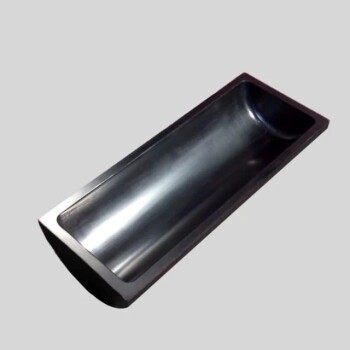
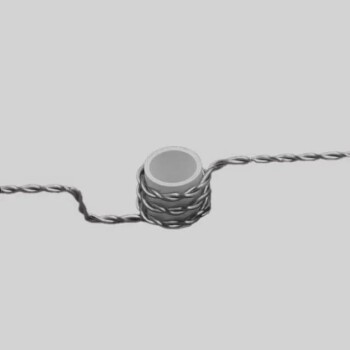
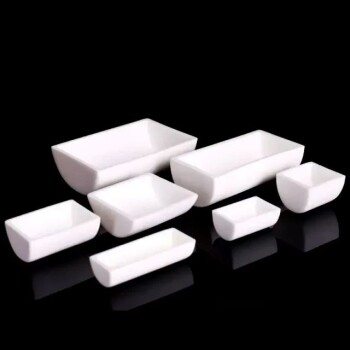
In the context of Fast Moving Bed Pyrolysis (FMBP), the quartz boat functions as a specialized, low-thermal-mass reaction vessel designed to facilitate rapid heating rates.
Its primary role is to transport a mixture of metal salt precursors and carriers into the high-temperature zone of a tube furnace almost instantaneously, typically allowing the reactants to reach target temperatures in under 5 seconds. This rapid thermal transfer is the catalyst for the specific kinetic conditions required to synthesize High-Entropy Alloy Nanoparticles (HEA-NPs).
The quartz boat is not merely a passive container; its low thermal capacity is a functional component of the synthesis process. By permitting extreme heating rates, it enables burst nucleation, forcing multiple immiscible metal elements to co-nucleate into a single, uniform structure before they can separate into different phases.
The Critical Role of Material Properties
Thermal Capacity and Heat Transfer
The effectiveness of the quartz boat relies heavily on its low thermal capacity.
Because the boat does not absorb significant heat energy itself, it allows the precursor mixture inside to heat up rapidly.
This ensures the sample reaches the target temperature (often above 923 K) almost immediately upon entering the furnace's heating zone.
Chemical Stability at High Temperatures
Quartz is selected for its exceptional chemical inertness and high-temperature resistance.
It remains stable in the strictly controlled reducing atmospheres (such as argon or hydrogen) required for HEA-NP synthesis.
This prevents the container from reacting with the metal salts or the reducing gases, ensuring the purity of the final alloy.
Driving Reaction Kinetics
Facilitating Mechanical Propulsion
The quartz boat is designed to interface with a mechanical propulsion system, such as a stepper motor and guide rails.
This system drives the boat into the furnace center at high speeds (e.g., 20 cm/s).
The boat's structural integrity allows it to withstand this rapid movement without compromising the placement of the powder mixture.
Achieving High Monomer Supersaturation
The rapid entry of the quartz boat triggers an immediate thermal decomposition of the metal precursors.
This creates a state of high monomer supersaturation, a critical requirement of the LaMer nucleation mechanism.
By flooding the reaction zone with monomers simultaneously, the process forces the system to relieve energy through burst nucleation rather than slow crystal growth.
Ensuring Uniform Alloy Formation
The speed at which the quartz boat facilitates heating is the key to overcoming thermodynamic barriers.
Many metal elements in High-Entropy Alloys are immiscible (they do not naturally mix) at lower temperatures or slower heating rates.
The instantaneous heating provided by the boat's rapid insertion promotes co-nucleation, locking the different elements into a uniform solid solution before they have time to segregate.
Understanding the Trade-offs
Thermal Mass vs. Sample Volume
While the quartz boat is essential, there is a trade-off between the boat's size and the heating rate.
Overloading the boat or using a boat with walls that are too thick can increase the total thermal mass.
This acts as a heat sink, slowing down the heating rate and potentially leading to phase separation or larger, less uniform particles.
Mechanical Precision Requirements
The use of a moving quartz boat introduces mechanical variables into the chemical synthesis.
If the propulsion system stutters or the boat is misaligned, the entry speed will vary.
Inconsistent entry speeds result in uneven heating rates across different batches, reducing the reproducibility of the nanoparticle size and dispersion.
Making the Right Choice for Your Goal
To maximize the effectiveness of the FMBP process, consider how the quartz boat interacts with your specific synthesis targets:
- If your primary focus is Ultra-Small Particle Size: Minimize the mass of the quartz boat and the sample load to ensure the fastest possible heating rate and maximum burst nucleation.
- If your primary focus is Alloy Uniformity: Prioritize high-precision propulsion to ensure the boat enters the hot zone smoothly and consistently, guaranteeing simultaneous reduction of all metal elements.
The quartz boat is the physical interface between the heating source and your chemistry; its thermal behavior dictates the success of the high-entropy alloy formation.
Summary Table:
| Feature | Function in FMBP Process | Impact on HEA-NP Synthesis |
|---|---|---|
| Low Thermal Mass | Minimizes heat absorption by the vessel | Enables heating to >923 K in <5 seconds |
| Chemical Inertness | Prevents reactions with precursors/reducing gases | Ensures high purity of the final alloy particles |
| Mechanical Design | Interfaces with high-speed propulsion systems | Facilitates consistent entry speed (e.g., 20 cm/s) |
| Rapid Entry | Triggers immediate thermal decomposition | Promotes burst nucleation over phase separation |
Elevate Your Material Research with KINTEK Precision
Achieving the perfect kinetic conditions for High-Entropy Alloy Nanoparticles requires more than just chemistry—it requires the right hardware. KINTEK specializes in high-performance laboratory equipment, providing the specialized tube furnaces, quartz vessels, and high-temperature reactors essential for successful Fast Moving Bed Pyrolysis (FMBP).
Whether you are focusing on ultra-small particle sizes or complex alloy uniformity, our comprehensive range of high-temperature solutions, including CVD systems, vacuum furnaces, and precision ceramics, ensures your synthesis is reproducible and efficient.
Ready to optimize your HEA-NP synthesis? Contact our technical experts today to find the ideal equipment for your laboratory.
References
- Shaojie Gao, Jun Lü. Synthesis of high-entropy alloy nanoparticles on supports by the fast moving bed pyrolysis. DOI: 10.1038/s41467-020-15934-1
This article is also based on technical information from Kintek Solution Knowledge Base .
Related Products
- Optical Window Glass Substrate Wafer Quartz Plate JGS1 JGS2 JGS3
- Molybdenum Tungsten Tantalum Special Shape Evaporation Boat
- Hemispherical Bottom Tungsten Molybdenum Evaporation Boat
- Tungsten Evaporation Boat for Thin Film Deposition
- Aluminized Ceramic Evaporation Boat for Thin Film Deposition
People Also Ask
- What is optical quartz? The Ultimate Material for UV and High-Temp Optics
- Can quartz glass be heated? Mastering High-Temperature Applications with Quartz
- What is the temperature range of quartz glass? Master Its Thermal Limits for Demanding Applications
- What is the working temperature of quartz glass? Master Its High-Temp Limits & Applications
- What temperature does quartz glass melt at? Understanding Its Softening Point and Practical Limits