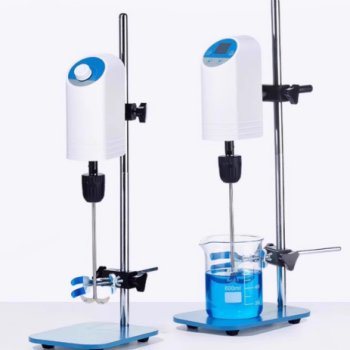
The reactor's stirrer functions as the critical mechanical driver required to achieve thorough contact between the specific reactants 3-aminopropyltriethoxysilane and monoethanolamine. By generating consistent mechanical force, the stirrer ensures a uniform distribution of these primary ingredients alongside necessary antioxidants and catalysts. This physical agitation is the prerequisite for facilitating stable chemical reactions and maximizing synthesis efficiency.
High-efficiency stirring acts as the "heartbeat" of the synthesis process, transforming distinct chemical components into a homogenous mixture. It ensures that essential molecular collisions occur reliably, regardless of whether the system is at room temperature or undergoing heating.
The Mechanics of Efficient Synthesis
The stirrer addresses the deep need for consistency in a complex chemical environment. Without it, the synthesis of biodegradable aminosiloxanes would likely suffer from stratification and incomplete reactions.
Achieving Chemical Homogeneity
The primary role of the stirrer is to prevent the separation of ingredients. It mechanically forces the 3-aminopropyltriethoxysilane and monoethanolamine to mix intimately with antioxidants and catalysts.
This creates a uniform mixture where every part of the reactor volume contains the correct ratio of reactants.
Facilitating Molecular Collisions
For a chemical reaction to occur, molecules must physically interact. The stirrer actively promotes these effective molecular collisions.
By keeping the fluid in motion, the equipment increases the probability of reactant molecules meeting, directly improving the reaction rate.
Stability Across Thermal Phases
The synthesis process involves different thermal stages, including room-temperature operations and subsequent heating.
The stirrer maintains reaction stability during these transitions. It ensures that heat and reactants remain evenly distributed, preventing localized overheating or "cold spots" that could degrade the product.
Understanding the Trade-offs
While the stirrer is essential, understanding the implications of mechanical force is necessary for process optimization.
The Consequence of Inadequate Mixing
If the stirring efficiency is too low, the reactants will not achieve the necessary uniform distribution.
This leads to incomplete reactions and a lower yield of biodegradable aminosiloxanes. It wastes raw materials and results in a product with inconsistent quality.
Balancing Force and Stability
The goal is high-efficiency stirring, but it must be balanced to ensure stable chemical reactions.
The mechanical force must be sufficient to drive collisions but consistent enough to avoid creating turbulence that might disrupt the specific reaction kinetics required for this synthesis.
Optimizing Your Synthesis Process
To ensure the successful production of biodegradable aminosiloxanes, focus on how your equipment manages reactant contact.
- If your primary focus is Reaction Speed: Prioritize high-efficiency stirring to maximize the frequency of effective molecular collisions between reactants.
- If your primary focus is Product Consistency: Ensure the stirrer maintains a uniform distribution of antioxidants and catalysts during both room-temperature and heating stages.
Ultimately, the stirrer is not just a mixing tool, but the fundamental control mechanism for reaction stability and efficiency.
Summary Table:
| Feature | Function in Synthesis | Impact on Final Product |
|---|---|---|
| Mechanical Force | Ensures uniform distribution of reactants and catalysts | Prevents stratification and material waste |
| Molecular Collisions | Increases physical interaction between molecules | Accelerates reaction rate and efficiency |
| Thermal Stability | Distributes heat evenly during room temp and heating phases | Prevents localized overheating and degradation |
| Homogeneity | Eliminates separation of 3-aminopropyltriethoxysilane | Guarantees consistent quality and high yield |
Elevate Your Chemical Synthesis with KINTEK Precision
Achieving consistent results in the synthesis of complex materials like biodegradable aminosiloxanes requires more than just chemistry—it requires superior engineering. KINTEK specializes in advanced laboratory solutions designed to give you total control over your reaction environment.
Our range of high-temperature high-pressure reactors and autoclaves is engineered for high-efficiency stirring and precise thermal management, ensuring stable chemical reactions and maximum yield. Whether you are scaling up battery research or optimizing specialized chemical production, KINTEK provides the high-performance tools you need, from crushing and milling systems to PTFE products and ceramics.
Ready to optimize your lab's efficiency? Contact our experts today to find the perfect reactor configuration for your specific synthesis needs.
References
- A. O. Patianova, V.L. Semenov. Improving the environmental production of electrodes for solar panels. DOI: 10.15826/chimtech.2020.7.4.09
This article is also based on technical information from Kintek Solution Knowledge Base .
Related Products
- Laboratory Small Constant Temperature Heated Magnetic Stirrer Heater and Stirrer
- High Performance Laboratory Stirrers for Diverse Applications
- Customizable Laboratory High Temperature High Pressure Reactors for Diverse Scientific Applications
- High Pressure Laboratory Autoclave Reactor for Hydrothermal Synthesis
- Mini SS High Pressure Autoclave Reactor for Laboratory Use
People Also Ask
- What role does a magnetic stirrer with heating play in ZnO nanoparticle synthesis? Precision Control for Quality Results
- What role does a constant temperature heating magnetic stirrer play in MFC-HAp synthesis? Achieve Material Homogeneity
- What is the function of a laboratory magnetic stirrer in Ni–Cr–P electrodeposition? Optimize Ion Transport & Coating
- Why is a laboratory magnetic stirrer required for benzoic acid esters? Boost Reaction Speed & Yield with High RPM
- What role does a laboratory magnetic stirrer play in TiO2 and TiO2-Ag sol preparation? Master Chemical Kinetics