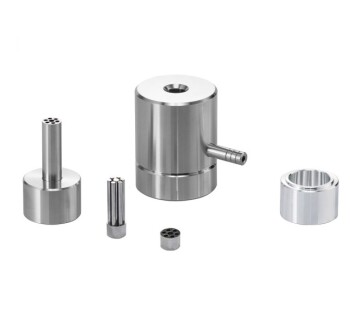
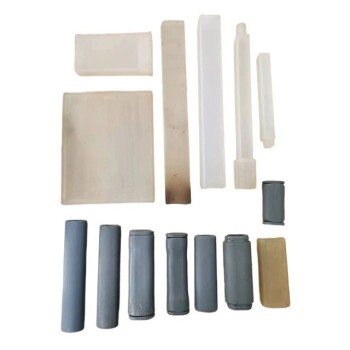
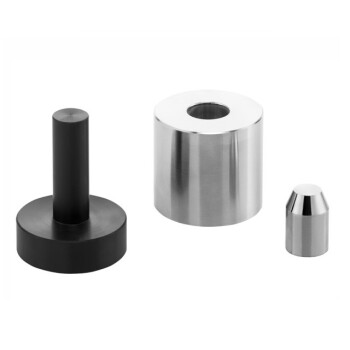
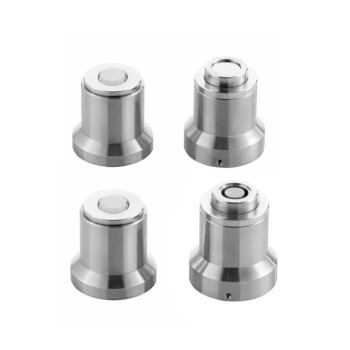
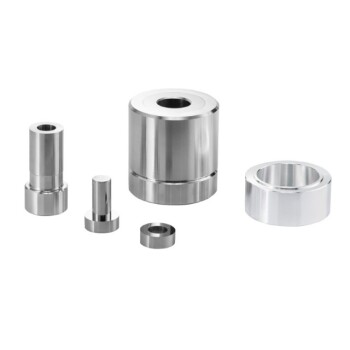
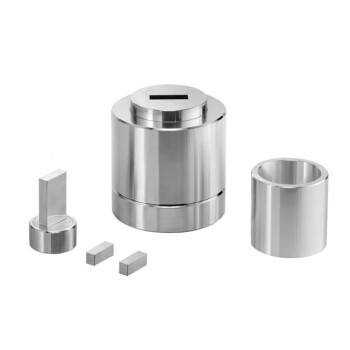
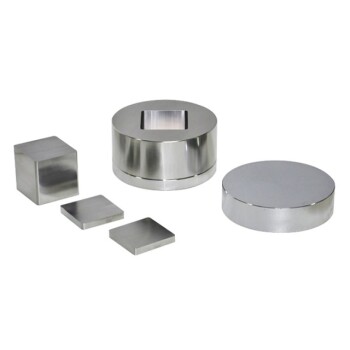
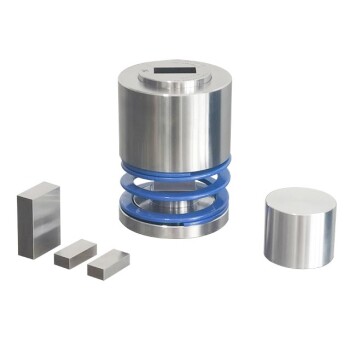
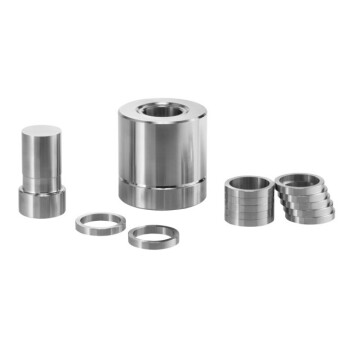
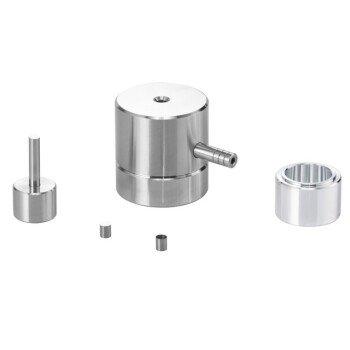
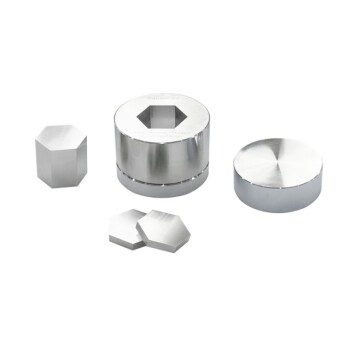
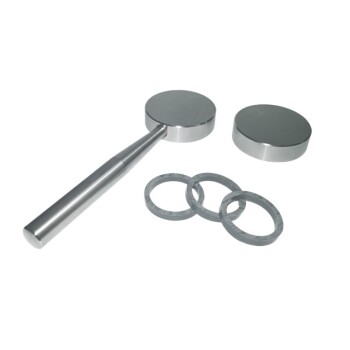
A stainless steel pressure mold serves as a critical mechanical constraint system. Its primary function during electrochemical testing is to apply and maintain constant, high external pressure on the all-solid-state battery cell. This pressure ensures tight physical contact between solid electrodes and the solid electrolyte, effectively compensating for the significant volume changes active materials undergo during charge and discharge cycles.
Without a liquid electrolyte to fill voids, solid-state batteries rely entirely on mechanical pressure to maintain ionic pathways. The pressure mold prevents the physical separation of material layers caused by volume expansion and contraction, preventing contact failure and stabilizing interfacial resistance.
The Challenge of Solid-Solid Interfaces
Overcoming the Lack of "Wetting"
In traditional batteries, liquid electrolytes naturally "wet" the electrode surfaces, filling every microscopic void to ensure ion flow.
All-solid-state batteries lack this mechanism. The stainless steel mold forces the solid particles of the cathode, anode, and electrolyte together to create a continuous path for ions to travel.
Managing Volume Fluctuations
Active materials in batteries effectively "breathe" during operation. Materials like sodium sulfide (Na2S) or NCM-811 undergo significant expansion and contraction during cycling.
Without external constraint, this movement leads to interface separation. The pressure mold acts as a stiff clamp, accommodating these volume changes while preventing the layers from physically detaching.
Operational Mechanisms of the Device
Stabilizing Interfacial Resistance
The primary failure mode in these tests is often a spike in impedance (resistance). This occurs when gaps form between the electrode and electrolyte.
By applying constant pressure (examples include 360 MPa in high-pressure scenarios, though ranges vary by chemistry), the mold minimizes interfacial resistance. It ensures that the "solid-solid" contact remains intimate throughout the lifespan of the test.
Ensuring Uniform Distribution
A high-quality stainless steel die is designed to be extremely rigid. It must withstand hundreds of megapascals without deforming.
This rigidity ensures that pressure is applied uniformly across the entire surface of the battery pellet. This prevents density gradients, where some areas are compressed well and others are loose, which would lead to localized failure or delamination.
Understanding the Trade-offs
Mechanical Limits and Deformation
While pressure is vital, the mold itself must not deform. If the stainless steel yields under the immense stress, the pressure applied to the battery becomes inconsistent.
This requires the use of high-strength steel alloys. Using a mold with insufficient yield strength can lead to erroneous test results, as the loss of pressure will look like electrochemical failure.
Distinguishing Pressure Effects
It is important to note that the pressure applied by the mold influences the electrochemical behavior.
High pressure improves contact but can also alter the physical properties of soft electrolytes (like sulfides). When analyzing data, one must account for the fact that the results are dependent on the specific pressure environment provided by the mold.
Making the Right Choice for Your Testing
To ensure valid data, your choice of pressure hardware should match your specific testing goals:
- If your primary focus is Cycle Stability: Prioritize a mold with a calibrated locking mechanism to maintain constant stack pressure despite volume expansion.
- If your primary focus is Material Densification: Ensure the mold is rated for pressures significantly higher (e.g., >300 MPa) than your testing target to prevent die deformation.
The stainless steel pressure mold is not merely a container; it is an active variable that defines the structural integrity necessary for solid-state chemistry to function.
Summary Table:
| Feature | Function in Electrochemical Testing |
|---|---|
| Mechanical Constraint | Maintains tight physical contact between solid electrodes and electrolytes. |
| Volume Management | Compensates for active material expansion/contraction during cycling. |
| Interfacial Stability | Minimizes impedance spikes by preventing layer separation and gaps. |
| Pressure Uniformity | Ensures consistent ion pathways across the entire battery pellet surface. |
| Structural Rigidity | High-strength stainless steel prevents die deformation under high MPa loads. |
Elevate Your Solid-State Battery Research with KINTEK
Precise mechanical control is the cornerstone of reliable electrochemical data. KINTEK specializes in high-performance laboratory equipment designed for the rigorous demands of next-generation energy storage. Our robust stainless steel pressure molds and isostatic/hydraulic presses provide the extreme rigidity and uniform pressure distribution necessary to stabilize solid-solid interfaces and eliminate contact failure.
Whether you are focusing on material densification or long-term cycle stability, KINTEK offers a comprehensive range of solutions—from high-temperature furnaces and CVD systems to specialized battery research tools and consumables.
Ready to achieve superior interface stability in your ASSB testing? Contact KINTEK today to discover how our precision-engineered hardware can streamline your laboratory workflow and deliver more accurate, reproducible results.
Related Products
- Battery Lab Equipment 304 Stainless Steel Strip Foil 20um Thick for Battery Test
- Special Shape Press Mold for Lab
- Isostatic Molding Pressing Molds for Lab
- Button Battery Tablet Press Sealing Mold for Lab Use
- Button Battery Disassembly and Sealing Mold for Lab Use
People Also Ask
- How is a galvanostat used to evaluate F-rGO layers? Quantifying Protective Performance in Lithium Metal Batteries
- What is the sputtering cathode method? A Guide to Thin Film Deposition Technology
- What is sputtering target material? The Blueprint for High-Quality Thin Film Coatings
- What is organic thin film? A Guide to Engineered Molecular Layers for Advanced Tech
- What are the target materials for sputtering? From Metals to Ceramics for Precise Thin Films