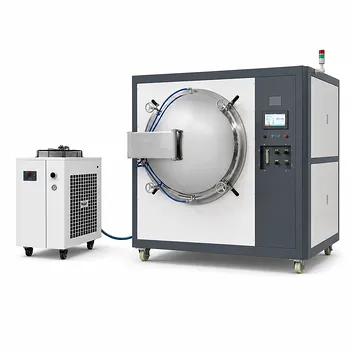
The primary function of a vacuum oven in processing functionalized siloxane oligomers is to overcome the material's natural viscosity to mechanically extract entrapped air and reduce dissolved oxygen. Because these oligomers are too viscous to allow bubbles generated during mixing to escape naturally, the vacuum environment is essential to force their removal prior to UV curing.
Core Takeaway While removing visible bubbles ensures structural consistency, the vacuum oven’s most critical chemical function is reducing dissolved oxygen. This prevents "oxygen inhibition" during free radical polymerization, ensuring the final material cures efficiently without surface tackiness.
The Physics of De-aeration
Overcoming Material Viscosity
Functionalized siloxane oligomers possess a specific viscosity that acts as a physical barrier to natural degassing.
When you mix these materials, air is inevitably introduced. Without external intervention, the fluid is too thick for these buoyant forces to overcome the drag, trapping the bubbles inside the mixture indefinitely.
Forcing Bubble Evacuation
The vacuum oven alters the environmental pressure, drastically changing the physics inside the sample.
By lowering the pressure, the vacuum environment causes the trapped air pockets to expand in volume. This expansion increases their buoyancy, forcing them to rise to the surface and rupture, effectively removing the residual air bubbles that mixing created.
The Chemistry of Curing
Eliminating the Oxygen Threat
Beyond visible bubbles, the vacuum oven performs a critical chemical service: reducing dissolved oxygen content.
Oxygen is a known inhibitor in free radical polymerization, the chemical reaction used to cure these materials. If oxygen remains within the oligomer, it scavenges the free radicals needed to create polymer chains, stalling the reaction.
Ensuring Surface Integrity
The presence of oxygen is particularly detrimental at the surface of the film, leading to a defect known as surface tackiness.
By degassing the sample in a vacuum, you minimize the oxygen available to interfere with the cure. This leads to significantly improved curing efficiency and a tack-free finish that is difficult to achieve otherwise.
Understanding the Structural Impact
Achieving Microscopic Density
The removal of air affects the internal integrity of the cured film, not just its appearance.
A proper degassing cycle ensures a dense microscopic structure. Without this step, microscopic voids would remain in the cured film, potentially compromising the material's mechanical strength and barrier properties.
Making the Right Choice for Your Goal
To optimize your UV curing process, consider how the vacuum step aligns with your specific quality requirements:
- If your primary focus is Structural Integrity: Prioritize the vacuum cycle to remove entrapped air bubbles, ensuring a dense microscopic structure free of voids.
- If your primary focus is Surface Finish: Ensure the vacuum level is sufficient to lower dissolved oxygen, preventing inhibition and eliminating surface tackiness.
By controlling the atmosphere before the cure begins, you secure the chemical potential of the oligomer.
Summary Table:
| Feature | Impact on Siloxane Oligomers | Benefit to UV Curing |
|---|---|---|
| Pressure Reduction | Expands trapped air bubbles for easy removal | Ensures microscopic density & structural integrity |
| Oxygen Removal | Reduces dissolved oxygen levels in the material | Eliminates oxygen inhibition for efficient polymerization |
| Viscosity Management | Overcomes material drag to allow degassing | Prevents internal voids and surface defects |
| Surface Treatment | Minimizes oxygen at the material interface | Achieves a tack-free, professional surface finish |
Elevate Your Materials Research with KINTEK Precision
Don't let oxygen inhibition or entrapped bubbles compromise your UV curing results. KINTEK specializes in advanced laboratory solutions designed for high-performance material processing. Whether you are degassing functionalized siloxanes or conducting complex polymer research, our precision vacuum ovens, high-temperature furnaces, and specialized high-pressure reactors provide the controlled environments necessary for superior chemical outcomes.
From high-quality PTFE consumables to sophisticated battery research tools, KINTEK is your partner in achieving microscopic density and flawless surface integrity.
Ready to optimize your lab's degassing and curing efficiency? Contact KINTEK Today to Find Your Perfect Equipment Solution
References
- Dan Du, Hong Dong. The Preparation of Acryloxyl Group Functionalized Siloxane Polymers and the Study of Their Ultra Violet Curing Properties. DOI: 10.3390/polym16040465
This article is also based on technical information from Kintek Solution Knowledge Base .
Related Products
- 56L Vertical Laboratory Vacuum Drying Oven
- 23L Laboratory Vacuum Drying Oven
- Vacuum Heat Treat Sintering Brazing Furnace
- 2200 ℃ Graphite Vacuum Heat Treat Furnace
- Dental Porcelain Zirconia Sintering Ceramic Vacuum Press Furnace
People Also Ask
- Why is a laboratory vacuum drying oven recommended for rice straw residues? Protect Your Biomass Integrity
- What role does a laboratory vacuum drying oven play in the preparation of modified multi-walled carbon nanotubes?
- What is the importance of using a laboratory vacuum drying oven? Preserving Slow-Release Microcapsule Integrity
- Why is a Laboratory Vacuum Drying Oven recommended for PBAT microspheres? Protect Sensitive Polymer Integrity
- What role does a laboratory vacuum drying oven play in processing nanoparticle powder samples? Protect Sample Integrity