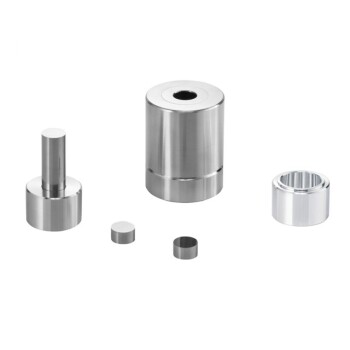
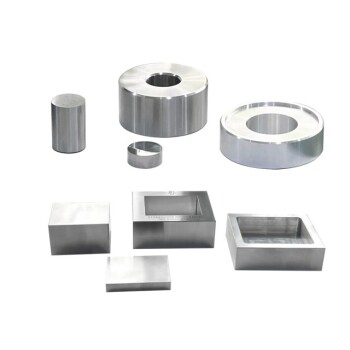
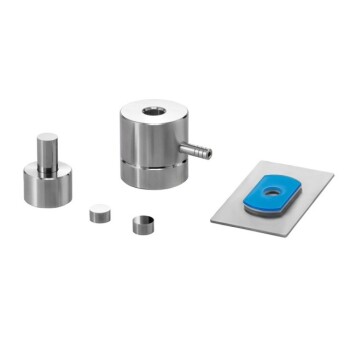
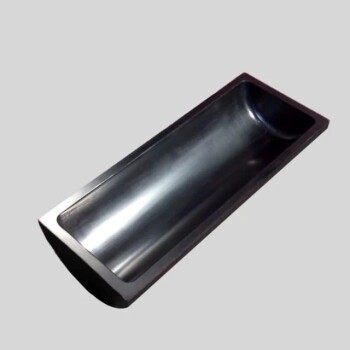
Graphite molds serve as the essential structural interface during the hot pressing of Tantalum Carbide (TaC) ceramics, acting as both the containment vessel and the mechanism for force application. Their primary function is to effectively transmit uniaxial pressure from the hydraulic system to the ceramic powder while maintaining precise geometric shape under extreme sintering temperatures of up to 2000°C.
Core Takeaway Graphite molds are critical because they possess the unique ability to maintain structural rigidity and chemical stability at temperatures where metal molds would melt or deform. They enable the simultaneous application of heat and pressure required to densify Tantalum Carbide, ensuring the final component achieves high density and accurate dimensions.
The Mechanics of Densification and Containment
Uniaxial Pressure Transmission
The primary mechanical role of the graphite mold is to convert the force from the hydraulic press into uniform pressure on the TaC powder.
The mold acts as a piston-and-cylinder system. It must be strong enough to transmit significant mechanical pressure (often around 30 MPa) directly to the powder without buckling.
This pressure is vital for the sintering process. It forces particle rearrangement and induces plastic deformation in the powder, driving the material toward full density.
Structural Stability at Extreme Temperatures
Tantalum Carbide requires exceptionally high temperatures to sinter, often reaching 2000°C.
Graphite is one of the few materials that does not melt or significantly soften at these temperatures. By maintaining its stiffness, the mold ensures the ceramic sample retains its intended shape throughout the heating cycle.
This high-temperature rigidity guarantees the "dimensional accuracy" of the final part, preventing warping or slumping that would occur with less thermally stable mold materials.
Thermal and Chemical Regulation
Beyond physical shaping, the graphite mold influences the thermal and chemical environment of the sintering process.
Graphite has high thermal conductivity. This allows it to transfer heat uniformly from the heating elements into the TaC powder, preventing hot spots and ensuring even densification.
Additionally, graphite creates a "reducing atmosphere" within the hot press vacuum. This helps strip oxygen and prevents the oxidation of the Tantalum Carbide, preserving the chemical purity of the ceramic.
Understanding the Trade-offs
The Consumable Nature of Graphite
While graphite is thermally stable, it is generally considered a consumable in this process.
Repeated cycling to 2000°C and high pressure eventually fatigues the material. Molds may degrade over time, affecting dimensional tolerances if reused too frequently.
Carbon Diffusion Risks
Because the mold is made of carbon and is in direct contact with the ceramic at high temperatures, there is a possibility of carbon diffusion.
While usually acceptable for carbide ceramics like TaC, this interaction must be monitored to ensure it does not alter the stoichiometry (chemical balance) of the surface layer of the final part.
Making the Right Choice for Your Goal
How to Apply This to Your Project
To maximize the effectiveness of graphite molds in your specific application, consider the following based on your priority:
- If your primary focus is Dimensional Precision: Prioritize high-strength, high-density graphite grades that resist creep deformation even at maximum hold times at 2000°C.
- If your primary focus is Material Purity: Ensure the mold design accounts for potential carbon diffusion and verify that the reducing atmosphere provided by the graphite aligns with your specific TaC stoichiometry requirements.
By selecting the correct mold grade and design, you ensure that the extreme conditions of hot pressing yield a Tantalum Carbide component that is both dense and dimensionally accurate.
Summary Table:
| Function | Description | Key Benefit |
|---|---|---|
| Pressure Transmission | Converts hydraulic force into uniaxial pressure (approx. 30 MPa). | Drives particle rearrangement and high density. |
| Structural Support | Maintains rigidity at extreme temperatures up to 2000°C. | Ensures dimensional accuracy and prevents warping. |
| Thermal Regulation | High thermal conductivity ensures uniform heat distribution. | Prevents hot spots for consistent material properties. |
| Chemical Shielding | Creates a reducing atmosphere within the vacuum furnace. | Prevents oxidation and preserves TaC chemical purity. |
Elevate Your Material Research with KINTEK Precision Solutions
Achieving full density in Tantalum Carbide (TaC) ceramics requires more than just heat—it requires high-performance tooling and pressure systems that withstand extreme environments. KINTEK specializes in advanced laboratory equipment, offering high-strength hydraulic presses (pellet, hot, and isostatic) and high-temperature vacuum and atmosphere furnaces specifically designed for advanced ceramic sintering.
Whether you are focusing on dimensional precision or material purity, our expert team can provide the high-density graphite consumables, hot pressing systems, and high-temperature reactors tailored to your laboratory's needs.
Ready to optimize your densification process? Contact KINTEK today to discuss your project requirements!
Related Products
- Carbide Lab Press Mold for Laboratory Applications
- Special Heat Press Mold for Lab Use
- Ball Press Mold for Lab
- Double Plate Heating Press Mold for Lab
- Anti-Cracking Press Mold for Lab Use
People Also Ask
- How to use a press mold? Master the Art of Creating Consistent Ceramic Forms
- What is the press mould method? A Guide to Consistent, Detailed Ceramic Forms
- What is the function of press molds during the preparation of SiCf/Ti-43Al-9V composites? Achieve Structural Precision
- What is a press mold used for? Achieve Repeatable Precision and Efficiency
- What is the purpose of specialized pressure devices in sulfide solid-state batteries? Ensure Chemo-Mechanical Stability