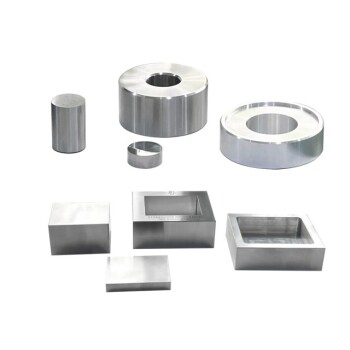
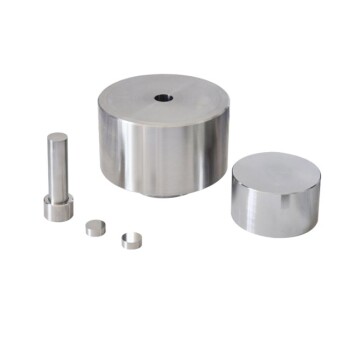
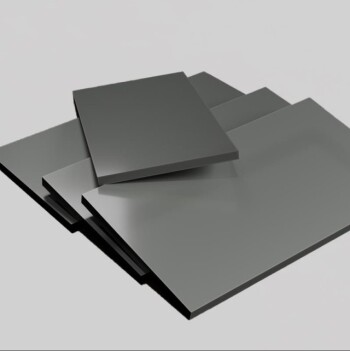
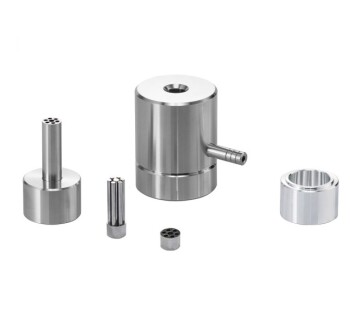
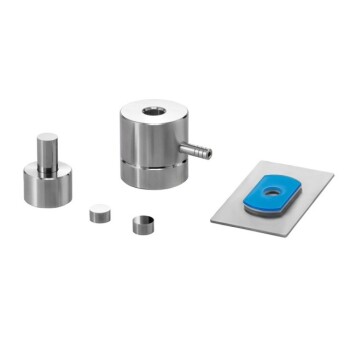
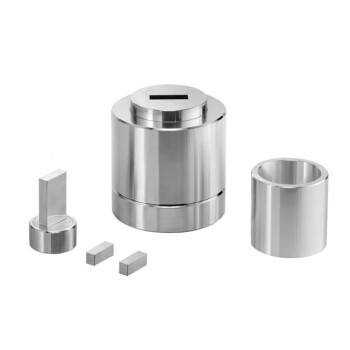
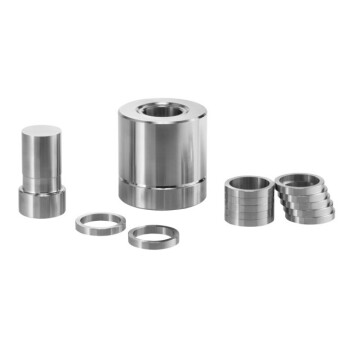
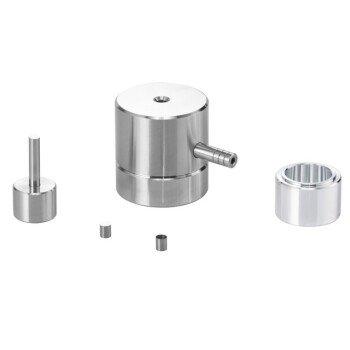
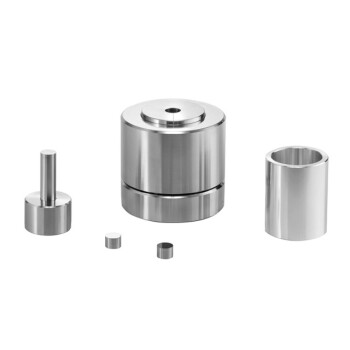
Graphite molds act as the critical structural and thermal interface during the hot pressing of LSLBO ceramic electrolytes. They function primarily as high-strength containers capable of withstanding the extreme uniaxial pressure required to compact the powder, while simultaneously utilizing their superior thermal conductivity to ensure heat is transferred uniformly throughout the material. Furthermore, graphite remains chemically stable when in contact with oxide electrolytes, provided the process occurs within a vacuum environment.
Core Takeaway The effectiveness of the graphite mold lies in its dual ability to act as a robust pressure vessel and a precise thermal conductor. It enables the high-density compaction of LSLBO powder without introducing thermal gradients or chemical contamination, which are common causes of failure in ceramic electrolytes.
Mechanical Role: Compaction and Containment
Withstanding Uniaxial Pressure
In the hot pressing process, densification is achieved by applying significant mechanical force.
Graphite molds possess high mechanical strength, allowing them to withstand heavy uniaxial pressure without deforming.
This resistance is essential for compacting the LSLBO powder into a solid, cohesive shape.
Containing the Powder Matrix
At high temperatures, ceramic powders can become unstable or difficult to contain.
The mold serves as a high-temperature resistant container, holding the LSLBO powder in place during the transition from loose particles to a sintered solid.
This ensures the final ceramic maintains precise geometric dimensions and structural integrity.
Thermal Role: Uniformity and Transfer
Ensuring Uniform Heat Distribution
One of the greatest challenges in sintering ceramics is avoiding "hot spots" or uneven heating, which can lead to cracks.
Graphite utilizes its excellent thermal conductivity to transfer heat evenly from the source to the LSLBO powder.
This creates a uniform thermal field, ensuring that the entire ceramic pellet sinters at the same rate and achieves consistent density.
Facilitating Efficient Heat Transfer
The mold acts as the direct medium between the heating element and the ceramic.
Its conductive properties allow for rapid and efficient thermal energy transfer, minimizing the lag time between the furnace environment and the sample core.
Chemical Role: Stability and Purity
Preventing Chemical Reaction
When processing oxide electrolytes like LSLBO, contamination from the mold material is a significant risk.
Graphite remains chemically stable in contact with these oxides, preventing unwanted reactions that could degrade the electrolyte's performance.
The Necessity of a Vacuum Environment
This chemical stability is conditional on the processing environment.
The primary reference explicitly states that this stability is maintained when used in a vacuum environment.
This prevents the graphite from oxidizing or reacting with atmospheric gases, which preserves both the mold's lifespan and the purity of the LSLBO ceramic.
Understanding the Operational Constraints
Environmental Sensitivity
While graphite is robust thermally and mechanically, it is highly sensitive to oxygen at high temperatures.
You must operate in a vacuum (or inert atmosphere) to prevent the mold from degrading. If exposed to air at sintering temperatures, the graphite will oxidize, potentially damaging the LSLBO sample.
Mechanical Limitations
Although graphite is strong, it is brittle compared to metals.
It withstands compressive (uniaxial) forces exceptionally well but has lower tensile strength. Care must be taken during the loading and unloading phases to avoid subjecting the mold to shear stress or impact.
Making the Right Choice for Your Goal
When selecting mold materials and parameters for LSLBO hot pressing, consider your specific objectives:
- If your primary focus is maximizing density: Ensure the graphite grade chosen has sufficient mechanical strength to withstand higher uniaxial pressures without fracture.
- If your primary focus is chemical purity: Verify that your hot pressing chamber maintains a high-quality vacuum to leverage the graphite's inherent chemical stability with oxides.
Graphite molds are not just containers; they are active thermal components that define the structural and chemical quality of your final LSLBO electrolyte.
Summary Table:
| Feature | Function in LSLBO Hot Pressing | Benefit |
|---|---|---|
| High Mechanical Strength | Withstands uniaxial pressure | Ensures high-density compaction without deformation |
| Thermal Conductivity | Uniform heat distribution | Prevents cracks by eliminating thermal gradients |
| Chemical Stability | Resistant to oxide reactions | Maintains high purity of the LSLBO electrolyte |
| Vacuum Compatibility | Prevents mold oxidation | Extends mold lifespan and protects sample integrity |
Elevate Your Material Research with KINTEK Precision Solutions
Achieving the perfect LSLBO ceramic electrolyte requires more than just high temperatures—it requires precision-engineered tools. KINTEK specializes in advanced laboratory equipment, including high-performance hot pressing systems, graphite molds, and high-temperature vacuum furnaces designed to meet the rigorous demands of battery research and ceramic engineering.
From high-pressure reactors and hydraulic presses to specialized consumables like crucibles and ceramic components, we provide the end-to-end solutions your lab needs to ensure chemical purity and structural integrity.
Ready to optimize your sintering process? Contact KINTEK today to discuss your project requirements!
Related Products
- Special Heat Press Mold for Lab Use
- Anti-Cracking Press Mold for Lab Use
- Double Plate Heating Press Mold for Lab
- Ball Press Mold for Lab
- Cylindrical Lab Electric Heating Press Mold for Laboratory Applications
People Also Ask
- How to use a press mold? Master the Art of Creating Consistent Ceramic Forms
- What is the press mould method? A Guide to Consistent, Detailed Ceramic Forms
- What is a press mold used for? Achieve Repeatable Precision and Efficiency
- What is the function of press molds during the preparation of SiCf/Ti-43Al-9V composites? Achieve Structural Precision
- What is the purpose of specialized pressure devices in sulfide solid-state batteries? Ensure Chemo-Mechanical Stability