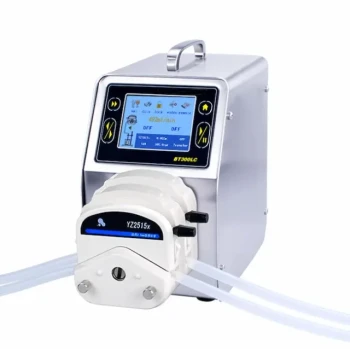
The primary function of the vacuum pump system during high-pressure MPCVD is to actively maintain a clean deposition environment while stabilizing the process pressure. Specifically, in the 20 to 23 Torr range used for DLC film preparation, the system continuously removes desorbed contaminants and reaction byproducts to ensure the purity of the final coating.
Core Takeaway The vacuum system is not merely a static pressure container; it is a dynamic exhaust mechanism. Its critical role is maintaining viscous flow conditions, ensuring that waste byproducts are efficiently swept away from the substrate to prevent defects in the Diamond-Like Carbon (DLC) film.
The Critical Role of Vacuum Dynamics
Active Contaminant Removal
The most vital task of the vacuum pump is the continuous extraction of impurities.
During the deposition process, various reaction byproducts and desorbed contaminants are generated inside the chamber.
The pump system effectively exhausts these unwanted elements, preventing them from re-depositing on the substrate and compromising the film's quality.
Maintaining Viscous Flow
For DLC preparation, the process operates under viscous flow conditions.
Unlike high-vacuum processes where molecules move individually, viscous flow allows for a steady stream of gas.
The pump must maintain this flow regime to ensure a consistent transport of reactants to the surface and waste products away from it.
Pressure Stabilization
The system must maintain a specific "high-pressure" window, typically between 20 and 23 Torr.
Stability in this range is essential for meeting production requirements and ensuring uniform film growth.
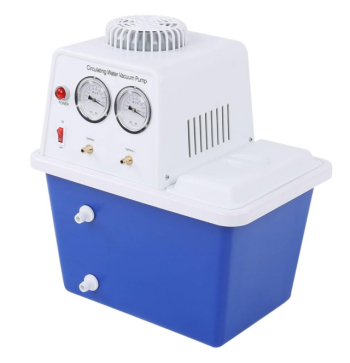
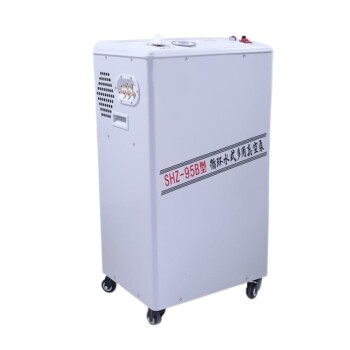
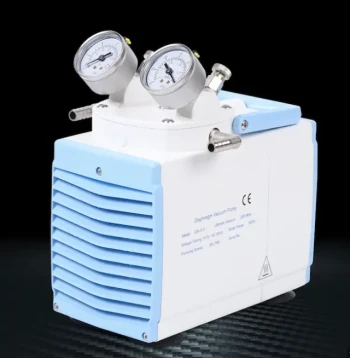
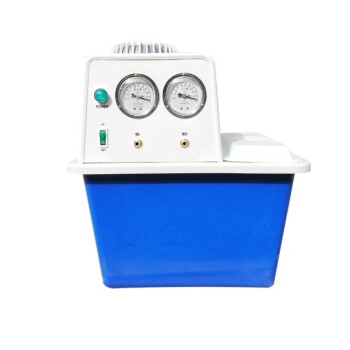
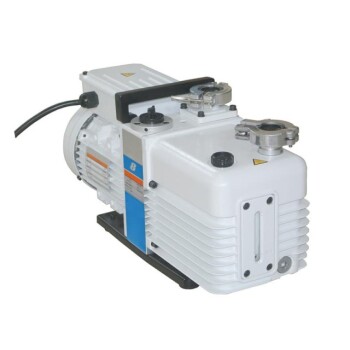
A standard, high-stability mechanical vacuum pump is generally sufficient to achieve this, making the process robust and reliable.
Understanding Operational Trade-offs
Simplicity vs. Complexity
One of the advantages of this specific process is reduced hardware complexity.
Because the process operates at 20-23 Torr using a mechanical pump, you avoid the need for complex ultra-high vacuum systems often required for other semiconductor processes.
However, this simplicity relies on the pump's mechanical stability; fluctuation in pumping speed can disrupt the delicate viscous flow balance.
Balancing Flow and Pressure
A common pitfall is focusing solely on achieving the target pressure without considering gas flow rates.
If the pump throttles too much to maintain pressure, contaminants may linger in the chamber.
The system must balance gas inlet flow with pumping speed to ensure fresh reactants constantly replace the exhausted byproducts.
Making the Right Choice for Your Goal
To optimize your DLC film production, align your vacuum strategy with your specific quality targets:
- If your primary focus is Film Purity: Ensure your pump has sufficient throughput to rapidly evacuate reaction byproducts, preventing re-contamination of the substrate.
- If your primary focus is Cost-Efficiency: Utilize high-stability mechanical pumps rather than turbo-molecular systems, as the 20-23 Torr range does not require ultra-high vacuum equipment.
Ultimately, the vacuum pump acts as the lungs of the MPCVD system, breathing out impurities to allow the high-quality DLC film to grow.
Summary Table:
| Function | Description | Impact on DLC Film Quality |
|---|---|---|
| Contaminant Removal | Actively exhausts reaction byproducts and desorbed impurities. | Prevents defects and ensures high chemical purity. |
| Viscous Flow Maintenance | Sustains a steady stream of gas to transport reactants/waste. | Ensures uniform film growth and efficient byproduct evacuation. |
| Pressure Stabilization | Maintains a constant 20-23 Torr operating window. | Provides process repeatability and meets production standards. |
| Dynamic Exhaust | Balances gas inlet flow with continuous pumping speed. | Prevents stagnation of waste gases near the substrate surface. |
Elevate Your MPCVD Thin Film Precision with KINTEK
High-quality DLC film deposition requires perfect synchronization between pressure control and vacuum stability. At KINTEK, we specialize in providing advanced laboratory equipment, including high-stability mechanical vacuum pumps, MPCVD and PECVD systems, and specialized high-temperature reactors tailored for semiconductor and battery research.
Whether you are refining your vacuum dynamics or scaling up production, KINTEK offers the expert-grade tools and consumables—from PTFE components to precision ceramic crucibles—to ensure your lab achieves superior results.
Ready to optimize your deposition process? Contact our technical experts today to find the perfect vacuum and furnace solution for your application.
References
- Sambita Sahoo, S. K. Pradhan. Structural and mechanical characterization of diamond like carbon films grown by microwave plasma CVD. DOI: 10.1016/j.surfcoat.2010.02.058
This article is also based on technical information from Kintek Solution Knowledge Base .
Related Products
- 915MHz MPCVD Diamond Machine Microwave Plasma Chemical Vapor Deposition System Reactor
- Cylindrical Resonator MPCVD Machine System Reactor for Microwave Plasma Chemical Vapor Deposition and Lab Diamond Growth
- Microwave Plasma Chemical Vapor Deposition MPCVD Machine System Reactor for Lab and Diamond Growth
- Split Chamber CVD Tube Furnace with Vacuum Station Chemical Vapor Deposition System Equipment Machine
- Chemical Vapor Deposition CVD Equipment System Chamber Slide PECVD Tube Furnace with Liquid Gasifier PECVD Machine
People Also Ask
- How does a microwave plasma reactor facilitate the synthesis of diamond? Master MPCVD with Precision Technology
- What are the advantages of a Microwave Plasma CVD reactor for MCD/NCD coatings? Precision Multilayer Diamond Engineering
- How do vacuum pumps and valves collaborate in MPCVD? Achieve Precise Pressure Control for Superior CNT Synthesis
- What are the primary advantages of the CVD method for growing diamonds? Engineering High-Purity Gems and Components
- How is a diamond formed from CVD? The Science of Growing Diamonds Atom by Atom