Knowledge Why is a gas ballast valve necessary on a rotary vane vacuum pump? Protect Your Oil and Extend Pump Life
Author avatar

Tech Team · Kintek Solution

Updated 2 days ago

Why is a gas ballast valve necessary on a rotary vane vacuum pump? Protect Your Oil and Extend Pump Life


The gas ballast valve is a critical defense mechanism designed to protect your rotary vane vacuum pump’s oil from contamination. It functions by allowing a controlled amount of atmospheric air into the pump’s compression stage, which prevents condensable vapors—such as water, solvents, or alcohols—from liquefying inside the pump housing and mixing with the lubricating oil.

The core function of the gas ballast is to ensure vapors remain in a gaseous state until they are exhausted. Without it, these vapors condense and contaminate the oil, causing a cascade of issues ranging from poor vacuum performance to catastrophic mechanical failure.

The Mechanics of Condensation

How Vapors Behave Under Pressure

When a rotary vane pump operates, it compresses gases to force them out of the exhaust valve.

The Condensation Point

If you are pumping condensable vapors (like moisture from the air or solvents from a process), the act of compression can raise their pressure to the point where they turn back into a liquid before they can be expelled.

The Role of the Ballast

The gas ballast mitigates this by introducing fresh air to dilute the vapor. This prevents the vapor from reaching its saturation point during compression, allowing it to be swept out of the pump as a gas rather than condensing into a liquid.

The Consequences of Operating Without Gas Ballast

Contaminated Lubrication

If condensation occurs, the liquid mixes with the vacuum pump oil. This emulsification degrades the oil’s lubricating properties, leading to increased friction and heat.

Loss of Performance

As the oil becomes contaminated with water or solvents, the pump’s ability to pull a deep vacuum diminishes. You will observe a noticeably higher ultimate pressure, meaning the pump cannot reach its rated vacuum level.

Internal Damage and Deposits

Over time, contaminated oil leads to the formation of internal deposits and sludge. These contaminants can clog filters and coat the internal components—such as the rotor and vanes—leading to corrosion, physical damage, and eventual pump failure.

Understanding the Trade-offs

Impact on Ultimate Vacuum

While the gas ballast is essential for protection, using it does come with a minor operational trade-off. When the valve is open, the introduction of atmospheric air means the pump cannot achieve its lowest possible ultimate vacuum pressure.

Balancing Protection and Performance

You must balance the need for deep vacuum against the need to protect the oil. The valve is typically opened during the initial phase of a process (when vapor load is high) and closed once the system is dry to achieve final pressure.

Making the Right Choice for Your Goal

To maximize the lifespan of your rotary vane pump, apply the gas ballast strategically based on your current application:

  • If your primary focus is handling high vapor loads (wet samples, solvents): Open the gas ballast valve to prevent liquid from forming in the oil sump and destroying your lubrication.
  • If your primary focus is achieving the deepest possible vacuum: Close the gas ballast valve only after the system has been purged of condensable vapors to reach the lowest ultimate pressure.

By correctly utilizing the gas ballast, you transform a fragile instrument into a durable workhorse capable of handling demanding environments.

Summary Table:

Feature Gas Ballast Open Gas Ballast Closed
Primary Function Prevents vapor condensation Achieves maximum vacuum
Oil Condition Protected from contamination Risk of emulsification/sludge
Vacuum Performance Slightly higher ultimate pressure Lowest possible ultimate pressure
Best For Wet samples, solvents, high moisture Dry systems, final stage vacuum
Internal Protection High (prevents corrosion) Low (if vapors are present)

Optimize Your Laboratory Performance with KINTEK

Don't let contaminated oil compromise your research or production. KINTEK specializes in high-performance laboratory equipment, providing robust rotary vane vacuum pumps, high-temperature furnaces, and specialized high-pressure reactors. Our technical experts are ready to help you select the right cooling solutions, vacuum systems, and consumables to ensure your lab runs at peak efficiency.

Ready to upgrade your equipment? Contact KINTEK Experts Today to discover how our comprehensive range of vacuum pumps, crushing systems, and hydraulic presses can deliver the precision and durability your work demands.

Related Products

People Also Ask

Related Products

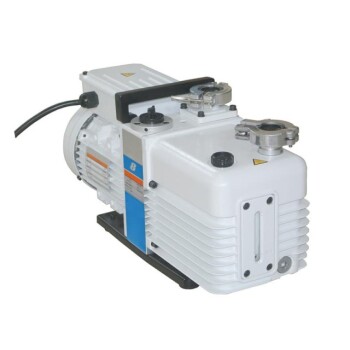
Laboratory Rotary Vane Vacuum Pump for Lab Use

Laboratory Rotary Vane Vacuum Pump for Lab Use

Experience high vacuum pumping speed and stability with our UL-certified Rotary Vane Vacuum Pump. Two-shift gas ballast valve and dual oil protection. Easy maintenance and repair.

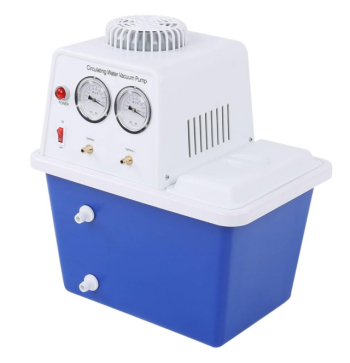
Circulating Water Vacuum Pump for Laboratory and Industrial Use

Circulating Water Vacuum Pump for Laboratory and Industrial Use

Efficient circulating water vacuum pump for labs - oil-free, corrosion-resistant, quiet operation. Multiple models available. Get yours now!

Laboratory Benchtop Water Circulating Vacuum Pump for Lab Use

Laboratory Benchtop Water Circulating Vacuum Pump for Lab Use

Need a water circulating vacuum pump for your lab or small-scale industry? Our Benchtop Water Circulating Vacuum Pump is perfect for evaporation, distillation, crystallization, and more.

Laboratory Vertical Water Circulating Vacuum Pump for Lab Use

Laboratory Vertical Water Circulating Vacuum Pump for Lab Use

Looking for a reliable water circulating vacuum pump for your lab or small-scale industry? Check out our Vertical Water Circulating Vacuum Pump with five taps and a larger air sucking amount, perfect for evaporation, distillation, and more.

Oil Free Diaphragm Vacuum Pump for Laboratory and Industrial Use

Oil Free Diaphragm Vacuum Pump for Laboratory and Industrial Use

Oil-free diaphragm vacuum pump for labs: clean, reliable, chemical-resistant. Ideal for filtration, SPE, and rotary evaporation. Maintenance-free operation.

Vacuum Sealed Continuous Working Rotary Tube Furnace Rotating Tube Furnace

Vacuum Sealed Continuous Working Rotary Tube Furnace Rotating Tube Furnace

Experience efficient material processing with our vacuum-sealed rotary tube furnace. Perfect for experiments or industrial production, equipped with optional features for controlled feeding and optimized results. Order now.

Variable Speed Peristaltic Pump

Variable Speed Peristaltic Pump

KT-VSP Series Smart Variable Speed Peristaltic Pumps offer precise flow control for labs, medical, and industrial applications. Reliable, contamination-free liquid transfer.

Electric Rotary Kiln Continuous Working Small Rotary Furnace Heating Pyrolysis Plant

Electric Rotary Kiln Continuous Working Small Rotary Furnace Heating Pyrolysis Plant

Efficiently calcine and dry bulk powder and lump fluid materials with an electric heating rotary furnace. Ideal for processing lithium ion battery materials and more.

Vacuum Hot Press Furnace Machine for Lamination and Heating

Vacuum Hot Press Furnace Machine for Lamination and Heating

Experience clean and precise lamination with Vacuum Lamination Press. Perfect for wafer bonding, thin-film transformations, and LCP lamination. Order now!

Lab Scale Rotary Single Punch Tablet Press Machine TDP Tablet Punching Machine

Lab Scale Rotary Single Punch Tablet Press Machine TDP Tablet Punching Machine

This machine is a single-pressure automatic rotating, continuous tableting machine that compresses granular raw materials into various tablets. It is mainly used for tablet production in the pharmaceutical industry, and is also suitable for chemical, food, electronics and other industrial sectors.

Ultra-High Temperature Graphite Vacuum Graphitization Furnace

Ultra-High Temperature Graphite Vacuum Graphitization Furnace

The ultra-high temperature graphitization furnace utilizes medium frequency induction heating in a vacuum or inert gas environment. The induction coil generates an alternating magnetic field, inducing eddy currents in the graphite crucible, which heats up and radiates heat to the workpiece, bringing it to the desired temperature. This furnace is primarily used for graphitization and sintering of carbon materials, carbon fiber materials, and other composite materials.

Vacuum Heat Treat Furnace with Ceramic Fiber Liner

Vacuum Heat Treat Furnace with Ceramic Fiber Liner

Vacuum furnace with polycrystalline ceramic fiber insulation liner for excellent heat insulation and uniform temperature field. Choose from 1200℃ or 1700℃ max. working temperature with high vacuum performance and precise temperature control.

2200 ℃ Graphite Vacuum Heat Treat Furnace

2200 ℃ Graphite Vacuum Heat Treat Furnace

Discover the power of the KT-VG Graphite Vacuum Furnace - with a maximum working temperature of 2200℃, it's perfect for vacuum sintering of various materials. Learn more now.

Graphite Vacuum Furnace High Thermal Conductivity Film Graphitization Furnace

Graphite Vacuum Furnace High Thermal Conductivity Film Graphitization Furnace

The high thermal conductivity film graphitization furnace has uniform temperature, low energy consumption and can operate continuously.

Graphite Vacuum Furnace Bottom Discharge Graphitization Furnace for Carbon Materials

Graphite Vacuum Furnace Bottom Discharge Graphitization Furnace for Carbon Materials

Bottom-out graphitization furnace for carbon materials, ultra-high temperature furnace up to 3100°C, suitable for graphitization and sintering of carbon rods and carbon blocks. Vertical design, bottom discharging, convenient feeding and discharging, high temperature uniformity, low energy consumption, good stability, hydraulic lifting system, convenient loading and unloading.

KF ISO Stainless Steel Vacuum Flange Blind Plate for High Vacuum Systems

KF ISO Stainless Steel Vacuum Flange Blind Plate for High Vacuum Systems

Discover KF/ISO stainless steel vacuum flange blind plates, ideal for high vacuum systems in semiconductor, photovoltaic, and research labs. High-quality materials, efficient sealing, and easy installation.<|end▁of▁sentence|>

Vacuum Cold Trap Chiller Indirect Cold Trap Chiller

Vacuum Cold Trap Chiller Indirect Cold Trap Chiller

Boost vacuum system efficiency and prolong pump life with our Indirect Cold Trap. Built-in chilling system with no need for fluid or dry ice. Compact design and easy to use.

Stainless Steel Quick Release Vacuum Chain Three-Section Clamp

Stainless Steel Quick Release Vacuum Chain Three-Section Clamp

Discover our stainless steel quick release clamp vacuum clamp, Ideal for high vacuum applications, Strong connections, reliable sealing, Easy installation, and durable design.

Small Vacuum Heat Treat and Tungsten Wire Sintering Furnace

Small Vacuum Heat Treat and Tungsten Wire Sintering Furnace

The small vacuum tungsten wire sintering furnace is a compact experimental vacuum furnace specially designed for universities and scientific research institutes. The furnace features a CNC welded shell and vacuum piping to ensure leak-free operation. Quick-connect electrical connections facilitate relocation and debugging, and the standard electrical control cabinet is safe and convenient to operate.

Graphite Vacuum Continuous Graphitization Furnace

Graphite Vacuum Continuous Graphitization Furnace

High-temperature graphitization furnace is a professional equipment for graphitization treatment of carbon materials. It is a key equipment for the production of high-quality graphite products. It has high temperature, high efficiency and uniform heating. It is suitable for various high-temperature treatments and graphitization treatments. It is widely used in metallurgy, electronics, aerospace, etc. industry.


Leave Your Message