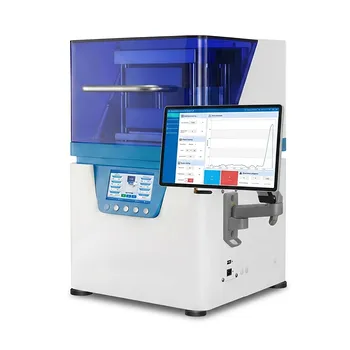
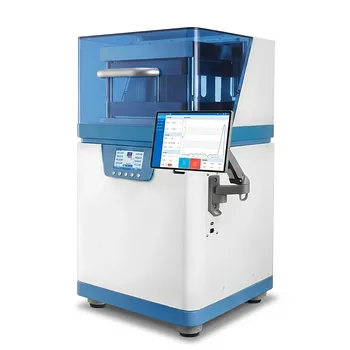
The laboratory hydraulic press is a critical instrument in MXene research because it transforms loose powders and slurries into high-density electrodes with optimized electrical pathways. By applying precise, multi-ton pressure, the press eliminates internal voids and ensures tight contact between MXene particles, which is essential for reducing contact resistance and accurately measuring the material's intrinsic electrochemical performance.
A laboratory hydraulic press is the bridge between raw MXene synthesis and reliable electrochemical analysis, providing the mechanical force necessary to minimize interfacial resistance and maximize volumetric energy density. Without this controlled compaction, researchers risk obtaining data that reflects poor electrode fabrication rather than the material's true potential.
Optimizing Electrical Connectivity
Reducing Particle-to-Particle Resistance
In MXene research, particularly with non-titanium variants, cold-pressing powders into dense pellets is vital for establishing tight contact between individual flakes. By applying high-pressure loads (often reaching 0.8 GPa or several tons), the hydraulic press eliminates internal pores that would otherwise act as insulating barriers. This process ensures that measurements, such as those taken via the four-probe method, accurately reflect the material's intrinsic resistivity and capacitance.
Improving Interfacial Contact with Current Collectors
When MXene slurries are coated onto substrates like copper foil or nickel mesh, the press is used to compact the composite material. This high-pressure flattening increases the electrical contact area between the active material and the current collector. Lowering this interfacial resistance is essential for high-rate performance, as it allows electrons to flow efficiently from the MXene sheets into the external circuit.
Enhancing Structural and Mechanical Integrity
Achieving Mechanical Strength in Free-Standing Pellets
For solid-state characterization, researchers often require free-standing, disc-shaped specimens that can withstand handling. The hydraulic press provides the uniform mechanical pressure needed to fuse particles into a cohesive structure without the need for excessive binders. These dense pellets provide the structural stability required for rigorous testing of mechanical and electrical properties.
Ensuring Durability During Electrochemical Cycling
Compaction through a hydraulic press ensures that active materials, conductive additives, and binders are securely bonded to the current collector. This structural reinforcement is critical during high-current charge and discharge cycles, where volume changes can lead to material delamination. By reinforcing this bond, the press helps maintain the cycling stability and long-term life of the electrode.
Impact on Data Accuracy and Specialized Testing
Eliminating Artifacts in In-Situ Research
During specialized in-situ gas or pressure testing, uniform current distribution is paramount. A hydraulic press ensures tight mechanical contact with irregular collectors, such as steel mesh, which prevents current crowding. This ensures that observed behaviors, like gas evolution, represent the intrinsic properties of the MXene rather than artifacts caused by poor electrical contact.
Consistency in Battery Packaging
Beyond electrode preparation, the hydraulic press is often used for the final sealing of coin cells. Stable, controlled pressure ensures that battery cases are hermetically sealed, preventing electrolyte leakage or air ingress. This consistency is vital for maintaining a controlled environment during long-term stability testing.
Understanding the Trade-offs
While high pressure is beneficial for density, it involves a delicate balance between connectivity and accessibility. Applying excessive pressure can over-compact the material, potentially crushing delicate MXene structures or closing off the ion transport channels necessary for electrolyte penetration. Conversely, insufficient pressure leaves internal voids, leading to high resistance and artificially low capacitance readings. Researchers must optimize pressure settings (e.g., 5 tons versus 10 tons) based on the specific MXene morphology and the presence of intercalants.
How to Apply This to Your Research
Making the Right Choice for Your Goal
- If your primary focus is measuring intrinsic resistivity: Use a hydraulic press with a precision mold to cold-press powders into high-density pellets (approaching 0.8 GPa) to eliminate all internal voids.
- If your primary focus is high-rate battery performance: Apply moderate pressure (around 5 tons) to coated electrode foils to enhance current collector contact while maintaining enough porosity for electrolyte ion diffusion.
- If your primary focus is in-situ gas evolution testing: Focus on the uniformity of the press to ensure the active material is perfectly flush against irregular current collectors like steel mesh.
- If your primary focus is material longevity: Use the press to maximize the mechanical bond between the binder and the current collector, which prevents the active layer from shedding during volume expansion.
A laboratory hydraulic press is not merely a tool for shaping materials, but a fundamental requirement for ensuring that MXene electrodes are dense, stable, and electrically optimized for accurate scientific discovery.
Summary Table:
| Research Challenge | Hydraulic Press Solution | Impact on MXene Results |
|---|---|---|
| High Contact Resistance | Eliminates internal voids and pores | Reflects intrinsic electrochemical performance |
| Poor Rate Performance | Maximizes contact with current collectors | Facilitates efficient electron flow at high rates |
| Structural Fragility | Fuses particles into cohesive pellets | Enables stable testing of mechanical properties |
| Electrode Delamination | Reinforces bond between binder and foil | Increases cycling stability and long-term life |
| Inconsistent Packaging | Provides hermetic sealing for coin cells | Prevents electrolyte leakage and air ingress |
Precision Engineering for Breakthrough MXene Research
Don't let poor electrode fabrication mask the true potential of your materials. KINTEK specializes in providing the high-precision tools necessary for advanced battery and energy storage research. From achieving perfect material density to ensuring airtight cell assembly, our equipment is designed to deliver repeatable, accurate results.
Our Comprehensive Research Portfolio Includes:
- Hydraulic Presses: A full range of pellet, hot, and isostatic presses for superior material compaction.
- High-Temperature Furnaces: Muffle, vacuum, CVD, and tube furnaces for precise material synthesis.
- Battery Research Tools: Specialized tools and consumables for coin cell and pouch cell development.
- Sample Preparation: Crushing and milling systems, high-purity crucibles, and ceramic components.
Ready to optimize your lab’s efficiency and data reliability? Contact KINTEK today to discuss your specific application and find the perfect equipment solution for your research goals.
References
- Sandhya Venkateshalu, Kwangyeol Lee. Recent advances in MXenes: beyond Ti-only systems. DOI: 10.1039/d3ta01590d
This article is also based on technical information from Kintek Solution Knowledge Base .
Related Products
- Laboratory Hydraulic Press Lab Pellet Press Machine for Glove Box
- Laboratory Hydraulic Press Split Electric Lab Pellet Press
- Fully Automatic Heated Hydraulic Lab Press for Materials Sintering and Sample Preparation
- Laboratory Hydraulic Press Lab Pellet Press for Button Battery
- Automatic Laboratory Hydraulic Press for XRF & KBR Pellet Press
People Also Ask
- What is the function of a laboratory hydraulic press in W-Cu composites? Control Porosity and Material Ratio
- What is the role of a laboratory hydraulic press in the initial stages of Li6PS5Cl preparation? Key to Green Pellets
- What role does a laboratory hydraulic press play in triboelectric testing? Achieve Precision Alloy Sample Prep
- How can a laboratory hydraulic press be applied to chitosan for wastewater treatment? Optimize Pores & Strength
- How do a precision laboratory hydraulic press and specialized molds contribute to the fabrication of spherical ceramic samples? Achieving High-Density Material Precision