Particle size uniformity is the silent engine of high-performance carbon synthesis.
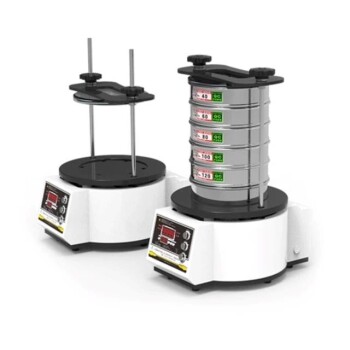
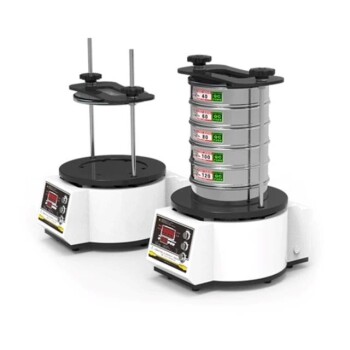
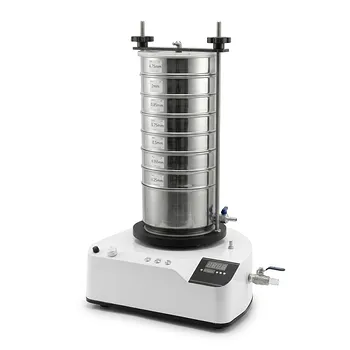
Using a standard vibrating sieve in the initial stages of magnetic biochar preparation ensures that raw materials, such as biomass powders, maintain a regular and uniform particle size. This consistency is critical for facilitating even chemical impregnation and ensuring uniform heat transfer during thermal conversion processes like pyrolysis. Ultimately, this standardization results in a magnetic biochar with a stable structure, controllable surface area, and highly reproducible performance.
Core Takeaway: A standard vibrating sieve acts as a foundational quality control tool that eliminates material variables, ensuring that subsequent chemical modifications and thermal treatments produce a consistent, high-functioning magnetic composite.
Optimizing the Chemical Impregnation Process
Achieving Uniform Iron Salt Distribution
The preparation of magnetic biochar typically involves the impregnation of iron salt solutions into a biomass precursor. A vibrating sieve ensures that every particle has a similar surface-area-to-volume ratio, allowing the solution to penetrate the material evenly. Without this uniformity, smaller particles may become oversaturated while larger particles remain untreated, leading to a product with inconsistent magnetic strength.
Enhancing Surface Area Control
By strictly controlling the grain size (for example, using a 120-mesh or 200-mesh sieve), researchers can better predict the specific surface area of the final product. Consistent initial sizing prevents the formation of irregular aggregates during the modification phase. This creates a reliable material foundation for the subsequent development of the biochar’s pore structure.
Enhancing Thermal Conversion and Stability
Facilitating Consistent Heat Conduction
During hydrothermal carbonization or pyrolysis, heat must permeate the biomass to trigger carbonization. Uniform particle sizes ensure uniform heat conduction throughout the material bed in a furnace or reactor. This prevents localized "hot spots" or under-processed cores, resulting in a biochar substrate with stable and predictable structural properties.
Controlling Pore Structure and Active Sites
The distribution of active sites—the areas where adsorption actually happens—is heavily influenced by how the material reacts to heat. When particles are uniform, the resulting pore structure is more homogeneous across the entire batch. This level of control is essential for ensuring that the magnetic functionalized biochar performs reliably in complex water treatment or soil remediation tasks.
Reliability in Experimental and Industrial Scaling
Ensuring Reproducibility of Results
In scientific research, the ability to replicate an experiment is paramount. Using standard sieves (such as a 0.096 mm aperture) eliminates surface area variations that would otherwise skew adsorption kinetic studies or performance evaluations. This standardization allows for the creation of accurate predictive models that can be trusted across different studies.
Predicting Fluid Dynamics and Mass Transfer
For industrial applications, biochar is often used in flow-through systems where fluid dynamic characteristics are vital. Consistent particle sizes provide predictable mass transfer rates, ensuring that water or chemicals move through the biochar bed at a steady, calculable pace. This prevents issues like "channeling," where fluid bypasses the media due to irregular packing of different-sized particles.
Understanding the Trade-offs
Material Loss and Processing Yields
While high-precision sieving increases quality, it often leads to lower material yields because a significant portion of the raw biomass may fall outside the required size range. This necessitates a balance between the desired level of uniformity and the cost of discarded raw material.
Maintenance and Equipment "Blinding"
Using very fine, high-mesh sieves (like 250-mesh) can lead to sieve blinding, where particles clog the mesh openings. This requires regular maintenance and specialized vibrating equipment to ensure the screening process remains efficient and does not introduce new inconsistencies into the production line.
Making the Right Choice for Your Goal
When integrating a standard vibrating sieve into your workflow, consider the specific requirements of your end application:
- If your primary focus is experimental reproducibility: Use a high-mesh standard analysis sieve (e.g., 200-mesh) to eliminate particle size as a variable in your adsorption and kinetic models.
- If your primary focus is industrial-scale production: Prioritize a vibrating sieve system that balances high throughput with a particle size range optimized for the heat transfer capabilities of your specific pyrolysis reactor.
- If your primary focus is maximizing magnetic performance: Ensure a tight particle size distribution during the initial powder preparation to guarantee that iron salt impregnation is uniform across the entire batch.
- If your primary focus is soil remediation or composting: Use a larger aperture sieve (e.g., 2mm) to remove impurities and ensure a standardized contact area for mixing with soil or manure.
Standardizing your raw material through precise sieving is the most effective way to transform unpredictable biomass into a high-performance, engineered magnetic adsorbent.
Summary Table:
| Key Aspect | Benefit for Magnetic Biochar | Performance Outcome |
|---|---|---|
| Particle Size Uniformity | Ensures even iron salt distribution during impregnation | Consistent magnetic strength & stability |
| Surface Area Control | Predictable grain size (e.g., 200-mesh) | Controlled pore structure & active sites |
| Heat Conduction | Eliminates hot spots during pyrolysis/hydrothermal carbonization | Stable structural properties |
| Mass Transfer | Predictable fluid dynamics in flow-through systems | Reliable adsorption in industrial applications |
Precision Tools for High-Performance Carbon Synthesis
Achieving reproducibility in magnetic biochar requires absolute control over material variables. KINTEK specializes in providing the laboratory precision you need—from high-performance vibrating sieves and sieving equipment for initial powder preparation to high-temperature furnaces (muffle, vacuum, atmosphere) and high-pressure reactors for consistent pyrolysis and carbonization.
Whether you are a researcher focused on adsorption kinetics or an industrial producer scaling up soil remediation solutions, our portfolio of milling systems, hydraulic presses, and thermal processing tools ensures your materials meet the highest standards.
Ready to optimize your biochar production? Contact our laboratory equipment experts today to find the perfect configuration for your workflow!
References
- Yi Wen, Rui Xu. Cadmium Elimination via Magnetic Biochar Derived from Cow Manure: Parameter Optimization and Mechanism Insights. DOI: 10.3390/pr11082295
This article is also based on technical information from Kintek Solution Knowledge Base .
Related Products
- Vibratory Sieve Shaker Machine Dry Three-Dimensional Vibrating Sieve
- Laboratory Vibratory Sieve Shaker Machine Slap Vibrating Sieve
- Laboratory Wet Three-Dimensional Vibratory Sieve Shaker Machine
- Laboratory Test Sieves and Vibratory Sieve Shaker Machine
- Laboratory Vibratory Sieve Shaker Machine for Dry and Wet Three-Dimensional Sieving
People Also Ask
- How is a vibratory sieve shaker used in the particle size analysis of mechanically alloyed powders? Expert Guide
- Why use a vibratory sieve shaker for PET powder? Achieve Precise Particle Size Control for Chemical Research
- What is the principle of vibratory sieve shaker? Achieve Accurate Particle Size Analysis
- What is the function of a vibratory sieve shaker? Achieve Precise Particle Size Analysis
- What is the use of vibratory sieve shaker? Achieve Precise Particle Size Analysis for Your Lab