Knowledge rotary furnace What is the industrial application of calcination? Transforming Raw Materials for Manufacturing
Author avatar

Tech Team · Kintek Solution

Updated 2 months ago

What is the industrial application of calcination? Transforming Raw Materials for Manufacturing


At its core, calcination is a foundational thermal process used across heavy industry to induce chemical changes in raw materials. Its most widespread industrial application is in the production of cement, where limestone (calcium carbonate) is heated in a kiln to produce lime (calcium oxide), a critical ingredient. It is also essential for extracting metals from their natural ores by removing volatile components before the final smelting stage.

The fundamental purpose of calcination is to use high heat—just below a material's melting point—to force a chemical decomposition, drive off volatile substances like water or carbon dioxide, or trigger a specific phase transition. It is a process of purification and transformation, not of melting.
What is the industrial application of calcination? Transforming Raw Materials for Manufacturing

The Role of Calcination in Industrial Processes

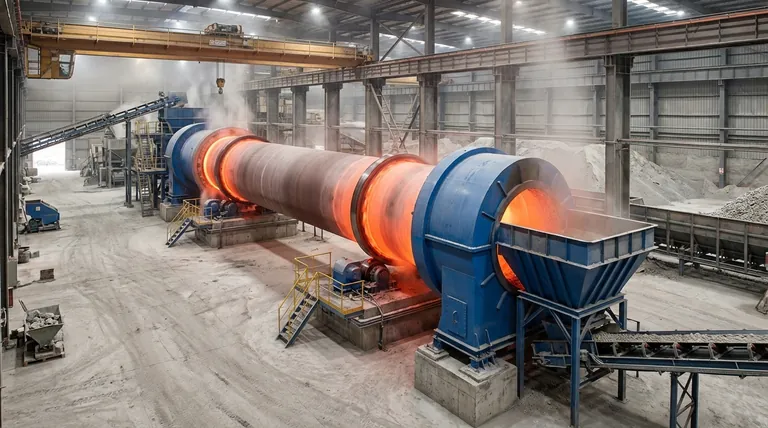
Calcination is a form of thermal treatment. The process is conducted in a specialized furnace or reactor, often a large rotating cylinder called a calciner, which allows for precise temperature control.

The goal isn't to liquefy the material but to heat it intensely enough to break chemical bonds and fundamentally change its composition or structure.

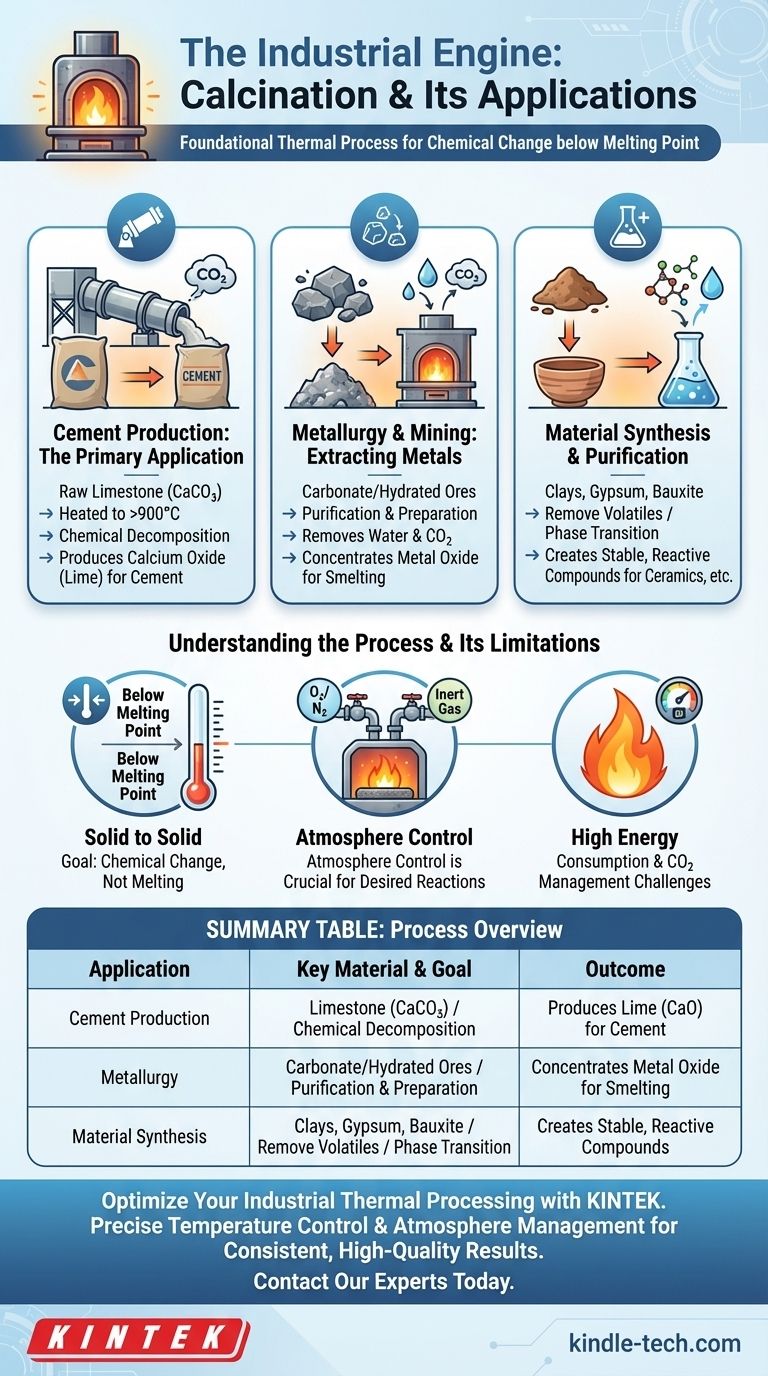
Cement Production: The Primary Application

The most common and highest-volume use of calcination is in manufacturing Portland cement.

Raw limestone (calcium carbonate, CaCO₃) is fed into a massive rotary kiln and heated to over 900°C. This heat causes a decomposition reaction, driving off carbon dioxide (CO₂) and leaving behind calcium oxide (CaO), commonly known as quicklime. This lime is the primary component of cement.

Metallurgy and Mining: Extracting Metals from Ores

Calcination is a critical preparatory step in smelting and refining metals. Many metals, such as lead, zinc, and copper, are mined as carbonate or hydrated ores.

Before these ores can be smelted to extract the pure metal, they must be calcined. The process removes water from hydrated minerals and carbon dioxide from carbonate ores, concentrating the metal oxide and making the subsequent smelting process more efficient and effective.

Material Synthesis and Purification

Beyond cement and metals, calcination is used to prepare a wide range of industrial materials.

The process is used to remove volatile organic compounds from clays before firing them into ceramics. It is also used to activate materials like petroleum coke or to drive water out of substances like bauxite and gypsum to create more stable or reactive compounds for further processing.

Understanding the Process and Its Limitations

While powerful, calcination is a specific tool for a specific job. Misunderstanding its principles can lead to process failures or undesired outcomes.

The Goal: Chemical Change, Not Melting

The defining characteristic of calcination is that it occurs below the material's melting point. If the temperature is too high and the material melts, the process becomes smelting or refining, which has a different purpose and outcome.

Atmosphere Control is Crucial

The chemical result of calcination is highly dependent on the atmosphere inside the furnace. For example, heating a substance in an oxygen-rich environment can promote oxidation, which may or may not be desired. In other cases, an inert atmosphere is required to prevent unwanted side reactions.

High Energy Consumption

Bringing massive volumes of raw material to temperatures of 900°C or higher is an extremely energy-intensive process. The cost of fuel and the management of emissions (especially the CO₂ released from carbonates) are significant operational challenges in industries that rely on calcination.

Making the Right Choice for Your Goal

Calcination is a versatile tool for material transformation. The key is to align the process parameters with your desired end product.

  • If your primary focus is chemical decomposition: Use calcination to break down carbonate compounds into their essential oxides, as seen in cement and lime production.
  • If your primary focus is material purification: Apply calcination to remove unwanted volatile substances, such as water from hydrated minerals or CO₂ from raw ores before smelting.
  • If your primary focus is phase transition: Use precise temperature control during calcination to change the crystalline structure of a material, thereby altering its physical properties.

Ultimately, calcination is the industrial engine for transforming raw, earthy materials into the purified and reactive building blocks of modern manufacturing.

Summary Table:

Application Key Material Process Goal Outcome
Cement Production Limestone (CaCO₃) Chemical Decomposition Produces Lime (CaO) for cement
Metallurgy Carbonate/Hydrated Ores Purification & Preparation Concentrates metal oxide for smelting
Material Synthesis Clays, Gypsum, Bauxite Remove Volatiles / Phase Transition Creates stable, reactive compounds

Optimize Your Industrial Thermal Processing with KINTEK

Whether you are developing new materials, purifying ores, or producing cement, precise thermal treatment is critical. KINTEK specializes in high-performance lab furnaces and industrial calcination equipment that deliver the exact temperature control and atmosphere management required for your specific process goals.

Our solutions help you achieve consistent, high-quality results while managing energy consumption effectively.

Ready to enhance your calcination process? Contact our experts today to discuss your application and discover the right equipment for your laboratory or production needs.

Visual Guide
What is the industrial application of calcination? Transforming Raw Materials for Manufacturing Visual Guide

Related Products

People Also Ask

Related Products

1700℃ Laboratory High Temperature Tube Furnace with Alumina Tube

1700℃ Laboratory High Temperature Tube Furnace with Alumina Tube

Looking for a high-temperature tube furnace? Check out our 1700℃ Tube Furnace with Alumina Tube. Perfect for research and industrial applications up to 1700C.

Vacuum Heat Treat and Pressure Sintering Furnace for High Temperature Applications

Vacuum Heat Treat and Pressure Sintering Furnace for High Temperature Applications

Vacuum pressure sintering furnaces are designed for high temperature hot pressing applications in metal and ceramic sintering. Its advanced features ensure precise temperature control, reliable pressure maintenance, and a robust design for seamless operation.

High Temperature Muffle Oven Furnace for Laboratory Debinding and Pre Sintering

High Temperature Muffle Oven Furnace for Laboratory Debinding and Pre Sintering

KT-MD High temperature debinding and pre-sintering furnace for ceramic materials with various molding processes. Ideal for electronic components such as MLCC and NFC.

1400℃ Laboratory High Temperature Tube Furnace with Alumina Tube

1400℃ Laboratory High Temperature Tube Furnace with Alumina Tube

Looking for a tube furnace for high-temperature applications? Our 1400℃ Tube Furnace with Alumina Tube is perfect for research and industrial use.

1400℃ Muffle Oven Furnace for Laboratory

1400℃ Muffle Oven Furnace for Laboratory

Get precise high-temperature control up to 1500℃ with KT-14M Muffle furnace. Equipped with a smart touch screen controller and advanced insulation materials.

1200℃ Muffle Furnace Oven for Laboratory

1200℃ Muffle Furnace Oven for Laboratory

Upgrade your lab with our 1200℃ Muffle Furnace. Achieve fast, precise heating with Japan alumina fibers and Molybdenum coils. Features TFT touch screen controller for easy programming and data analysis. Order now!

1800℃ Muffle Oven Furnace for Laboratory

1800℃ Muffle Oven Furnace for Laboratory

KT-18 muffle furnace with Japan Al2O3 polycrystalline fibe and Silicon Molybdenum heating element, up to 1900℃, PID temperature control and 7" smart touch screen. Compact design, low heat loss, and high energy efficiency. Safety interlock system and versatile functions.

1700℃ Muffle Oven Furnace for Laboratory

1700℃ Muffle Oven Furnace for Laboratory

Get superior heat control with our 1700℃ Muffle Furnace. Equipped with intelligent temperature microprocessor, TFT touch screen controller & advanced insulation materials for precise heating up to 1700C. Order now!

1700℃ Controlled Atmosphere Furnace Nitrogen Inert Atmosphere Furnace

1700℃ Controlled Atmosphere Furnace Nitrogen Inert Atmosphere Furnace

KT-17A Controlled atmosphere furnace: 1700℃ heating, vacuum sealing technology, PID temperature control, and versatile TFT smart touch screen controller for laboratory and industrial use.

1200℃ Split Tube Furnace with Quartz Tube Laboratory Tubular Furnace

1200℃ Split Tube Furnace with Quartz Tube Laboratory Tubular Furnace

KT-TF12 split tube furnace: high-purity insulation, embedded heating wire coils, and max. 1200C. Widely used for new materials and chemical vapour deposition.

1400℃ Controlled Atmosphere Furnace with Nitrogen and Inert Atmosphere

1400℃ Controlled Atmosphere Furnace with Nitrogen and Inert Atmosphere

Achieve precise heat treatment with KT-14A controlled atmosphere furnace. Vacuum sealed with a smart controller, it's ideal for lab and industrial use up to 1400℃.

Vertical High Temperature Graphite Vacuum Graphitization Furnace

Vertical High Temperature Graphite Vacuum Graphitization Furnace

Vertical high temperature graphitization furnace for carbonization and graphitization of carbon materials up to 3100℃.Suitable for shaped graphitization of carbon fiber filaments and other materials sintered in a carbon environment.Applications in metallurgy, electronics, and aerospace for producing high-quality graphite products like electrodes and crucibles.

Ultra-High Temperature Graphite Vacuum Graphitization Furnace

Ultra-High Temperature Graphite Vacuum Graphitization Furnace

The ultra-high temperature graphitization furnace utilizes medium frequency induction heating in a vacuum or inert gas environment. The induction coil generates an alternating magnetic field, inducing eddy currents in the graphite crucible, which heats up and radiates heat to the workpiece, bringing it to the desired temperature. This furnace is primarily used for graphitization and sintering of carbon materials, carbon fiber materials, and other composite materials.

2200 ℃ Tungsten Vacuum Heat Treat and Sintering Furnace

2200 ℃ Tungsten Vacuum Heat Treat and Sintering Furnace

Experience the ultimate refractory metal furnace with our Tungsten vacuum furnace. Capable of reaching 2200℃, perfect for sintering advanced ceramics and refractory metals. Order now for high-quality results.

Electric Rotary Kiln Continuous Working Small Rotary Furnace Heating Pyrolysis Plant

Electric Rotary Kiln Continuous Working Small Rotary Furnace Heating Pyrolysis Plant

Efficiently calcine and dry bulk powder and lump fluid materials with an electric heating rotary furnace. Ideal for processing lithium ion battery materials and more.

2200 ℃ Graphite Vacuum Heat Treat Furnace

2200 ℃ Graphite Vacuum Heat Treat Furnace

Discover the power of the KT-VG Graphite Vacuum Furnace - with a maximum working temperature of 2200℃, it's perfect for vacuum sintering of various materials. Learn more now.

Graphite Vacuum Furnace Bottom Discharge Graphitization Furnace for Carbon Materials

Graphite Vacuum Furnace Bottom Discharge Graphitization Furnace for Carbon Materials

Bottom-out graphitization furnace for carbon materials, ultra-high temperature furnace up to 3100°C, suitable for graphitization and sintering of carbon rods and carbon blocks. Vertical design, bottom discharging, convenient feeding and discharging, high temperature uniformity, low energy consumption, good stability, hydraulic lifting system, convenient loading and unloading.

Horizontal High Temperature Graphite Vacuum Graphitization Furnace

Horizontal High Temperature Graphite Vacuum Graphitization Furnace

Horizontal Graphitization Furnace: This type of furnace is designed with the heating elements placed horizontally, allowing for uniform heating of the sample. It's well-suited for graphitizing large or bulky samples that require precise temperature control and uniformity.

Electric Rotary Kiln Pyrolysis Furnace Plant Machine Calciner Small Rotary Kiln Rotating Furnace

Electric Rotary Kiln Pyrolysis Furnace Plant Machine Calciner Small Rotary Kiln Rotating Furnace

Electric rotary kiln - precisely controlled, it's ideal for calcination and drying of materials like lithium cobalate, rare earths, and non-ferrous metals.

High Temperature Alumina (Al2O3) Furnace Tube for Engineering Advanced Fine Ceramics

High Temperature Alumina (Al2O3) Furnace Tube for Engineering Advanced Fine Ceramics

High temperature alumina furnace tube combines the advantages of high hardness of alumina, good chemical inertness and steel, and has excellent wear resistance, thermal shock resistance and mechanical shock resistance.


Leave Your Message