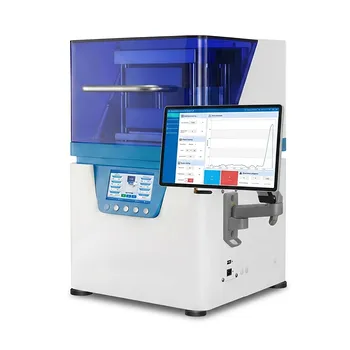
The necessity of a laboratory hydraulic press lies in its ability to transform qualitative observations into quantitative data. It serves as the bridge between raw biomass and a viable industrial fuel by measuring mechanical durability—specifically vertical compressive and radial tensile strength—to ensure pellets survive the rigors of transport. Furthermore, it allows for the precise simulation of industrial molding environments, enabling producers to optimize forming pressure, moisture content, and binder usage before scaling up production.
Utilizing a laboratory hydraulic press is the only way to establish a scientific baseline for pellet quality. By applying precise mechanical loads and simulating extrusion conditions, researchers can optimize production energy efficiency and ensure the physical integrity of biomass fuels across the entire supply chain.
Quantifying Mechanical Integrity and Durability
Measuring Compressive and Tensile Strength
A laboratory hydraulic press applies a precise and controlled mechanical load until a pellet reaches its fracture point. This quantitative measurement determines the maximum stress a pellet can endure, providing the "break point" data necessary for quality control.
Predicting Logistical Resilience
Biomass pellets must withstand significant pressure during storage in silos and vibration during long-distance transport. By testing radial tensile strength, researchers can predict whether pellets will crumble into dust (fines), which poses a fire risk and reduces feeding efficiency in industrial boilers.
Evaluating Material Variables
The press allows for the isolated testing of how moisture content, particle size, and binders impact the final strength of the pellet. This capability ensures that the chemical composition of the biomass is physically supported by a stable mechanical structure.
Optimizing Industrial Production Parameters
Simulating Large-Scale Molding Conditions
Advanced laboratory presses allow researchers to adjust die wall temperatures (60°C to 130°C) and high compression pressures (up to 300-555 MPa). This simulates the single-hole molding process, allowing for the optimization of industrial-scale pellet mill dies without wasting tons of raw material.
Analyzing Extrusion Friction and Energy Use
By recording the friction generated during the pelletization process, a hydraulic press helps predict industrial energy consumption. Understanding the relationship between forming pressure and friction allows manufacturers to select the most energy-efficient settings for mass production.
Increasing Energy and Bulk Density
Loose biomass is difficult to transport due to its low bulk density; a hydraulic press facilitates the study of mechanical densification. Increasing the density of materials like torrefied wood or straw significantly reduces logistical costs and improves the efficiency of subsequent combustion or gasification.
Enhancing Experimental Accuracy and Repeatability
Standardizing Samples for Combustion
For scientific research, the hydraulic press creates pellets with standardized dimensions and density. This uniformity is critical for combustion experiments, ensuring that variations in data result from the material's properties rather than inconsistent fuel shapes.
Predicting Material Swelling and Agglomeration
In thermochemical conversion studies, researchers use presses to observe how pellets behave under heat, including particle swelling (which can reach 50-80%). This helps in understanding how released tars act as binders, preventing unexpected agglomeration in industrial reactors.
Understanding the Trade-offs and Pitfalls
Single Pellet vs. Bulk Reality
While testing a single pellet provides high precision, it may not always reflect the stochastic nature of bulk production. It is a common pitfall to assume a laboratory-perfect pellet will behave identically when produced by the thousands in a high-speed mechanical mill.
The Risk of Over-Compression
Applying excessive pressure (over-densification) can lead to pellets that are too hard, which may cause incomplete combustion or excessive wear on industrial feeding equipment. Finding the "optimal" strength—rather than the "maximum" strength—is essential for a functional product.
How to Apply These Methods to Your Project
Making the Right Choice for Your Goal
To get the most value from your laboratory equipment, align your testing protocols with your primary operational objective.
- If your primary focus is reducing transport losses: Prioritize radial tensile strength testing to simulate the crushing forces found in transport containers and silos.
- If your primary focus is lowering production costs: Use the press to find the minimum forming pressure and temperature required to achieve acceptable durability, thereby saving energy.
- If your primary focus is scientific research: Utilize standardized dies to ensure geometric uniformity, which is vital for the repeatability of thermochemical and combustion data.
By integrating laboratory strength testing into your workflow, you move from guesswork to a data-driven strategy that ensures both the physical and economic viability of your biomass fuel.
Summary Table:
| Key Benefit | Laboratory Function | Industrial Value |
|---|---|---|
| Mechanical Durability | Measures radial tensile and compressive strength. | Reduces breakage (fines) and fire risks during transport. |
| Process Optimization | Simulates die temperatures (60-130°C) and pressure. | Minimizes energy consumption and material waste in mass production. |
| Material Validation | Evaluates moisture, particle size, and binder impact. | Ensures consistent fuel quality and logistical resilience. |
| Sample Uniformity | Produces standardized density and dimensions. | Increases accuracy for combustion and thermochemical research. |
Elevate Your Biomass Research with KINTEK Precision
Ready to transform your biomass material testing into industrial success? KINTEK specializes in high-performance laboratory equipment designed to deliver the quantitative data you need for scientific excellence and production efficiency.
Our extensive portfolio features advanced manual and automatic hydraulic presses (pellet, hot, and isostatic) for superior densification, alongside crushing and milling systems and sieving equipment to ensure optimal particle preparation. To support your entire thermal analysis workflow, we also offer a comprehensive range of high-temperature furnaces (muffle, tube, vacuum, and atmosphere), cooling solutions, and essential consumables like crucibles and ceramics.
Partner with KINTEK to achieve unmatched repeatability, reduce logistical losses, and optimize your energy consumption.
Don't leave your fuel quality to guesswork—contact our technical experts today to find the perfect solution for your laboratory!
References
- Muhammet Enes Önür, Sema Yurdakul. Quality Properties and Torrefaction Characteristics of Pellets: Rose Oil Distillation Solid Waste and Red Pine Sawdust. DOI: 10.3390/su151410971
This article is also based on technical information from Kintek Solution Knowledge Base .
Related Products
- Laboratory Hydraulic Press Lab Pellet Press Machine for Glove Box
- Laboratory Hydraulic Press Split Electric Lab Pellet Press
- Fully Automatic Heated Hydraulic Lab Press for Materials Sintering and Sample Preparation
- Laboratory Hydraulic Press Lab Pellet Press for Button Battery
- Automatic Laboratory Hydraulic Press for XRF & KBR Pellet Press
People Also Ask
- How do laboratory hydraulic presses contribute to zero-gap electrolyzers? Optimize Performance & Safety
- Why is a laboratory hydraulic press necessary for ZrO2/Cr2O3 interface analysis? Optimize Sample Density and Accuracy
- How do a precision laboratory hydraulic press and specialized molds contribute to the fabrication of spherical ceramic samples? Achieving High-Density Material Precision
- What is the role of a laboratory hydraulic press in the preparation of rare earth denitrification catalysts?
- How does pressure control of a laboratory hydraulic press affect W-Ti alloys? Optimize Grain Structure & Density