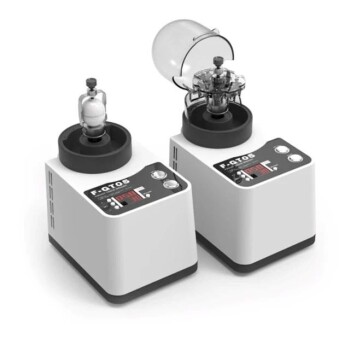
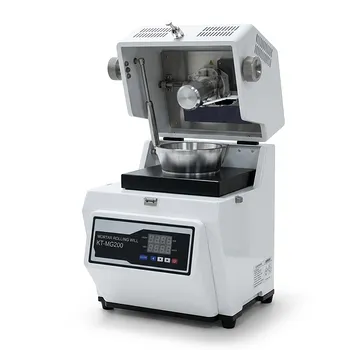
The primary objective of utilizing a high-speed uniaxial ball mill at 625 rpm is to generate powerful mechanical forces that ensure the uniform mixing of anode active materials and solid electrolyte powders (LLZ). This specific high-energy process is critical for maximizing the microscopic contact area between these two distinct phases.
The mechanical intensity of this process establishes the physical foundation for continuous lithium-ion transport. By maximizing contact area now, you ensure that subsequent co-sintering results in dense, highly conductive interfaces rather than isolated particles.
Establishing the Physical Foundation
High-Energy Mechanical Mixing
Operating at 625 rpm for an extended duration (typically 15 hours) moves beyond simple blending.
It utilizes high kinetic energy to force the anode materials and solid electrolyte powders together.
Maximizing Microscopic Contact
The ultimate goal of this intense milling is to increase the contact area between phases at the microscopic level.
This ensures that the solid electrolyte is not just sitting next to the anode material, but is intimately integrated with it.
Critical Implications for Battery Performance
Continuous Ion Transport Channels
For a solid-state battery to function, lithium ions must move freely between the anode and the electrolyte.
This milling process establishes continuous pathways (channels), preventing "dead zones" where ions cannot travel.
Preparation for Co-sintering
The milling process is a prerequisite for the heat treatment that follows.
By achieving a uniform mix beforehand, the subsequent co-sintering process yields a dense interfacial contact, which is essential for structural integrity and electrochemical performance.
Understanding Process Intensity and Trade-offs
Intensity vs. Material Integrity
It is vital to distinguish between high-energy mixing and low-energy coating.
While 625 rpm is ideal for creating dense solid-state interfaces, other materials (like Li-C composites) often require Low-Energy Ball Milling (LEGBM).
When Less is More
In scenarios requiring only a physical coating or delicate structures, high speeds can be destructive.
LEGBM, for instance, uses gentle impact to coat carbon with lithium without forming unwanted carbide crystal structures. The 625 rpm method is specifically reserved for when deep structural integration is required.
Making the Right Processing Choice
To determine the correct milling parameter for your composite, analyze your structural goals:
- If your primary focus is dense solid-state integration: Utilize high-speed milling (625 rpm) to maximize microscopic contact and establish robust ion transport channels for co-sintering.
- If your primary focus is surface coating or delicate composites: Opt for low-energy milling to achieve uniform dispersion and physical coating without altering the core crystal structure of the components.
Success in composite preparation relies not just on mixing the materials, but on matching the mechanical energy to the desired interfacial architecture.
Summary Table:
| Parameter | Objective | Impact on Battery Performance |
|---|---|---|
| Milling Speed | 625 RPM (High Energy) | Maximizes microscopic contact area between phases |
| Mixing Time | ~15 Hours | Ensures intimate integration of LLZ and anode materials |
| Process Goal | Mechanical Alloying/Mixing | Establishes continuous lithium-ion transport channels |
| Post-Process | Co-sintering Readiness | Enables dense, conductive interfaces for solid-state batteries |
Elevate Your Solid-State Battery Research with KINTEK
Precision in material preparation is the cornerstone of battery innovation. At KINTEK, we understand that achieving the perfect interfacial architecture requires high-performance equipment. Whether you need the high kinetic energy of our crushing and milling systems for LLZ integration or delicate hydraulic presses for pellet preparation, we provide the tools to ensure your success.
Our value to your laboratory:
- Comprehensive Equipment Range: From high-speed ball mills to vacuum furnaces and specialized battery research tools.
- Optimized Performance: Achieve the precise mechanical forces needed for dense, conductive solid-state interfaces.
- Expert Support: Our team helps you select the right parameters—from 625 rpm milling to low-energy coating solutions.
Ready to optimize your composite preparation? Contact KINTEK today to find the perfect milling solution for your research!
Related Products
- High-Energy Omnidirectional Planetary Ball Mill Milling Machine for Laboratory
- High Energy Planetary Ball Mill Milling Machine for Laboratory
- High Energy Planetary Ball Mill Milling Machine for Laboratory
- High-Energy Omnidirectional Planetary Ball Mill Machine for Laboratory
- High Energy Vibratory Ball Mill for Lab Use
People Also Ask
- How does a planetary ball mill solve mixing challenges with PEO? Unlock solid-state synthesis for insoluble dopants
- What is the role of a planetary ball mill in preparing doped high-nickel cathode materials? Enhance Battery Stability
- Why is a planetary ball mill used for LNMO precursor powders? Optimize Particle Uniformity & Battery Performance
- What is the function of a planetary ball mill in the solid-state synthesis of LiTa2PO8? Achieve High-Purity Electrolytes
- What is the critical role of a planetary ball mill in the processing of inorganic fillers? Enhance Battery Performance