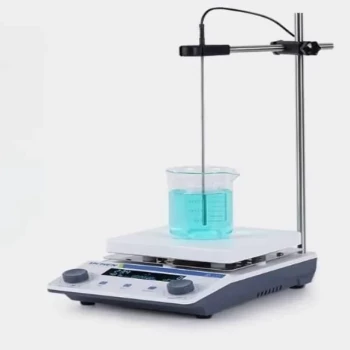
The primary function of a magnetic stirrer in the synthesis of finely dispersed tungstic acid is to generate high-intensity mechanical shear and forced convection. This action ensures the instantaneous and uniform mixing of the sodium tungstate and hydrochloric acid solutions, acting as the critical control mechanism for precipitate formation.
The stirrer eliminates local concentration gradients within the reactor. By doing so, it prevents the excessive growth and agglomeration of precipitate particles, ensuring the final product consists of ultra-fine particles with a high specific surface area.
The Mechanics of Particle Control
Generating High-Intensity Shear
In this specific synthesis, simple blending is insufficient. The magnetic stirrer provides mechanical shear, a physical force that rapidly disperses the reactants at a microscopic level.
This shear force is necessary to break down fluid boundaries immediately upon the contact of sodium tungstate and hydrochloric acid.
Eliminating Concentration Gradients
The greatest threat to producing "finely dispersed" material is non-uniformity. Without vigorous agitation, distinct zones of high concentration (gradients) form within the solution.
In these high-concentration zones, reaction rates accelerate locally. This leads to uneven precipitation where some particles grow much larger than others.
Preventing Agglomeration
The rapid convection driven by the stirrer acts as a physical barrier to clumping.
By maintaining a dynamic flow state, the stirrer prevents the newly formed precipitate particles from sticking together (agglomeration). This is essential for maintaining the ultra-fine nature of the tungstic acid.
Common Pitfalls in Agitation
The Risk of Low-Intensity Mixing
If the stirring speed is insufficient to generate high shear, the reactants will mix via diffusion rather than convection.
This slower process allows "local pockets" of reactants to linger. The result is inevitably a product with larger, inconsistent particle sizes rather than a finely dispersed powder.
Mass Transfer Limitations
While the primary goal is particle size control, the stirrer also ensures general kinetic uniformity.
Drawing from broader chemical engineering principles, if the stirring does not reach the entire volume of the reactor, "dead zones" can occur. In these zones, mass transfer drops, leading to incomplete reactions or sedimentation of the product.
Making the Right Choice for Your Goal
To ensure the successful synthesis of finely dispersed tungstic acid, consider these operational priorities:
- If your primary focus is Particle Size Reduction: Prioritize high stirring speeds to maximize mechanical shear and prevent immediate particle growth.
- If your primary focus is Product Uniformity: Ensure the stirring bar size and shape are appropriate for the vessel to guarantee total volumetric turnover and eliminate dead zones.
Effective synthesis relies on using agitation not just to mix fluids, but to actively shape the physical properties of the precipitate.
Summary Table:
| Mechanism | Role in Synthesis | Outcome |
|---|---|---|
| Mechanical Shear | Disperses reactants at a microscopic level | Breaks fluid boundaries instantly |
| Forced Convection | Eliminates local concentration gradients | Ensures kinetic uniformity |
| Dynamic Flow | Prevents particles from sticking together | Inhibits agglomeration |
| Mass Transfer | Reaches entire reactor volume | Eliminates dead zones and sedimentation |
Precision Agitation for Superior Material Synthesis
Achieving the perfect particle size for finely dispersed tungstic acid requires more than just basic mixing—it requires the high-intensity shear and reliable performance of professional-grade equipment. At KINTEK, we specialize in providing scientists with the advanced laboratory tools needed for critical chemical synthesis.
From high-performance magnetic stirrers and homogenizers to high-temperature high-pressure reactors and autoclaves, our portfolio is designed to meet the rigorous demands of material science. We also offer specialized consumables like PTFE products, ceramics, and crucibles to complement your research.
Ready to optimize your synthesis process? Contact KINTEK today for expert solutions and premium laboratory equipment!
References
- E. A. Mazulevsky, N. M. Seidakhmetova. Production of fine-dispersed tungstic acid. DOI: 10.17580/nfm.2022.02.06
This article is also based on technical information from Kintek Solution Knowledge Base .
Related Products
- Laboratory Small Constant Temperature Heated Magnetic Stirrer Heater and Stirrer
- Custom PTFE Teflon Parts Manufacturer for Magnetic Stirring Bar
- High Performance Laboratory Stirrers for Diverse Applications
- Three-dimensional electromagnetic sieving instrument
- Custom PTFE Teflon Parts Manufacturer for PTFE Stirring Bar Recovery Rod
People Also Ask
- What role does a magnetic stirrer with heating play in ZnO nanoparticle synthesis? Precision Control for Quality Results
- What role does a constant temperature heating magnetic stirrer play in MFC-HAp synthesis? Achieve Material Homogeneity
- What is the function of a laboratory magnetic stirrer in Ni–Cr–P electrodeposition? Optimize Ion Transport & Coating
- Why is a laboratory magnetic stirrer required for benzoic acid esters? Boost Reaction Speed & Yield with High RPM
- What role does a laboratory magnetic stirrer play in TiO2 and TiO2-Ag sol preparation? Master Chemical Kinetics