Knowledge What is the primary function of a planetary ball mill in AlN production? Achieve Perfect Material Dispersion
Author avatar

Tech Team · Kintek Solution

Updated 1 day ago

What is the primary function of a planetary ball mill in AlN production? Achieve Perfect Material Dispersion


In the production of Aluminum Nitride (AlN) ceramics, the primary function of a planetary ball mill is to execute high-energy mechanical grinding that thoroughly disperses AlN powder with sintering additives. Operating typically within an anhydrous ethanol medium, this process breaks down agglomerations to ensure a completely uniform distribution of additives like Y2O3 or Dy2O3 throughout the material matrix.

Core Takeaway Achieving a homogeneous mixture is not merely about blending; it is the fundamental prerequisite for successful sintering. The planetary ball mill ensures the uniform dispersion of additives required to lower sintering temperatures and stabilize the grain boundary phases in the final ceramic structure.

The Mechanics of Effective Dispersion

High-Energy Mechanical Grinding

The planetary ball mill operates by generating intense centrifugal forces through high-speed rotation. This drives the grinding media to exert strong impact and shear forces on the raw materials.

For AlN production, this mechanical action is essential for breaking down powder agglomerates. It ensures that the primary AlN particles are physically separated and coated with the necessary additives.

The Role of the Medium

The process is conducted in a wet environment, specifically using anhydrous ethanol. This liquid medium facilitates the suspension of particles and prevents the re-agglomeration of the fine powders during the high-energy mixing process.

Using an anhydrous (water-free) liquid is critical for AlN, as it prevents hydrolysis or unwanted oxidation of the aluminum nitride powder during the milling stage.

Why Uniformity is Critical for AlN

Optimizing Sintering Additives

Aluminum Nitride is difficult to sinter due to its covalent bonding. To achieve densification, sintering additives such as Yttrium Oxide (Y2O3) or Dysprosium Oxide (Dy2O3) are required.

The ball mill ensures these additives are not just present, but evenly distributed at a microscopic level. This uniformity allows the additives to react efficiently, effectively reducing the temperature required for the subsequent sintering steps.

Controlling Microstructure

The quality of the final ceramic is determined by the formation of uniform grain boundary phases.

By ensuring the additives are dispersed homogeneously, the planetary ball mill creates the conditions for a consistent microstructure. This prevents defects and ensures the material achieves its target thermal and mechanical properties.

Understanding the Trade-offs

Risk of Impurity Contamination

The same high-energy impact that refines the powder can also cause wear on the grinding media (balls) and the jar lining.

If the grinding media material is not compatible with AlN, this wear can introduce impurities into the mixture. These contaminants can degrade the thermal conductivity of the final ceramic, negating the benefits of the milling process.

Over-Milling and Lattice Damage

While refining particle size increases reactivity, excessive milling energy or duration can introduce defects into the crystal lattice.

It is crucial to balance the need for dispersion with the preservation of the raw material's crystalline integrity to avoid adverse effects during the sintering phase.

Making the Right Choice for Your Goal

To maximize the effectiveness of your planetary ball milling process, consider your specific production targets:

  • If your primary focus is Reducing Sintering Temperature: Prioritize the selection and ultra-fine dispersion of additives like Y2O3 to activate liquid-phase sintering earlier.
  • If your primary focus is High Thermal Conductivity: Ensure your grinding media is highly wear-resistant or made of compatible materials to prevent phonon-scattering impurities.

The precision of your milling stage directly dictates the thermal performance and structural integrity of your final AlN ceramic.

Summary Table:

Feature Function in AlN Mixing Stage Impact on Final Product
High-Energy Grinding Breaks down powder agglomerates Ensures fine, uniform particle distribution
Anhydrous Ethanol Medium Prevents hydrolysis and re-agglomeration Maintains chemical purity and powder stability
Additive Dispersion Homogenizes Y2O3 or Dy2O3 additives Lowers sintering temperature & stabilizes phases
Centrifugal Forces Provides intense impact and shear Creates a reactive, high-surface-area mixture

Elevate Your Ceramic Research with KINTEK Precision

Achieving the perfect microstructure for Aluminum Nitride ceramics starts with superior mixing. KINTEK specializes in advanced planetary ball mills, crushing and milling systems, and high-purity consumables designed to eliminate contamination and ensure homogeneous dispersion.

Whether you are refining sintering additives or developing high-thermal-conductivity materials, our comprehensive range of laboratory equipment—from vacuum furnaces to ceramic crucibles—is engineered to meet your exact specifications.

Ready to optimize your material processing? Contact us today to discover how KINTEK can enhance your lab's efficiency and results.

Related Products

People Also Ask

Related Products

High Energy Planetary Ball Mill Milling Machine for Laboratory

High Energy Planetary Ball Mill Milling Machine for Laboratory

The biggest feature is that the high energy planetary ball mill can not only perform fast and effective grinding, but also has good crushing ability

High Energy Planetary Ball Mill Milling Machine for Laboratory

High Energy Planetary Ball Mill Milling Machine for Laboratory

Experience fast and effective sample processing with the F-P2000 high-energy planetary ball mill. This versatile equipment offers precise control and excellent grinding capabilities. Perfect for laboratories, it features multiple grinding bowls for simultaneous testing and high output. Achieve optimal results with its ergonomic design, compact structure, and advanced features. Ideal for a wide range of materials, it ensures consistent particle size reduction and low maintenance.

High Energy Planetary Ball Mill for Laboratory Horizontal Tank Type Milling Machine

High Energy Planetary Ball Mill for Laboratory Horizontal Tank Type Milling Machine

KT-P4000H uses the unique Y-axis planetary motion trajectory, and utilizes the collision, friction and gravity between the sample and the grinding ball to have a certain anti-sinking ability, which can obtain better grinding or mixing effects and further improve the sample output.

High-Energy Omnidirectional Planetary Ball Mill Machine for Laboratory

High-Energy Omnidirectional Planetary Ball Mill Machine for Laboratory

The KT-P2000E is a new product derived from the vertical high-energy planetary ball mill with a 360°rotation function. The product not only has the characteristics of the vertical high-energy ball mill, but also has a unique 360°rotation function for the planetary body.

Laboratory Horizontal Planetary Ball Mill Milling Machine

Laboratory Horizontal Planetary Ball Mill Milling Machine

Improve sample uniformity with our Horizontal Planetary Ball Mills. KT-P400H reduces sample deposition and KT-P400E has multi-directional capabilities. Safe, convenient and efficient with overload protection.

Laboratory Planetary Ball Mill Rotating Ball Milling Machine

Laboratory Planetary Ball Mill Rotating Ball Milling Machine

KT-P400E is a desktop multi-directional planetary ball mill with unique grinding and mixing capabilities. It offers continuous and intermittent operation, timing, and overload protection, making it ideal for various applications.

High Energy Planetary Ball Mill Machine for Laboratory Horizontal Tank Type

High Energy Planetary Ball Mill Machine for Laboratory Horizontal Tank Type

The KT-P2000H uses a unique Y-axis planetary trajectory, and utilizes the collision, friction and gravity between the sample and the grinding ball.

Laboratory Planetary Ball Mill Cabinet Planetary Ball Milling Machine

Laboratory Planetary Ball Mill Cabinet Planetary Ball Milling Machine

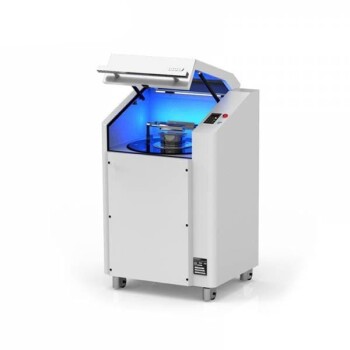
The vertical cabinet structure combined with ergonomic design enables users to obtain the best comfortable experience in standing operation. The maximum processing capacity is 2000ml, and the speed is 1200 revolutions per minute.

High-Energy Omnidirectional Planetary Ball Mill Milling Machine for Laboratory

High-Energy Omnidirectional Planetary Ball Mill Milling Machine for Laboratory

The KT-P4000E is a new product derived from the vertical high-energy planetary ball mill with a 360° swivel function. Experience faster, uniform, and smaller sample output results with 4 ≤1000ml ball mill jars.

Laboratory Jar Mill with Agate Grinding Jar and Balls

Laboratory Jar Mill with Agate Grinding Jar and Balls

Grind your materials with ease using Agate Grinding Jars with Balls. Sizes from 50ml to 3000ml, perfect for planetary and vibration mills.

High Energy Vibratory Laboratory Ball Mill Grinding Mill Single Tank Type

High Energy Vibratory Laboratory Ball Mill Grinding Mill Single Tank Type

High-energy vibration ball mill is a small desktop laboratory grinding instrument.It can be ball-milled or mixed with different particle sizes and materials by dry and wet methods.

Laboratory Single Horizontal Jar Mill

Laboratory Single Horizontal Jar Mill

KT-JM3000 is a mixing and grinding instrument for placing a ball milling tank with a volume of 3000ml or less. It adopts frequency conversion control to realize timing, constant speed, direction change, overload protection and other functions.

Lab Vibration Mill

Lab Vibration Mill

Vibration Mill for Efficient Sample Preparation, Suitable for Crushing and Grinding a Variety of Materials with Analytical Precision. Supports Dry / Wet / Cryogenic Grinding and Vacuum/Inert Gas Protection.

Laboratory Ten-Body Horizontal Jar Mill for Lab Use

Laboratory Ten-Body Horizontal Jar Mill for Lab Use

The Ten-body horizontal jar mill is for 10 ball mill pots (3000ml or less). It has frequency conversion control, rubber roller movement, and PE protective cover.

High Energy Vibratory Ball Mill for Lab Use

High Energy Vibratory Ball Mill for Lab Use

The high-energy vibrating ball mill is a high-energy oscillating and impacting multifunctional laboratory ball mill. The table-top type is easy to operate, small in size, comfortable and safe.

Precision Machined Zirconia Ceramic Ball for Engineering Advanced Fine Ceramics

Precision Machined Zirconia Ceramic Ball for Engineering Advanced Fine Ceramics

zirconia ceramic ball have the characteristics of high strength, high hardness, PPM wear level, high fracture toughness, good wear resistance, and high specific gravity.

Small Injection Molding Machine for Lab Use

Small Injection Molding Machine for Lab Use

The small injection molding machinehas fast and stable movements; good controllability and repeatability, super energy saving; the product can be automatically dropped and formed; the machine body is low, convenient for feeding, easy to maintain, and no height restrictions on the installation site.

CVD Diamond Cutting Tool Blanks for Precision Machining

CVD Diamond Cutting Tool Blanks for Precision Machining

CVD Diamond Cutting Tools: Superior Wear Resistance, Low Friction, High Thermal Conductivity for Non-Ferrous Materials, Ceramics, Composites Machining

Electric Rotary Kiln Continuous Working Small Rotary Furnace Heating Pyrolysis Plant

Electric Rotary Kiln Continuous Working Small Rotary Furnace Heating Pyrolysis Plant

Efficiently calcine and dry bulk powder and lump fluid materials with an electric heating rotary furnace. Ideal for processing lithium ion battery materials and more.

Benchtop Laboratory Freeze Dryer for Lab Use

Benchtop Laboratory Freeze Dryer for Lab Use

Premium benchtop laboratory freeze dryer for lyophilization, preserving samples with ≤ -60°C cooling. Ideal for pharmaceuticals & research.


Leave Your Message