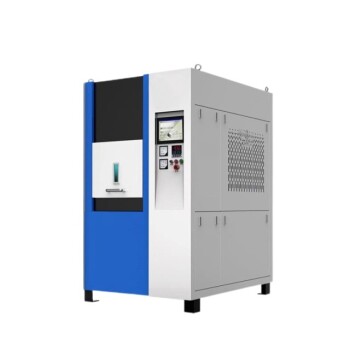
The primary function of an induction furnace in this specific application is to utilize electromagnetic induction to generate the high temperatures necessary to rapidly melt raw materials. Specifically for niobium-stabilized super duplex stainless steel, it melts scrap duplex steel and ferroalloys (such as FeCr, FeNb, and FeMo) to create a homogeneous liquid state.
Core Takeaway While the induction furnace provides the energy for melting, its critical value lies in generating a uniform thermal field. This ensures that complex alloying components—particularly niobium, chromium, and molybdenum—are thoroughly mixed, resulting in a molten steel with the precise chemical composition required for high-performance casting.
The Mechanics of the Smelting Process
Electromagnetic Heating
The furnace operates by generating heat through electromagnetic induction.
This allows for the rapid attainment of the high temperatures required to transition the metal from solid to liquid.
Raw Material Integration
The process involves melting a specific mix of scrap duplex steel and ferroalloys.
Key additions include FeCr (Ferro-Chromium), FeNb (Ferro-Niobium), and FeMo (Ferro-Molybdenum).
These materials must be fully liquefied to ensure the niobium stabilizes the alloy correctly without segregation.
Achieving Chemical Homogeneity
The Uniform Thermal Field
A defining characteristic of the induction furnace is its ability to create a uniform thermal field throughout the crucible.
Unlike furnaces that might create hot spots, induction ensures consistent temperature distribution.
Thorough Mixing
This thermal consistency is vital for the thorough mixing of alloying components in the liquid state.
For super duplex stainless steel, which relies on a precise balance of austenite and ferrite formers, this mixing prevents compositional gradients that could lead to material failure.
Critical Considerations and Trade-offs
Induction vs. Vacuum Induction
While a standard induction furnace melts efficiently, it interacts with the atmosphere.
As noted in advanced processing, a Vacuum Induction Furnace may be required if the goal is to prevent the oxidation of active elements or reduce impurities like oxygen and sulfur.
Standard induction prioritizes melting speed and mixing, while vacuum induction prioritizes extreme purity.
Smelting vs. Heat Treatment
It is crucial to distinguish the induction furnace's role (smelting/melting) from subsequent heat treatment steps.
Furnaces like the electric muffle furnace or isothermal heating furnace are used after casting to dissolve carbides or precipitate phases like Sigma.
The induction furnace creates the chemistry; the heat treatment furnaces dictate the final microstructure.
Making the Right Choice for Your Goal
To ensure the production of high-quality niobium-stabilized super duplex stainless steel, align your furnace choice with your specific purity and processing requirements.
- If your primary focus is Compositional Uniformity: Rely on the standard induction furnace to provide the electromagnetic stirring and uniform heat needed to mix heavy ferroalloys like FeNb and FeMo.
- If your primary focus is Oxidation Control: Upgrade to a vacuum induction environment to prevent the loss of reactive elements and minimize oxide inclusions during the melt.
- If your primary focus is Microstructural Balance: Recognize that the induction furnace only sets the chemistry; you must follow up with precise solution treatment (around 1080°C–1200°C) to eliminate casting stresses and unwanted phases.
The induction furnace is the foundational tool for establishing the chemical identity of the steel, ensuring that the complex alloy mix is perfectly homogenous before it ever solidifies.
Summary Table:
| Feature | Induction Furnace Role in Smelting | Benefit for Super Duplex Steel |
|---|---|---|
| Heating Method | Electromagnetic Induction | Rapid melting and energy-efficient temperature control |
| Thermal Profile | Uniform Thermal Field | Prevents hot spots and ensures consistent melt temperature |
| Mixing Action | Electromagnetic Stirring | Thoroughly integrates FeNb, FeCr, and FeMo alloys |
| Chemical Impact | Homogeneous Liquid State | Prevents compositional gradients and material segregation |
| Atmosphere | Standard or Vacuum | Protects reactive elements from oxidation (Vacuum models) |
Elevate Your Alloy Production with KINTEK Precision
Producing high-performance niobium-stabilized super duplex stainless steel requires uncompromising control over melting and homogenization. At KINTEK, we specialize in advanced laboratory and industrial equipment designed to meet these exact standards.
Our extensive portfolio features high-performance induction melting systems, vacuum induction furnaces (VIM), and CVD/PECVD systems for advanced material synthesis. To ensure your alloys achieve the perfect microstructure after smelting, we also provide a comprehensive range of muffle furnaces, tube furnaces, and isostatic presses for critical post-processing heat treatments.
Why choose KINTEK?
- Precision Engineering: Achieve the exact thermal fields required for complex alloying.
- Complete Solutions: From induction melting to crushing, milling, and pellet pressing.
- Technical Expertise: We provide the tools that bridge the gap between raw chemistry and high-performance casting.
Ready to optimize your smelting process? Contact KINTEK today to discuss your equipment needs and discover how our high-temperature solutions can enhance your laboratory's efficiency and material quality.
References
- Ángelo Oñate, D. Rojas. Exploring the Impact of Cooling Rate on Microstructural Features, Mechanical Properties, and Corrosion Resistance of a Novel Nb-Stabilized Super Duplex Stainless Steel in Shielded Metal Arc Welding. DOI: 10.3390/cryst13081192
This article is also based on technical information from Kintek Solution Knowledge Base .
Related Products
- Vacuum Arc Induction Melting Furnace
- Lab-Scale Vacuum Induction Melting Furnace
- Non Consumable Vacuum Arc Induction Melting Furnace
- 600T Vacuum Induction Hot Press Furnace for Heat Treat and Sintering
- Spark Plasma Sintering Furnace SPS Furnace
People Also Ask
- How do vacuum induction or arc melting furnaces facilitate the synthesis of U-Al-C MAX phases? Precision Heat & Purity
- What core role does a Vacuum Induction Melting furnace play in nickel-free steel production? Achieve High-Purity Alloys
- What is the function of a vacuum arc melting furnace? Master Homogeneity for Amorphous Alloy Ribbons
- What is the function of vacuum arc melting equipment? Creating High-Purity Ferrochrome (CrFe) Alloys
- What is the primary function of a vacuum arc melting furnace in RHEA preparation? Achieving Extreme Thermal Fusion