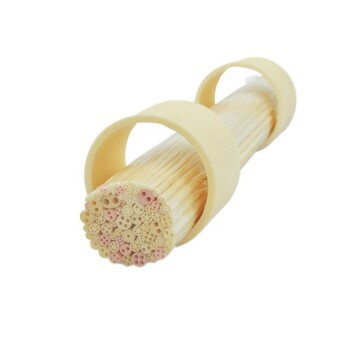
Quartz tubes are the distinct preference for chromium powder combustion synthesis because they solve the dual challenge of surviving extreme heat while maintaining optical transparency. They possess the thermal stability required to withstand reaction temperatures reaching 1640 °C, while simultaneously allowing researchers to visually track and record the internal combustion wave propagation.
The critical value of quartz lies in its ability to act as a "transparent shield," protecting the experiment from structural failure at temperatures over 1600 °C while permitting the high-speed imaging necessary to calculate reaction kinetics.
The Critical Role of Thermal Resistance
Withstanding Extreme Exothermic Environments
Combustion synthesis is an intensely energetic process.
In chromium powder experiments, temperatures spike dramatically, reaching up to 1640 °C.
Standard laboratory glass, such as borosilicate, would soften or melt under these conditions, destroying the experiment and ruining the sample.
Stability Under Thermal Stress
Quartz maintains its structural integrity even when subjected to these rapid temperature increases.
This robust thermal stability ensures the vessel does not deform during the reaction.
It allows the containment of the powder to remain consistent throughout the violent combustion phase.
The Necessity of Optical Transparency
Enabling Visual Data Collection
The primary reference highlights that transparency is a non-negotiable requirement for these experiments.
Researchers must be able to see inside the reactor to monitor the process in real-time.
Opaque ceramic vessels, while heat-resistant, would block this critical line of sight.
Recording Combustion Wave Propagation
The core of this research involves studying how the combustion wave moves through the chromium powder.
Quartz allows the use of high-speed imaging equipment to record the propagation of the combustion wave.
This visual data is essential for analyzing the speed, stability, and behavior of the reaction front.
Ensuring Experimental Integrity
Chemical Inertness
Drawing from broader applications in high-temperature oxidation, high-purity quartz acts as a chemically stable carrier.
It minimizes the risk of the vessel material reacting with the chromium or oxygen at high temperatures.
This ensures that the reaction environment remains pure and free from secondary contamination.
Data Accuracy
By preventing the vessel from participating in the reaction, quartz ensures the data collected reflects only the chromium combustion.
This isolation is vital for characterising the true kinetics of the material.
Understanding the Trade-offs
Brittleness and Handling
While quartz offers superior thermal resistance, it remains a brittle material.
It requires careful handling during setup to avoid micro-fractures that could propagate under thermal stress.
Cost vs. Performance
High-purity quartz is significantly more expensive than standard glass.
However, for temperatures exceeding 1000 °C, the cost is justified as it is often the only transparent material capable of surviving the process.
Making the Right Choice for Your Project
If you are designing an experimental setup for high-temperature synthesis, consider your specific data requirements:
- If your primary focus is kinetic analysis: You must use quartz to enable high-speed imaging of the reaction front propagation.
- If your primary focus is sample purity: You should prioritize high-purity quartz to prevent vessel-induced contamination or secondary reactions.
True experimental success depends on selecting a vessel that is as invisible chemically as it is optically.
Summary Table:
| Feature | Requirement for Chromium Combustion | Benefit of High-Purity Quartz |
|---|---|---|
| Thermal Resistance | Up to 1640 °C | Maintains structural integrity at extreme temperatures |
| Optical Clarity | High-speed imaging required | Permits visual tracking of combustion wave propagation |
| Chemical Stability | Minimizes contamination | High-purity inertness prevents reaction with samples |
| Durability | Rapid temperature spikes | Resists deformation under intense thermal stress |
Precision Solutions for Your High-Temperature Research
At KINTEK, we understand that experimental success hinges on the quality of your equipment. Whether you are conducting chromium powder combustion or advanced material synthesis, our premium quartz tubes and high-temperature furnaces provide the thermal stability and chemical purity you need.
Our extensive portfolio includes:
- High-Temperature Furnaces: Muffle, tube, vacuum, and CVD systems for precise control.
- Essential Consumables: High-purity quartz, ceramics, and crucibles designed for extreme environments.
- Specialized Lab Gear: High-pressure reactors, crushing systems, and cooling solutions.
Ready to elevate your lab's performance? Contact our expert team today to find the perfect tools for your target applications and secure the accuracy your research deserves!
References
- Nikolay S. Evseev, Yuliya N. Ryzhikh. Process of Obtaining Chromium Nitride in the Combustion Mode under Conditions of Co-Flow Filtration. DOI: 10.3390/pr8091056
This article is also based on technical information from Kintek Solution Knowledge Base .
Related Products
- Laboratory Rapid Thermal Processing (RTP) Quartz Tube Furnace
- 1200℃ Split Tube Furnace with Quartz Tube Laboratory Tubular Furnace
- Optical Window Glass Substrate Wafer Quartz Plate JGS1 JGS2 JGS3
- High Temperature Resistant Optical Quartz Glass Sheet
- Rotary Tube Furnace Split Multi Heating Zone Rotating Tube Furnace
People Also Ask
- What technical advantages does an RTP tube furnace offer for photoelectrodes? Achieve Precision & High Phase Purity
- How does a quartz tube furnace facilitate the synthesis of rGO? Optimize Your Cathode Matrix with Precise Pyrolysis
- What is the temperature of a quartz tube furnace? Master the Limits for Safe, High-Temp Operation
- What are the advantages of using an electric heating furnace with a quartz tube for liquid bismuth corrosion control?
- What is the maximum temperature for a quartz tube furnace? Key Limits for Safe & Efficient Operation