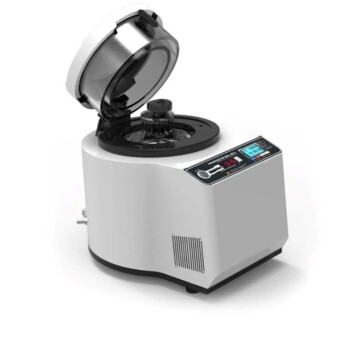
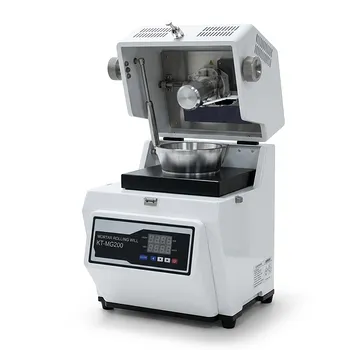
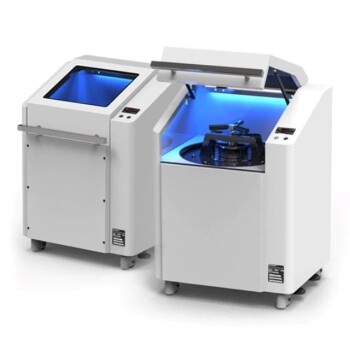
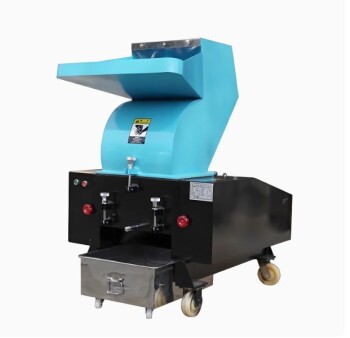
The primary function of grinding equipment in BiOCl-assisted CVD is to create intimate physical contact and maximize the reaction surface area between metal powders and BiOCl. This mechanical refinement ensures the efficient and uniform generation of volatile metal oxychloride intermediates during the heating phase. Without this step, the system cannot achieve the low-temperature growth required for high-quality 2D nanosheets.
Grinding transforms solid precursors into a highly reactive, homogenous mixture that facilitates the transition from solid-phase metals to gas-phase intermediates. This process is the technical foundation for controlling the chemical environment inside the CVD furnace.
Maximizing Precursor Reactivity through Mechanical Refinement
Increasing Specific Surface Area
The grinding process reduces the particle size of both the metal powder and the BiOCl auxiliary salt. By breaking down these materials, the equipment significantly increases the specific surface area, allowing for a higher number of reactive sites during the heating cycle.
Achieving Intimate Precursor Contact
Effective synthesis depends on the physical proximity of the reactants. Grinding ensures that metal particles and BiOCl are thoroughly mixed, creating a distribution where the auxiliary salt can readily react with the metal to initiate the chemical transformation.
Promoting Efficient Solid-State Reactions
In the early stages of heating, the precursors must interact while still in the solid or semi-solid state. The intimate contact produced by grinding equipment allows for a seamless transition to the intermediate phase, preventing delays in vapor generation.
The Role of Volatile Intermediates in Low-Temperature Growth
Generation of Metal Oxychlorides
The interaction between the metal and BiOCl, facilitated by grinding, leads to the formation of volatile metal oxychlorides. These intermediates have high vapor pressures at lower temperatures, which is the primary mechanism that enables 2D nanosheet growth without requiring extreme heat.
Ensuring Uniform Vapor Pressure
If the precursors are poorly mixed, the release of metal oxychlorides will be sporadic and uneven. Proper grinding ensures a uniform vapor pressure throughout the CVD chamber, which is critical for the consistent thickness and quality of the resulting 2D nanosheets.
Facilitating Reliable Mass Transport
A finely ground powder allows for predictable gas-phase transport of precursors to the substrate. This predictability is essential for researchers looking to control the nucleation and growth kinetics of the 2D material layers.
Understanding the Trade-offs and Technical Limitations
Potential for Precursor Contamination
Extensive grinding, especially with manual tools or low-grade mechanical mills, introduces a risk of impurities from the grinding media itself. Any foreign material introduced at this stage can be incorporated into the 2D nanosheet, degrading its electronic or structural properties.
Non-Uniform Particle Size Distribution
If the grinding process is not carefully timed or executed, it can result in a wide particle size distribution. This inconsistency leads to uneven evaporation rates in the CVD furnace, potentially causing "hot spots" or areas of over-deposition on the substrate.
Material Sensitivity and Oxidation
Some metal powders are sensitive to the heat or friction generated during the grinding process. Excessive mechanical energy can lead to premature oxidation or structural changes in the precursors before they even enter the CVD chamber.
Optimizing Your Material Preparation Strategy
How to Apply This to Your Project
To achieve the best results in BiOCl-assisted CVD, the grinding process must be tailored to the specific metal and the desired nanosheet characteristics.
- If your primary focus is low-temperature growth efficiency: Prioritize achieving the smallest possible particle size to maximize the generation of volatile intermediates at the lowest possible thermal threshold.
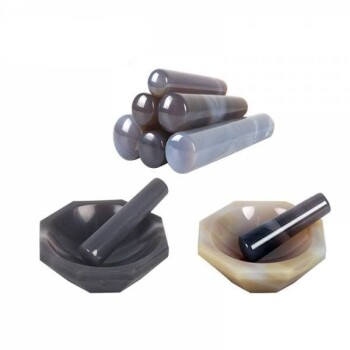
- If your primary focus is material purity and crystal quality: Use high-purity grinding media, such as zirconia or agate, and consider grinding in an inert atmosphere to prevent oxidation of the metal powders.
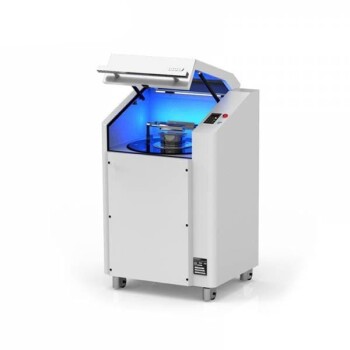
- If your primary focus is large-scale uniformity: Utilize industrial-grade mechanical mills with programmable settings to ensure a highly consistent and reproducible precursor mixture across multiple batches.
Proper mechanical preparation of raw materials is the silent partner of successful chemical vapor deposition, dictating the precision and quality of the final 2D architecture.
Summary Table:
| Key Function | Impact on CVD Process | Optimization Goal |
|---|---|---|
| Particle Size Reduction | Increases specific surface area and reactive sites | Maximizes precursor reactivity at low temperatures |
| Homogeneous Mixing | Ensures intimate contact between metal & BiOCl | Facilitates uniform vapor pressure and deposition |
| Intermediate Generation | Promotes volatile metal oxychloride formation | Enables low-temperature growth of 2D nanosheets |
| Contamination Control | Prevents impurities in the final 2D architecture | Requires high-purity media (e.g., zirconia, agate) |
Elevate Your 2D Material Synthesis with KINTEK
Success in BiOCl-assisted CVD begins with flawless precursor preparation. KINTEK provides the specialized grinding and milling systems necessary to achieve the precise particle size and homogeneity required for volatile intermediate generation.
From advanced CVD, PECVD, and atmosphere furnaces to high-purity zirconia and ceramic grinding media, our comprehensive lab solutions ensure your research achieves maximum uniformity and purity. Whether you are optimizing for low-temperature growth or large-scale reproducibility, our team is ready to support your workflow.
Ready to refine your material preparation? Contact us today to find the perfect equipment for your lab!
References
- Biao Qin, Xidong Duan. General low-temperature growth of two-dimensional nanosheets from layered and nonlayered materials. DOI: 10.1038/s41467-023-35983-6
This article is also based on technical information from Kintek Solution Knowledge Base .
Related Products
- Three-dimensional electromagnetic sieving instrument
- Laboratory High Throughput Tissue Grinding Mill Grinder
- Vibrating Disc Mill Small Laboratory Grinding Machine
- Laboratory Grinding Mill Mortar Grinder for Sample Preparation
- Laboratory Ball Mill Jar Mill with Metal Alloy Grinding Jar and Balls
People Also Ask
- Why is sieving equipment essential for the classification of processed bio-activated carbon? Optimize Performance
- What are the limitations of sieving? Understanding the Constraints of Particle Size Analysis
- What are advantages and disadvantages of sieving method? A Guide to Reliable & Cost-Effective Particle Sizing
- How is sieving important? The Critical Role of Particle Size Analysis in Quality Control
- What is sieving and how does it work? A Guide to Accurate Particle Size Analysis