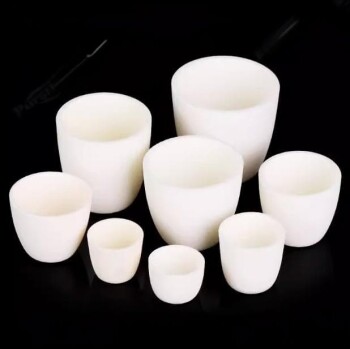
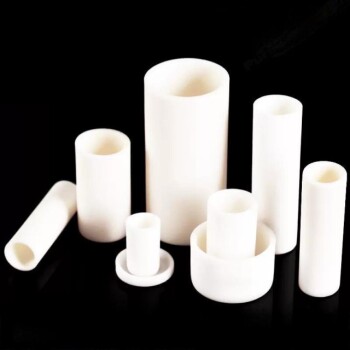
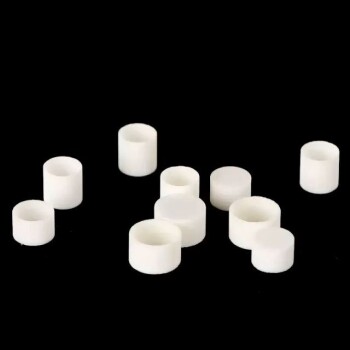
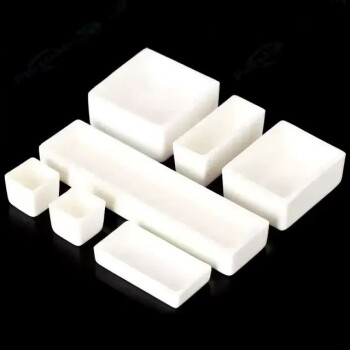
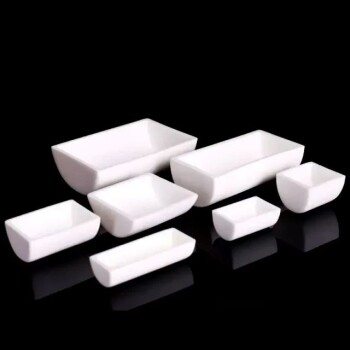
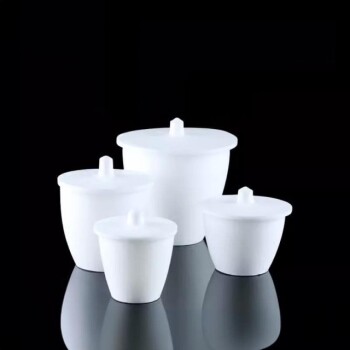
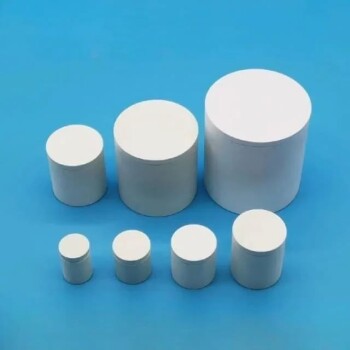
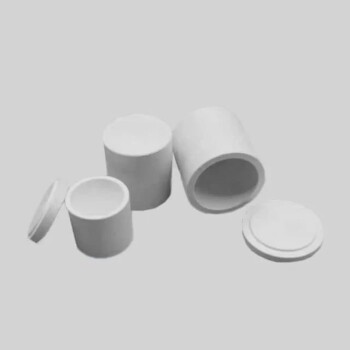
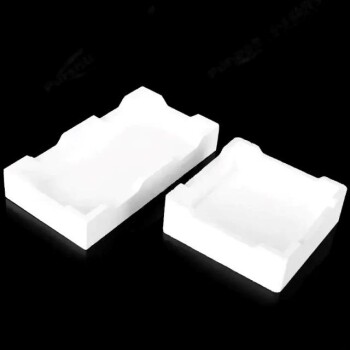
High-alumina crucibles serve as the foundational containment vessels for stabilizing reagent-grade powders prior to glass synthesis. In the specific context of pretreating iron phosphate (IP) and sodium aluminum phosphate (NaAlP), their primary function is to hold materials at 300°C, enabling the safe evaporation of volatile byproducts without compromising the chemical composition of the batch.
Core Insight: The value of using high-alumina crucibles lies in their chemical inertness. They withstand corrosive interactions with ammonium dihydrogen phosphate during the off-gassing of ammonia and moisture, which is essential to prevent violent boiling and contamination during the later high-temperature melting stages.
The Mechanics of Pretreatment
Facilitating Thermal Stability
The pretreatment phase requires heating reagent-grade powders to 300°C. High-alumina crucibles provide the necessary thermal stability to maintain structural integrity at this specific temperature.
This ensures the powders are contained securely while the initial chemical breakdowns occur, preparing the batch for significantly higher temperatures later.
Managing Chemical Corrosion
One of the most critical challenges in processing IP and NaAlP raw materials is handling corrosive agents. Specifically, the mixture often contains ammonium dihydrogen phosphate.
High-alumina crucibles are chemically inert. They resist reacting with these corrosive phosphate compounds, ensuring the vessel itself does not degrade during the heating process.
Ensuring Process Safety and Purity
Controlled Removal of Volatiles
The primary goal of the pretreatment phase is the evaporation of ammonia and moisture.
The crucible allows these volatiles to escape efficiently. By removing these gases at a lower temperature (300°C), the process stabilizes the raw material before it enters the melt phase.
Preventing Violent Boiling
If moisture and ammonia are not removed during pretreatment, they can cause catastrophic issues later.
Retained volatiles can lead to violent boiling when the temperature is raised for melting. The use of high-alumina crucibles during the pretreatment step acts as a safeguard, ensuring the melt proceeds smoothly without dangerous eruptions.
Preserving the Glass Matrix
For applications requiring high precision, such as vitrification or glass synthesis, purity is paramount.
Because the high-alumina material does not react with the charge, it prevents cross-contamination. This ensures the final glass matrix retains the exact chemical composition intended, without impurities leached from the container.
Understanding the Risks of Material Selection
The Cost of Incompatibility
Using a crucible with lower chemical resistance is a critical error in phosphate glass processing.
If the container reacts with the phosphate compounds, it introduces foreign elements into the mix. This alters the chemical composition of the final product, potentially ruining the physical properties of the glass.
Thermal Mismatches
While the pretreatment occurs at 300°C, the vessel is often used in subsequent steps reaching 1000°C or higher.
A crucible selected solely for the lower pretreatment temperature may fail during the transition to the melting phase. High-alumina is selected because it bridges this gap, performing consistently across the entire temperature gradient required for synthesis.
Making the Right Choice for Your Goal
To ensure the success of your glass synthesis project, apply the following principles:
- If your primary focus is Safety: Ensure the pretreatment phase completely evaporates ammonia and moisture to eliminate the risk of violent boiling during the melt.
- If your primary focus is Purity: Rely on high-alumina crucibles to prevent the container material from leaching into and altering the final glass matrix.
The correct crucible choice transforms pretreatment from a simple heating step into a critical quality control measure for your final material.
Summary Table:
| Feature | Function in Pretreatment | Benefit to Glass Synthesis |
|---|---|---|
| Thermal Stability | Maintains integrity at 300°C and above | Secure containment during volatile removal |
| Chemical Inertness | Resists corrosion from ammonium phosphate | Prevents batch contamination and leaching |
| Gas Management | Facilitates evaporation of ammonia and moisture | Eliminates violent boiling during melting stages |
| Material Purity | Zero reaction with IP and NaAlP powders | Ensures exact chemical composition of the glass matrix |
Elevate Your Laboratory Precision with KINTEK
Don't let contamination or violent reactions compromise your glass synthesis. KINTEK specializes in high-performance laboratory equipment and consumables designed for the most demanding thermal processes. Our premium high-alumina and ceramic crucibles provide the chemical inertness and thermal resilience required for safe pretreatment and high-temperature melting.
From high-temperature furnaces (muffle, vacuum, and atmosphere) to precision crushing systems and PTFE products, we provide the tools needed to ensure purity and safety in every batch. Whether you are researching battery materials or developing advanced vitrification techniques, our experts are ready to support your project.
Ready to optimize your material processing? Contact us today to find the perfect solution!
References
- Yaping Sun, Zhenghua Qian. Immobilization of simulated radioactive fluoride waste in phosphate glass. DOI: 10.1007/s40843-016-5010-x
This article is also based on technical information from Kintek Solution Knowledge Base .
Related Products
- Arc-Shaped Alumina Ceramic Crucible High Temperature Resistant for Engineering Advanced Fine Ceramics
- Engineering Advanced Fine Ceramics Alumina Al2O3 Crucible With Lid Cylindrical Laboratory Crucible
- Engineering Advanced Fine Ceramics Alumina Crucibles (Al2O3) for Thermal Analysis TGA DTA
- Engineering Advanced Fine Alumina Al2O3 Ceramic Crucible for Laboratory Muffle Furnace
- Alumina Al2O3 Ceramic Crucible Semicircle Boat with Lid for Engineering Advanced Fine Ceramics
People Also Ask
- Why Use Alumina Crucibles & Powder Burial for NaSICON? Ensure Phase Purity and Prevent Elemental Volatilization
- What is the primary purpose of using alumina crucibles for LLTO ceramics? Optimize Your High-Temperature Sintering
- Why are alumina crucibles and mother powder essential for LATP sintering? Optimize Your Solid Electrolyte Performance
- Why are high-purity alumina crucibles used for liquid lead corrosion experiments? Ensure Data Accuracy at 550°C
- Primary considerations for choosing alumina crucibles and quartz tubes in indium intercalation: Ensure Material Purity